You’re not paranoid. You’re being hunted.
Every day, authors receive messages that look like opportunities—collaboration requests, marketing offers, “fan” appreciation. Most are scams. And the professionals running them know more about your vulnerabilities than you know about theirs.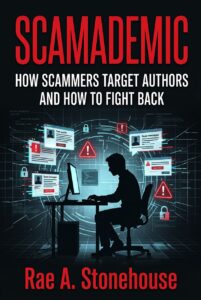
After losing $2,180.47 to a sophisticated fraud operation, author and scam survivor Rae A. Stonehouse spent months documenting exactly how these predators work—and how to stop them.
THE UNCOMFORTABLE TRUTH
Authors are targeted more aggressively than almost any other profession. Not because you’re gullible, but because:
- Your visibility makes you accessible
- Your isolation makes you vulnerable
- Your hope makes you manipulable
- Your community trust makes infiltration easy
Scammers understand your business model better than most legitimate service providers do. They’ve weaponized psychology, AI technology, and your own emotional triggers into an industrial-scale operation extracting an estimated $47 million annually from writers worldwide.
WHAT YOU’LL LEARN
THE SCAM ANATOMY
- The 6-stage universal script every scam follows (Hook → Engagement → Escalation → Pivot → Pressure → Collapse)
- 14 psychological manipulation tactics ranked by effectiveness (87%-42% success rates)
- Why traditional advice (“trust your gut”) fails against professional psychological warfare
THE TARGETING STRATEGY
- How scammers identify vulnerable authors through social media reconnaissance
- The Scammer’s Calendar: When predators strike based on your seasonal vulnerabilities (tax season, holidays, NaNoWriMo exhaustion)
- Why your professional strengths (trust, empathy, accessibility) become exploitable weaknesses
THE TECHNOLOGY ARSENAL
- Email forensics: 90-second header analysis that exposes spoofing and domain forgery
- AI-generated personas that pass reverse image searches
- Deepfake voice technology now mimicking industry professionals
- The payment processor trap: Why Payoneer demands mean 0% recovery rate
THE DEFENSE SYSTEM
- The Four-Layer Verification Protocol (Identity → Intent → Boundaries → Technology)
- Money recovery tactics when you’ve already paid (chargebacks, disputes, documentation)
- Response scripts for every manipulation tactic
- How to build scam-resistant author communities
INSIDE THE BOOK
Real case studies documented with forensic precision:
- The “Nancy Catherine” scam: $2,180.47 extracted through 9 stacked psychological hooks over 2 months
- The fake film rights scam: Multi-layered impersonation using three coordinated personas
- The AI-driven “Don DeLillo” impersonation: Conversational manipulation designed to funnel victims toward paid services
- The 82-year-old retired investigator who lost $3,000 to publisher impersonators—proving no one is immune
Includes comprehensive appendices (free downloadable resources):
- Appendix A: The Psychology Arsenal (Cialdini’s principles, casino design tactics, CIA interrogation techniques weaponized by scammers)
- Appendix B: Money Traps (Financial manipulation mechanics and payment processor vulnerabilities)
- Appendix C: Authority Illusion (How manufactured legitimacy bypasses skepticism)
- Appendix D: Love-Bombing (Overwhelming affection as manipulation weapon)
- Appendix E: The Scammer’s Calendar (Month-by-month vulnerability windows)
- Appendix F: Technological Factors (Digital infrastructure enabling modern fraud)
WHY THIS BOOK IS DIFFERENT
Most scam advice is useless because it addresses obvious fraud while ignoring sophisticated manipulation.
Generic warnings like “be careful online” and “if it sounds too good to be true…” fail because:
- Modern scammers don’t sound “too good to be true”—they sound reasonable
- They don’t present as strangers—they present as peers, professionals, and supporters
- They don’t trigger your suspicion—they trigger your hope
This book reverse-engineers actual scams. Using documented message threads, email headers, payment trails, and psychological analysis from real fraud operations, you’ll see precisely how professional scammers think, operate, and adapt.
WHO THIS PROTECTS
- Self-published authors managing marketing and vulnerable to “expert” outreach
- Traditionally published authors seeking supplemental promotion
- Aspiring writers unsure how to evaluate industry services
- Senior authors who assume experience protects them (one 82-year-old lost $3,000 despite criminal justice background)
- Anyone in creative fields (musicians, artists, podcasters—these tactics work across industries)
THE PROMISE
By the time you finish Scamademic, you will:
✅ Recognize the 14 psychological manipulation tactics scammers deploy—and understand why they work on intelligent people
✅ Know how to verify legitimacy through email headers, domain analysis, and social media forensics
✅ Understand which payment processors protect you and which leave you defenseless
✅ Possess a step-by-step protocol for responding to suspicious opportunities
✅ Have actionable recovery strategies if you’ve already been scammed
✅ Feel equipped to educate other writers in your community
Most importantly: You’ll understand that being targeted doesn’t mean you’re stupid—it means you’re visible. And now you’ll be protected.
FROM THE AUTHOR
“I never intended to become an expert on scams. Like most authors, I was focused on my craft. Then I met ‘Nancy Catherine’—except I didn’t really meet her. I met a carefully constructed illusion designed specifically to exploit writers like me.
After losing $2,180.47, I documented every message, every manipulation tactic, every psychological hook. That forensic analysis became The Nancy Catherine Scammer Playbook Exposed. But when three other authors contacted me with nearly identical experiences, I realized Nancy Catherine wasn’t unique. She was everywhere.
This book exists because the scamdemic targeting our community isn’t a series of isolated incidents—it’s an organized pandemic. And the only way to stop a pandemic is through herd immunity. Community education is our vaccine.
You didn’t choose to become a target. But you can choose to become immune.”
— Rae A. Stonehouse, Author, Victim, Advocate
URGENT NOTE
If you’ve already sent money and suspect fraud:
Skip directly to Chapter Eight: Money Recovery Tactics. Time is critical for chargebacks—get your money back first, understand the psychology later.
If you’re currently being approached:
Go immediately to Chapter Ten: Red Flags and Verification Protocols. The 7-step verification checklist can be completed in 5 minutes.
BOOK DETAILS
Genres: Nonfiction, Writing Reference, Digital Safety, Fraud Prevention, Author Resources
Topics: Publishing scams, online fraud, psychological manipulation, author safety, community protection
Paperback: [XXX pages]
Kindle: Available now
Free Resources: Appendices available as downloadable PDFs, audiobooks, and ebooks at AuthorsAgainstScammers.org
Every author reading this is vulnerable. Not because you’re foolish, but because scammers understand your business model better than most legitimate service providers do.
This book provides the immunity your community needs.
Order your copy today. Then share it with every author you know.
Because the only way to stop a scamdemic is through community education. Your awareness protects not just yourself—it protects the next target.
Silence protects scammers. Your voice stops them.
ADDITIONAL RESOURCES
Visit AuthorsAgainstScammers.org for:
- Free downloadable appendices
- Updated scam alerts
- Community verification support
- Reporting tools and templates
- Author safety workshops
The resistance begins with you.
Scamademic: How Scammers Target Authors and How to Fight Back
By Rae A. Stonehouse
Copyright © 2026