Pig‑butchering scams are one of the fastest‑growing forms of online fraud — a mix of romance scams, emotional grooming, and fake investment schemes. As your document explains, these scams rely on “long‑term emotional manipulation, staged trust building, and ultimately high‑pressure pushes into fake crypto investment platforms”.
Losses are staggering. In the U.S. alone, victims lost nearly $10 billion in 2023, and crypto‑related fraud jumped 66% in 2024.
But here’s the part many authors don’t realize: writers are prime targets.
Let’s break down what these scams look like — and why authors are uniquely vulnerable.
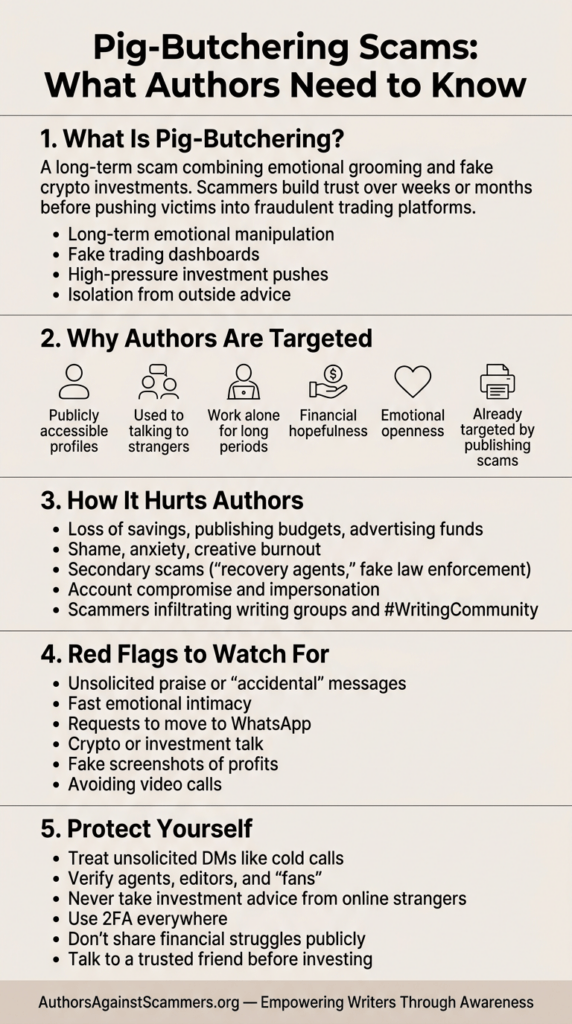
What Pig‑Butchering Actually Is
Pig‑butchering (Chinese: Sha Zhu Pan) is a long‑con scam where criminals “fatten up” victims with attention, flattery, and trust before financially “slaughtering” them.
Scammers typically:
- Initiate contact through social media, messaging apps, or dating platforms
- Build a warm, friendly relationship over weeks or months
- Introduce “investment opportunities,” usually crypto
- Use fake trading platforms showing fabricated profits
- Apply increasing pressure to invest more
- Isolate the victim from outside advice
Victims often describe a predictable cycle: consistent communication, fake success stories, emotional manipulation, and repeated attempts to re‑engage even after pulling away.
Why Authors Are High‑Value Targets
- Authors are publicly accessible
Writers maintain open DMs, social media profiles, newsletters, and community spaces. Scammers love easy entry points.
- Authors are used to talking to strangers
Readers, reviewers, and other writers reach out all the time. A friendly “Hello, is this Anna?” doesn’t feel suspicious.
- Writing is solitary
Scammers thrive on one‑on‑one attention. Authors often work alone for long stretches, making sustained messaging feel normal.
- Financial hopefulness
Many authors juggle unpredictable incomes. Scammers exploit hopes for:
- Supplemental income
- Funding creative projects
- “Passive income” while writing
- Emotional openness
Writers share personal stories online. Scammers use this to tailor manipulation.
- Authors already face industry scams
Fake agents, fake publishers, fake marketing services — authors are conditioned to evaluate offers. Scammers exploit this by posing as:
- Fans
- Business professionals
- Crypto‑savvy friends
- Supportive acquaintances
The relationship feels harmless… until the investment hook appears.
How Pig‑Butchering Hurts Authors
- Financial devastation
Losses can reach tens or hundreds of thousands. One network seized $15 billion in crypto. For authors, this can wipe out:
- Publishing budgets
- Advertising funds
- Savings
- Emergency reserves
- Emotional and creative burnout
Victims report shame, anxiety, depression, and difficulty focusing — all of which can derail writing output and career momentum.
- Secondary scams
Once targeted, victims often face:
- “Recovery agent” scams
- Fake law enforcement
- “We can get your money back” schemes
- Damage to online presence
If scammers gain access to an account, they can impersonate the author and harm their reputation.
- Infiltration of author communities
Scammers join:
- Writing groups
- Discord servers
- Facebook author communities
- Hashtags like #WritingCommunity
Once inside, they can target multiple authors at once.
Red Flags Authors Should Watch For
- Unsolicited praise or “accidental” messages
- Someone who quickly becomes emotionally invested
- A stranger who moves the conversation to WhatsApp
- Mentions of crypto or “investment opportunities”
- Fake screenshots of profits
- Pressure to act fast
- Requests for money, “test investments,” or personal financial details
- Profiles that avoid video calls
- Too‑good‑to‑be‑true returns
How Authors Can Protect Themselves
- Treat unsolicited DMs like cold calls — assume risk first
- Verify anyone claiming to be an agent, editor, or industry professional
- Never take investment advice from someone you met online
- Don’t move conversations off-platform without a reason
- Use two‑factor authentication everywhere
- Keep personal and financial struggles private online
- Talk to a trusted friend before making financial decisions
- Report suspicious contacts to platforms and cybercrime agencies
Final Thoughts
Pig‑butchering scams are sophisticated, patient, and emotionally manipulative. Authors — with their public visibility, creative isolation, and financial pressures — are uniquely appealing targets.
Awareness is your strongest defense. If someone online seems too supportive, too invested, or too eager to share a “life‑changing opportunity,” step back. Protect your creativity, your finances, and your peace of mind.

Rae Stonehouse is a Canadian author, publisher, and advocate committed to exposing publishing scams and supporting writers through education and community. As the creator of Authors Against Scammers, Rae provides clear, practical guidance to help writers protect their work, their money, and their peace of mind. His books and resources reflect a lifelong dedication to empowering others through knowledge, clarity, and real‑world experience.

Update – July 2026:
Since publishing this article, I’ve now had three separate fake LinkedIn profiles attempt to hijack my posts by promoting the same fraudulent “crypto recovery” website, Ciphertraces.com. Each account followed the same script: claiming to have lost USDT, warning about “fake recovery agents,” and then praising this one supposed service that “helped recover their funds.”
These comments are not genuine testimonials — they are part of the scam itself.
Pig‑butchering operations routinely deploy fake profiles to push recovery scams, which are often more predatory than the original fraud. Their goal is to target victims who are already vulnerable and desperate for help.
If you ever see unsolicited offers for “crypto recovery,” “wallet restoration,” or “fund retrieval,” assume it’s a scam. No legitimate firm recovers stolen crypto through comments or DMs.
I’ve reported each fake profile to LinkedIn and will continue documenting these attempts so readers can recognize the pattern.