How authors can recognize deceptive book-promotion tactics and protect reader trust
For authors, a message promising enthusiastic Goodreads reviews can be difficult to ignore. Visibility is hard to earn. New books must compete for limited attention, and a personal invitation may appear to offer a welcome shortcut. Yet paid or guaranteed review offers can put authors, readers, and the wider book-discovery ecosystem at risk.
This post examines two described examples of unsolicited outreach: a message associated with a Twitter account and promotional contact identified as coming from “BookTasters Premium.” The available material does not establish who operates these accounts, whether every message sent by them is fraudulent, or whether any particular transaction occurred. The purpose here is narrower and more useful: to analyse the wording and structure of the approaches as examples of warning patterns that authors may encounter elsewhere.
The basic pattern
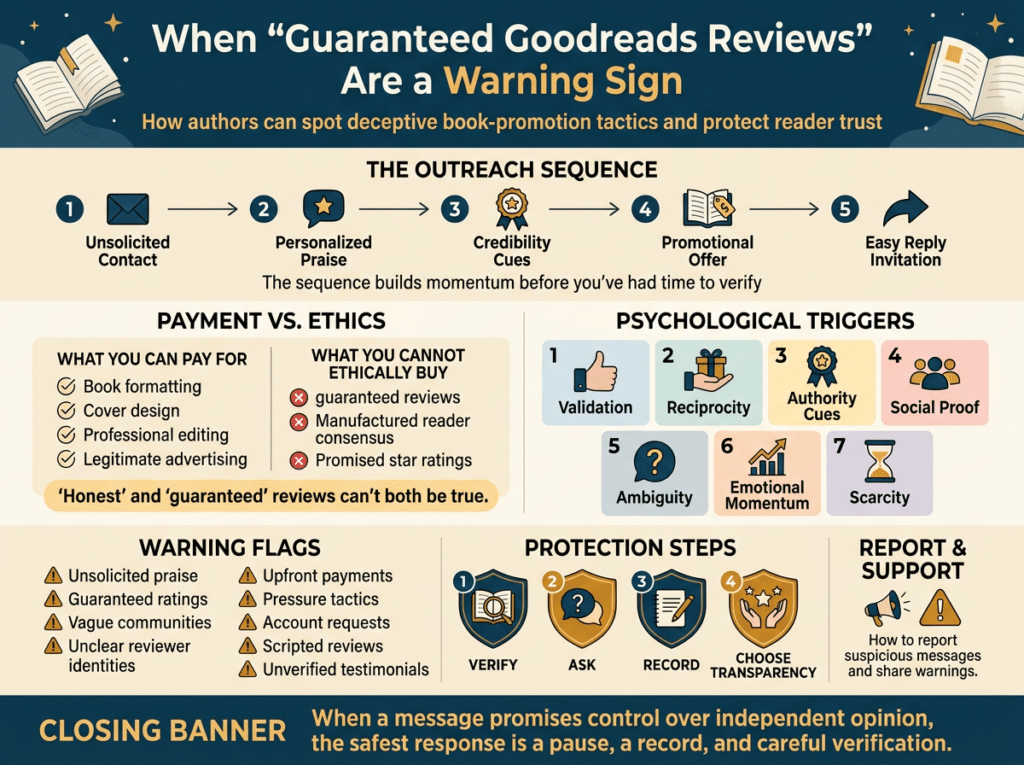
Review-related scams and deceptive promotional schemes often follow a recognisable sequence. First comes unsolicited contact. The sender then offers personalised praise, refers to the author or book, describes access to a supposedly active reader community, and presents a service that promises reviews, exposure, or engagement. The message may finish with an easy invitation to reply, often making the next step feel informal and risk-free.
In the examples under discussion, the apparent progression is more important than any individual phrase: contact, praise, credibility cues, a promotional offer, and an implied opportunity to improve the book’s visibility. This sequence can create momentum before the recipient has had time to verify the sender, examine the platform’s rules, or ask how the promised result would actually be achieved.
A legitimate marketing service may contact authors, and authors may reasonably pay for advertising, editing, public relations, or other defined services. The central concern is not that money changes hands. It is the combination of unclear methods, unsolicited persuasion, and a promise concerning the outcome of supposedly independent reader reviews.
Flattery and personalisation
Flattery is a common feature of persuasive outreach because it lowers an author’s guard. A sender may describe a book as compelling, timely, distinctive, or perfectly suited to a community. Even when the praise is vague, it can feel personal because it arrives directly in the author’s inbox or social-media notifications.
References to the book’s title, genre, description, or recent activity can make a message appear carefully researched. Sometimes that personalisation is genuine; sometimes, it may be drawn from publicly available information or automated searches. Either way, personalisation is not proof of legitimacy. It demonstrates that the sender knows something about the book, not that the sender has a trustworthy reader network or an ethical review process.
Authors should therefore separate two questions: “Does this person seem to understand my book?” and “Can this person provide a transparent, policy-compliant service?” The first may be true while the second remains unproven.
False authority and social proof
Promotional messages often borrow authority from names, labels, and presentation. A reference to Goodreads, a polished brand name such as “Premium”, a professional-looking profile, or a confident description of a reader community can imply institutional approval. Emojis and friendly wording may make the approach feel approachable, while branding can make an informal account appear more established than it is.
These cues are not necessarily deceptive on their own. A logo can be genuine, and a friendly message can be sincere. The warning sign appears when presentation substitutes for verifiable information. A credible service should be able to explain who it is, how reviewers are recruited, what authors pay for, what reviewers are told, how conflicts of interest are handled, and which platform policies govern the activity.
Broad claims such as “our readers love discovering new authors” or “we can get your book in front of thousands of reviewers” also function as social proof. They suggest that many other authors have already trusted the service. Without independently verifiable evidence, however, such claims remain marketing statements rather than proof of quality or legitimacy.
Why honest reviews cannot be sold or guaranteed
A genuine review is an independent reader’s response to a book. It may be favourable, mixed, brief, detailed, or entirely absent. The reviewer may choose to post publicly, and the platform may display or moderate the result according to its own rules. Those variables cannot honestly be controlled in advance.
An author can pay for legitimate exposure, such as an advertisement whose placement and duration are clearly defined. An author can also provide a review copy, provided the arrangement complies with the relevant platform’s policies and does not require a positive review. What an author cannot ethically purchase is a guaranteed independent opinion.
Promises of “honest reviews” and “guaranteed reviews” may appear compatible, but the terms can conflict. If payment is conditional on a review appearing, reviewers may feel pressure to post even when they do not finish the book or do not wish to comment. If payment is connected to positive ratings, the arrangement becomes still more clearly inconsistent with independent feedback. Even where the sender does not explicitly demand praise, guaranteeing a review outcome can distort the process.
Readers rely on reviews as signals of other people’s experiences. When those signals are manufactured, undisclosed, or obtained through pressure, the harm extends beyond one author. Readers may spend money or time based on unreliable information, while honest authors compete against artificial engagement. Platforms may also respond with removals, account restrictions, or other enforcement under their policies.
The psychology of the wording
The language of these approaches can work through several familiar psychological mechanisms.
- Validation: Praise reassures an author that the book is being noticed and understood. This can make the offer feel like recognition rather than a sales pitch.
- Reciprocity: A compliment or personal observation may create a subtle feeling that the recipient should respond courteously or return the sender’s attention.
- Authority cues: Platform names, branded identities, confident claims, and references to a reader community can suggest expertise without demonstrating it.
- Social proof: Statements about other authors, active readers, or established results imply that the service is already trusted.
- Ambiguity: Vague language about “exposure”, “engagement”, or “review opportunities” allows the recipient to imagine a better outcome than the message actually promises in writing.
- Emotional momentum: Praise followed quickly by an opportunity can encourage an immediate reply before the author investigates the sender.
- Scarcity or implied timing: References to upcoming campaigns, limited places, or a current opportunity can make delay feel costly, even when no genuine deadline is established.
None of these techniques proves that a particular sender is acting fraudulently. They do explain why authors should pause when a message produces excitement, urgency, or a strong desire to be selected. Strong emotion is a reason to verify, not a reason to feel embarrassed.
How an approach may develop
The following is an illustrative scenario, not a claim about what occurred in the messages referenced above. An author receives praise for a new release and is told that a private community of readers can provide “honest Goodreads reviews”. After the author replies, the sender may request a fee, a digital manuscript, a list of promotional materials, or personal contact details. The sender may then introduce additional packages for faster delivery, more reviewers, featured placement, or follow-up promotion.
Another possible development is a request to move from a public platform to private messaging, email, a payment app, or an external form. The shift may be presented as convenient. It can nevertheless reduce transparency and make it harder to assess the account’s history or preserve the full conversation. A sender might also ask the author to supply review wording, create accounts, use particular phrases, or avoid disclosing the arrangement. Those requests would be especially concerning because they move the activity away from independent reader judgment.
These examples are not predictions and should not be treated as evidence against a named account. They are practical illustrations of why authors should evaluate the entire process, not merely the first flattering message.
The broader industry pattern
Authors are targeted because visibility is a persistent challenge in publishing. The same pressure can support several forms of questionable promotion: purchased ratings, coordinated reviews, undisclosed endorsements, fake social-media engagement, automated comments, misleading bestseller claims, and services that promise access to influential readers without explaining how that access works.
Some schemes are overtly fraudulent, while others may provide a real but poorly described service that still conflicts with platform rules or ethical expectations. A service can have genuine participants and still create manipulated reviews if those participants are paid for a result, directed towards a rating, or not required to disclose the relationship.
This is why authors should avoid relying solely on labels such as “review campaign”, “reader network”, or “premium promotion”. The meaningful questions concern independence, disclosure, consent, payment structure, and compliance with the platform’s current policies.
Red flags to check
- An unsolicited message that immediately praises the author and offers a review or visibility package.
- A guarantee that a specific number of Goodreads reviews, ratings, or positive outcomes will appear.
- Vague references to a large, private, or exclusive reader community without verifiable details.
- Unclear reviewer identities, locations, qualifications, or relationship to the service provider.
- Requests for payment before the service, especially through difficult-to-reverse methods.
- Pressure to act quickly, accept a limited place, or continue the conversation privately.
- Requests for passwords, account access, unnecessary personal information, or unpublished material.
- Instructions to create accounts, post scripted language, conceal payment, or bypass platform safeguards.
- Promises that sound precise about results but vague about the actual work being performed.
- Testimonials or follower counts that cannot be independently verified.
Protecting your work and your readers
Start with verification. Review the sender’s account history, website, business registration details where relevant, contact information, terms of service, refund policy, and independent references. Search for the exact wording of unusual promises and examine whether the service has been discussed by authors or publishing professionals who are not connected to it.
Read the current policies of Goodreads and any other platform involved. Do not assume that a provider’s claim of compliance is accurate. Ask direct questions: Are reviewers paid? Are they required to post? Are they told what rating to give? Must they disclose the relationship? What happens if no one wishes to review the book? A provider who cannot answer clearly has not demonstrated a safe process.
Keep records before replying or paying. Save screenshots, profile links, dates, email headers, invoices, payment instructions, and the exact wording of promises. Avoid sharing passwords, payment-card details outside a reputable payment process, unnecessary identity documents, or files that the provider does not need. If you send a review copy, use a controlled method and make clear that no particular review, rating, or publication is required.
Prefer transparent promotion. Advertising, newsletter placement, event participation, interviews, library outreach, advance reading copies, and clearly disclosed partnerships can support discovery without pretending to manufacture independent opinion. No legitimate strategy can guarantee that readers will like a book. That uncertainty is not a weakness; it is part of authentic publishing.
Reporting and supporting one another
If an account or message appears suspicious, report it through the relevant social-media platform, email provider, payment service, or book platform. Preserve the underlying evidence rather than relying on a summary. If money or sensitive information has already been sent, contact the payment provider promptly and seek advice from an appropriate consumer-protection or fraud-reporting service in your jurisdiction.
Authors can also warn colleagues responsibly. Share the wording, method, and verifiable facts without asserting more than the evidence supports. Avoid publishing private personal information or identifying someone as a criminal unless that conclusion has been formally established. Pattern-based warnings are most useful when they are accurate, documented, and focused on prevention.
AuthorsAgainstScammers.org can serve as a place to share recurring approaches, compare experiences, and help other publishing professionals recognize manipulation early. Reporting a suspicious message may protect someone who has not yet received it, and a well-documented report can help platforms identify repeated behaviour.
Trust is not a shortcut
Personalised praise can be genuine, but it is not verification. A polished brand can be legitimate, but it is not proof of an ethical review process. A promise of “honest” reviews can sound reassuring, but honest reviews cannot be guaranteed as a paid outcome.
Sustainable book discovery depends on readers making their own choices and reviewers expressing their own views. Authors protect their careers, their audiences, and the integrity of publishing when they reject manufactured certainty, investigate unsolicited offers, and choose promotion methods that are transparent about what is—and is not—being purchased. When a message promises control over independent opinion, the safest first response is not enthusiasm or panic. It is a pause, a record, and careful verification.
Forensic Analysis:
Scam Confidence: 60–80% likelihood of a deceptive pattern; this is not a finding about any named sender. Unsolicited praise, a “guaranteed Goodreads reviews” pitch and an unverifiable “reader community” match documented book review scam tactics. The post itself says it does not establish who runs the accounts or whether any transaction happened. Public feedback on the “BookTasters” brand is mixed: some reader-reviewers report positive experiences, while some authors report non-delivery and lost payments. The score drops sharply if reviews are unconditional, disclosed and policy-compliant.
Threat Type: Deceptive Book Marketing / Paid Review Scheme. This can include fake or incentivized reviews, pay-to-play review campaigns, junk marketing upsells and possible advance-fee fraud where payment is taken and nothing is delivered. A related social engineering pattern uses flattery and authority cues.
Target Audience:
• Self-published and indie authors
• New-release and debut authors looking for visibility
• Small-press authors with public Goodreads, Amazon or X/Twitter author profiles
• Authors whose book details can be scraped for personalized outreach
Key Red Flags:
1. Unsolicited DM or email that opens with personalized praise
2. Guaranteed number of Goodreads reviews or ratings
3. Vague “exclusive reader community” with no verifiable reviewers
4. Upfront payment through hard-to-reverse methods
5. Urgency (“limited spots”) or a push to move to private chat
6. Requests for passwords, account access or scripted reviews
7. Undisclosed payment, or instructions to hide the arrangement
Recommended Actions:
1. Pause. Don’t reply, pay or send files yet.
2. Document everything: screenshots, profile URLs, dates and payment instructions.
3. Verify the sender’s history, terms, refund policy and independent author reports.
4. Check Goodreads’ Rating and Review Guidelines, which say undisclosed paid reviews may be removed.
5. Report to the platform, the payment provider, the FTC (US) or the Competition Bureau / Canadian Anti-Fraud Centre (Canada).
6. Warn others with fact-based, documented posts, for example on AuthorsAgainstScammers.org or to scams@authorsguild.org.
Related Scams:
• AI-driven book marketing scams (Nigeria-based), reported by Writer Beware and the Authors Guild
• Philippine publishing scams that sell “pay to play book reviews” and junk marketing (Writer Beware)
• Fake “reviewer” Gmail outreach that leads to paid-review or extortion attempts (Goodreads “Authors Beware” thread, 2022)
• AI-powered author “romance-style” scams, with one author losing about A$10,000 (The Guardian, Mar 2026)
• Purchased app reviews: Competition Bureau action against Amp Me Inc. ($1.5M penalty)
Sender Details: The post gives no email address or phone number. It describes: (1) an X/Twitter account and (2) promotional contact attributed to “BookTasters Premium.” The “Premium” label and Goodreads references work as authority cues. A Trustpilot profile for booktasters.net lists a Wilmington, DE registered-agent address, and ScamAdviser notes WHOIS privacy on the author subdomain. Not verified as matching the sender of the messages in this post; confirm the exact handle or domain against your screenshots.
Additional Context:
• The core issue is the contradiction between “honest” and “guaranteed” reviews.
• The FTC Consumer Reviews and Testimonials Rule (effective Oct 21, 2024) bans buying reviews that are conditioned on sentiment and allows civil penalties.
• Goodreads removes undisclosed commercial or paid reviews and requires disclosure for free review copies.
• The post deliberately uses pattern-based analysis, not accusations.
Book/Product Targeted: Any newly listed book with a Goodreads page; no specific title is named in the post. Pitches are typically review campaigns, “premium” visibility packages, beta-reader programs and promotional upsells.
Fake Website: No fake URL is identified in the post. booktasters.net and author.booktasters.net exist; ScamAdviser rates them high trust (97/100) based on automated checks only. Status: unverified. An automated score doesn’t confirm that a review service is legitimate or policy-compliant.
Reported Losses: None documented in this post. Comparable cases include about A$10,000 lost by one author over 6 months (Guardian) and individual Trustpilot and Reddit reports of paid campaigns not delivered, with amounts unstated.
Geographic Focus: Global. Outreach comes through X/Twitter, email and Goodreads. Regulators involved are the FTC (US) and the Competition Bureau (Canada). Related scam operations are reported in Nigeria, the Philippines and South Asia.
Footnotes/Sources:
1. FTC: “Federal Trade Commission Announces Final Rule Banning Fake Reviews and Testimonials” (Aug 14, 2024), ftc.gov
2. FTC: “The Consumer Reviews and Testimonials Rule: Questions and Answers,” ftc.gov
3. Goodreads: “Rating and Review Guidelines,” goodreads.com/review/guidelines
4. Competition Bureau Canada: “Five-star fake out” (Mar 2, 2022), canada.ca
5. Authors Guild: “Publishing Scam Alerts,” authorsguild.org
6. Writer Beware: “Overseas Scams,” writerbeware.blog/scam-archive
7. The Guardian: “Self-publish and be scammed…” (Mar 12, 2026)
8. Your own screenshots of the original messages, archived with the Wayback Machine (web.archive.org)

Rae Stonehouse is a Canadian author, publisher, and advocate committed to exposing publishing scams and supporting writers through education and community. As the creator of Authors Against Scammers, Rae provides clear, practical guidance to help writers protect their work, their money, and their peace of mind. His books and resources reflect a lifelong dedication to empowering others through knowledge, clarity, and real‑world experience.