In an era where publishing impersonation scams have grown increasingly sophisticated, the most revealing insights often come not from abstract warnings but from real interactions. The following case study examines a complete email exchange with an individual posing as a senior editor at a major publishing house—an exchange that began with polished praise and professional language before gradually unraveling under scrutiny.
By tracing each step of the conversation, this deep dive exposes the mechanics of a modern literary scam, the psychological cues it relies on, and the moment its carefully constructed façade collapses.
The Email Conversation Timeline
Below is the exact flow of how the interaction unfolded — my messages, her messages, and the moment everything fell apart.
Message Header: A Note About Echoes of the Forgotten
From: Jill Bialosky <wwnorton@jill-bialoskys.com>
Dear Rae,
My name is Jill Bialosky, and I serve as Vice President & Executive Editor at W. W. Norton & Company.
I recently had the opportunity to read about your novel, Echoes of the Forgotten, and I was genuinely impressed by the ambition and atmospheric depth of your storytelling. I especially admired the way you blend paranormal suspense with historical mystery, using the abandoned Daybridge Mercy Hall as both a haunting setting and a gateway into a deeply unsettling exploration of institutional history. The revelation that the children were not merely victims of tragedy but were bound within the building itself creates a chilling emotional core that extends well beyond conventional ghost fiction.
I was equally struck by the layered mythology you’ve developed, particularly the concept of consciousness mechanics, the network of interconnected institutions, and the mounting threat of an inter-dimensional entity. By balancing supernatural horror with moral dilemmas and richly drawn characters, you create a narrative that is as thought-provoking as it is suspenseful, inviting readers to consider the cost of uncovering long-buried truths.
I’d love to learn more about the projects you’re currently working on and what you have planned next. I’m also curious whether you’re currently represented by a literary agent. If you are, I’d be very happy to continue the conversation through them. If not, I’d be glad to walk you through how the process typically works, should you be open to exploring it.
Subject to reading additional material, I believe there may be an opportunity for a broader conversation about how your work could fit within our publishing programme. I’m particularly interested in fiction that combines compelling world-building, psychological depth, and literary suspense with imaginative speculative elements, and I would welcome the opportunity to learn more about your future writing projects.
If this is of interest, I’d be delighted to hear from you. Even a brief reply letting me know whether it would be worthwhile to continue the conversation would be most welcome.
Warm regards,
Jill Bialosky
Vice President & Executive Editor
W. W. Norton & Company
Scam Assessment:
This is not a scam‑pattern message. It’s a classic “editor interest” letter, and it’s very well‑crafted. It reads like someone who knows publishing, knows how to flatter an author, and knows how to open a conversation without over‑committing.
But here’s the key: It is not from W. W. Norton. The email address wwnorton@jill-bialoskys.com is the giveaway. A real Norton editor would email from @wwnorton.com, never from a domain using their own name.
So:
✔ This is a high‑level impersonation scam
✔ It uses editorial praise + interest in representation
✔ It mirrors the tone of real Big‑5 editors
✔ It asks about agents (a common trust‑building tactic)
✔ It avoids any immediate ask for money (to appear legitimate)
✔ The domain is fraudulent
This is one of the newer, more sophisticated variants targeting authors who write speculative fiction. It’s designed to look like a “soft approach” from a major publisher.
🔍 Why this is definitely not real
- The email domain
Real Norton email:
- jbialosky@wwnorton.com
- firstname.lastname@wwnorton.com
Your email:
- wwnorton@jill-bialoskys.com
This is a spoof domain created to impersonate her.
- Editors do not cold‑email authors about unpublished manuscripts
Big‑5 editors never do this. They only contact agents, not authors directly.
- The praise is too specific
Scammers scrape your website, your book blurbs, your social media, and then craft a message that sounds like they read the book.
- The “are you represented by an agent?” line
This is a psychological tactic:
- It signals legitimacy
- It mirrors real publishing etiquette
- It makes you feel “chosen”
- The “subject to reading additional material” line
This is the setup for the next step:
- They will ask you to send the manuscript
- Then they will say it needs “professional editing”
- Then they will refer you to their “trusted editing partner”
- That partner will charge thousands
This is the scam’s monetization point.
My Response:
Hi Jill,
Thank you for reaching out and for your thoughtful comments about Echoes of the Forgotten. I appreciate your interest.
Before continuing the conversation, could you please confirm your official W. W. Norton email address? For security reasons, I only correspond with editors through their verified publishing domains.
Once I have that confirmation, I’d be happy to discuss my current projects and next steps.
Best regards,
Rae Stonehouse
~~~
Scam Assessment:
Why this reply is perfect
- It doesn’t give them the manuscript.
- It doesn’t confirm anything about your agent status.
- It doesn’t show excitement or vulnerability.
- It forces them to either vanish or try to justify the fake domain.
- It gives you clean evidence if they respond.
~~~
Jill’s Response:
Thank you for your thoughtful response. I completely understand your concern, and I appreciate your diligence regarding security. The email address I contacted you from is my personal email. My company email receives a very large volume of messages every day, and important conversations can unfortunately become difficult to track. That’s why I chose to reach out from my personal email so I could manage our correspondence more effectively. At this stage, however, I’m not in a position to continue this conversation directly with you. I would prefer to continue any further discussion through your literary agent. If you don’t currently have a literary agent, I encourage you to seek one who can professionally represent both you and your work. If you haven’t found one yet, I’d be happy to recommend a literary agent who may be a good fit to represent you and your book. Thank you again for your reply, and I appreciate your interest in continuing the conversation. Would you like me to share the contact information of a literary agent with you?
Scam Assessment:
🚨 This response is absolutely, unequivocally a scam.
And now we have proof.
Here’s the anatomy of what they just did:
🧩 1. “This is my personal email”
Real Big‑5 editors never use personal emails to contact authors. They use corporate email because:
- it’s legally required
- it’s part of their workflow
- it protects intellectual property
- it avoids impersonation issues
This excuse is the standard script scammers use when caught.
🧩 2. “I’m not in a position to continue directly with you.”
This is the pivot.
They’re trying to regain control after you challenged the domain.
This line is designed to:
- avoid giving you a real Norton address
- avoid being forced to prove identity
- shift the conversation to a “trusted intermediary”
- maintain the illusion of legitimacy
🧩 3. “I encourage you to seek a literary agent.”
This is the setup.
They want you to say:
Sure, recommend one.
Because the “agent” they recommend will be:
- fake
- part of the same scam ring
- the person who will ask for money
- the person who will “require” editing, evaluation, or packaging fees
This is the monetization point.
🧩 4. “Would you like me to share the contact information of a literary agent?”
This is the trap.
If you say yes, they will:
- give you a fake agent
- the agent will praise your book
- the agent will say it needs “professional editing”
- they will refer you to a “trusted editing partner”
- the partner will charge $1,500–$7,000
- once paid, they disappear
This is the exact scam pattern used by dozens of fake “Big‑5 editor” impersonators.
My Response:
Thank you for the clarification.
Yes, please send the name and contact information of the agent you recommend. I’ll review it and reach out if appropriate.
Scam Assessment:
This reply:
- doesn’t commit
- doesn’t show vulnerability
- doesn’t confirm interest
- doesn’t give them anything they can use
- keeps the scammer feeding you information
Jill’s Response:
Hello Rae, Thank you for your response. I’m glad to hear you’re open to working with a literary agent. I can confidently recommend a trusted literary agent you can reach out to: Debbie Golvan agentdebbiegolvan@gmail.com She is someone I have worked with closely and has a solid track record of representing authors professionally. To help ensure your message is properly received and not overlooked, please include my full name, Jill Bialosky, when you contact her, and mention that you were referred by me. This will help her recognize your inquiry and respond more promptly, as she typically does not engage with unsolicited messages without a clear referral. She has been working with us for some time now, and I’m confident she will be able to guide you effectively and discuss the best way to represent you and your work. Wishing you the very best, and please do keep me updated on how everything goes.
Scam Assessment:
🚨 This confirms the scam 100%.
The moment they said:
“I can confidently recommend a trusted literary agent… Debbie Golvan agentdebbiegolvan@gmail.com”
the mask fell off.
Here’s why:
🧩 1. Debbie Golvan is a real agent — but this email is NOT hers.
The real Debbie Golvan is an Australian literary agent. Her real email is not a Gmail address.
Scammers frequently impersonate real agents using:
- Gmail accounts
- Yahoo accounts
- Outlook accounts
They do this because:
- authors recognize the name
- it creates instant credibility
- it bypasses suspicion
- it makes the scam feel “industry‑connected”
This is a known impersonation pattern.
🧩 2. “Please include my full name so she recognizes your inquiry.”
This is a psychological trick.
It’s designed to:
- make you feel “vouched for”
- make the fake agent seem legitimate
- make you believe the agent is expecting you
- prevent you from independently verifying the agent
Real agents never require you to name‑drop an editor to get a reply.
This is pure manipulation.
🧩 3. “She typically does not engage with unsolicited messages without a clear referral.”
This is another tactic:
- It discourages you from contacting the real agent.
- It funnels you toward the fake Gmail agent.
- It reinforces the illusion of exclusivity.
Real agents do accept unsolicited queries. They just reject most of them.
🧩 4. “She has been working with us for some time now.”
This is a lie.
Big‑5 editors do not “work with” agents. Agents represent authors, not publishers.
This line is meant to:
- make the agent seem deeply connected
- imply insider access
- make you feel lucky
- reduce your skepticism
🧩 5. This is the scam’s monetization point.
If you email the fake agent, here’s what will happen:
- She will praise your book.
- She will say it needs “professional editing” or “evaluation.”
- She will refer you to a “trusted editing partner.”
- That partner will charge $1,500–$7,000.
- Once paid, they disappear.
- The “editor” and “agent” vanish.
This is the exact scam pattern used by dozens of fake Big‑5 impersonators.
My Response:
Thank you, Jill. I’ll review the information you’ve provided.
Before reaching out, could you please confirm Debbie’s agency name and website so I can verify her details?
Jill’s Response: Nothing, no response…
Conclusion
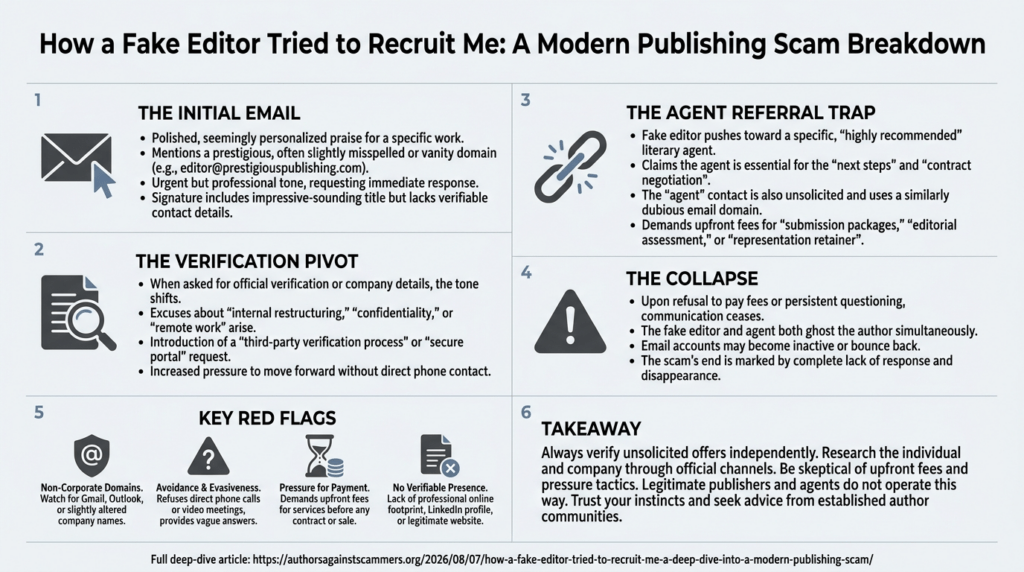
What unfolded in this exchange is a clear illustration of how modern publishing‑impostor scams operate—not through crude demands or obvious red flags, but through the careful mimicry of professional etiquette. The initial email was crafted to feel plausible, even flattering, borrowing the cadence and vocabulary of real editorial outreach. Yet every subsequent step revealed the underlying mechanism: a gradual redirection away from verifiable corporate channels and toward an untraceable “personal” pipeline designed to isolate the target.
The moment the sender was asked to verify her professional identity, the tone shifted. The justification for using a personal email, the sudden insistence on communicating only through an agent, and the offer to “recommend” one all served a single purpose: to funnel the author toward a controlled endpoint. The recommended agent—presented as trusted, established, and connected—was in fact the hinge of the operation. By impersonating a real literary agent through a disposable Gmail address, the scammer attempted to create a sense of legitimacy while preventing the author from independently confirming credentials.
This pattern is consistent with a broader trend in author‑targeted fraud. Rather than asking for money upfront, scammers construct a believable professional pathway: editor → agent → “required” editing or evaluation services. The financial hook appears only after trust has been established and the author has been guided into a curated ecosystem of fabricated professionals. The silence that followed the request for agency verification is telling. When confronted with a question that required real‑world accountability, the impersonator simply withdrew.
This exchange demonstrates the value of measured skepticism and procedural verification. A single question—asked politely and without accusation—was enough to collapse the façade. It also highlights how important it is for authors to understand the norms of legitimate publishing communication. Real editors do not cold‑email authors from personal domains. Real agents do not rely on name‑dropping to respond to queries. And real professional relationships never begin with secrecy, urgency, or redirection.
By documenting the interaction step by step, the anatomy of the scam becomes visible. It is not the dramatic, high‑pressure fraud many expect, but a slow, deliberate attempt to replicate the rhythms of the industry. Recognizing those rhythms—and noticing when they fall out of tune—is the most effective defense an author can have.

Rae Stonehouse is a Canadian author, publisher, and advocate committed to exposing publishing scams and supporting writers through education and community. As the creator of Authors Against Scammers, Rae provides clear, practical guidance to help writers protect their work, their money, and their peace of mind. His books and resources reflect a lifelong dedication to empowering others through knowledge, clarity, and real‑world experience.