Creators are facing a new wave of threats — and this time, it’s not coming from fake publishers or bogus marketing firms. It’s arriving quietly in inboxes as copyright “demand letters” over images used on blogs, websites, and speaker pages.
Last week, a professional speaking group shared a troubling thread: Several members had received aggressive notices claiming they owed thousands of dollars for a single photo. One person was told they owed money for images used nearly ten years ago. The group’s initial reaction was unanimous:
“It’s a racket. Don’t pay a dime.”
That instinct — push back — is good. But the blanket advice? That’s where things get dangerous.
There are two very different types of image claims circulating right now, and treating them the same way can hurt you in very different ways.
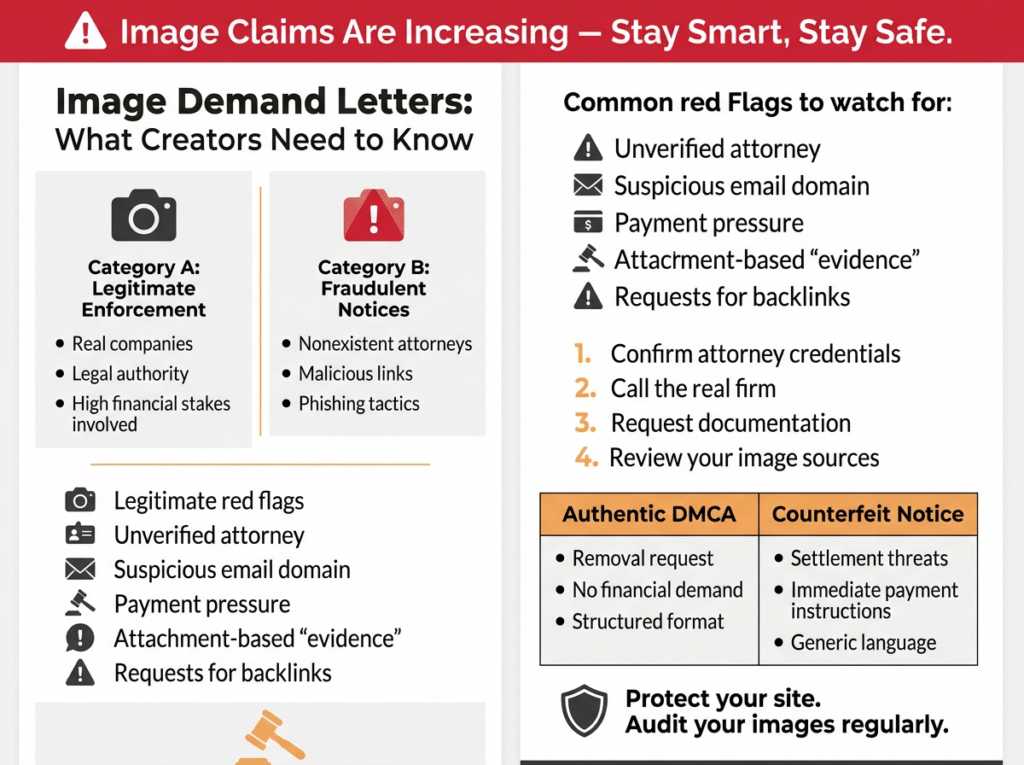
🧩 The Two Types of Image Claims (And Why They Matter)
- Legitimate Copyright Enforcement Firms
These are real companies representing real photographers or stock agencies. They can be:
- aggressive
- expensive
- sometimes wrong
- but fully capable of filing in federal court
If the image is registered, statutory damages can run $750 to $30,000 per work — even if you used it unintentionally.
- Fake “Law Firms” and Scam Operations
These are pure fraud. Their goals are usually:
- to get you to click a malicious link
- to collect your login credentials
- to trick you into giving a backlink
- to scare you into paying a fake “settlement fee”
Their attorneys don’t exist. Their firms aren’t real. Their claims fall apart the moment you verify anything.
⚠️ Why Creators Are Getting Targeted Now
Because the perfect storm has formed:
- Millions of blogs and speaker sites contain old images grabbed in 2014–2017 when “everything online felt free.”
- Stock agencies have become more aggressive in enforcing rights.
- Scammers know creators fear legal trouble and will panic‑click.
- AI makes it easy to generate official‑looking letters with fake case numbers and fabricated attorney names.
And most creators — authors, speakers, coaches, freelancers — don’t have a clean record of where every image came from.
That makes you a target.
🛑 Before You Pay, Reply, or Click Anything
Slow down. Verify. Protect yourself.
- Look up the attorney in your state bar directory
If they don’t appear, the claim is fake.
- Find the firm’s phone number yourself
Don’t use the number in the email. Call the real office and ask if the claim is theirs.
- Request specifics in writing
Ask for:
- the exact image
- the exact URL where it appears
- proof of ownership or registration
A real firm will provide this. A scammer will deflect, stall, or send you a dangerous link.
🔍 Then Audit Your Own Website
Most creators have:
- old blog posts
- outdated speaker pages
- forgotten articles
- images pulled from “free” sites that weren’t actually free
And “I got it from Canva” may not settle the issue if:
- the image was uploaded by a user who didn’t own it
- the license has changed
- you used it outside the permitted scope
This is where creators get blindsided.
🧪 How to Tell a Real Notice from a Fake One
Real DMCA Notices
- ask you to remove content
- do not demand payment
- come from legitimate service providers
- follow a specific legal format
Fake Notices
- demand money
- threaten lawsuits immediately
- ask you to click a link
- come from Gmail addresses
- use generic phrases like “copyright compliance fee”
- impersonate agencies like the U.S. Copyright Office (which never emails payment demands)
If the email asks you to link to someone’s gadget site? It’s a scam.
If the email threatens federal court but the attorney doesn’t exist? It’s a scam.
If the email includes a ZIP file with “evidence”? It’s malware.
💡 The Bigger Question Creators Should Be Asking
When was the last time you checked where every image on your website came from?
For most creators, the answer is: Never.
And that’s exactly why scammers — and legitimate enforcement firms — are targeting creators now.
🛡️ Practical Protection Steps for Authors & Speakers
- Replace old images with properly licensed ones
- Keep a folder of receipts, licenses, and source URLs
- Use reputable stock sites with clear terms
- Avoid “free image” sites unless you fully understand the license
- Run a quarterly audit of your website
- If you receive a claim, verify before responding
- If the claim is legitimate, consult an attorney before paying anything
You don’t need to panic. You just need to be prepared.
🔚 Final Thought
Creators shouldn’t live in fear of using images online — but we do need to be smarter, more organized, and more skeptical. Scammers thrive on confusion. Legitimate firms rely on ignorance. Your best defense is clarity.
~~~
Forensic Analysis:
Field Name Expanded Value
Scam Confidence 70-90% likelihood this is a scam for typical unsolicited image demand emails (Gmail origins, fake attorneys, malware links, USCO impersonation, generic threats). Remaining 10-30% may be legitimate aggressive enforcement from real firms (PicRights, Higbee & Associates, Copytrack) capable of federal lawsuits and $750–$30,000 statutory damages per registered image. Always verify independently—blanket “don’t pay” advice risks real liability.
Threat Type Image Copyright Demand Letter Scam (hybrid phishing/malware + extortion mixed with copyright troll enforcement). Fake “law firms” seek clicks, credentials, fake settlements, or backlinks; real firms pursue unlicensed stock photos on blogs/speaker sites.
Target Audience Self-published authors, professional speakers, coaches, bloggers, and freelance creators with personal websites, speaker pages, and outdated blog posts. Especially those using old (2014–2017) “free” or unlicensed images when everything online felt public-domain.
Key Red Flags 1. Gmail/free-email senders instead of official firm domains<br>2. Immediate payment/settlement fee demands without specifics<br>3. Unverifiable attorneys absent from state bar directories<br>4. Malicious ZIP files or links labeled “evidence” (malware/trojans)<br>5. Impersonation of U.S. Copyright Office (never emails payment demands)<br>6. Generic phrases (“copyright compliance fee”) and instant federal-court threats<br>7. Backlink requests to gadget sites instead of image removal
Recommended Actions 1. Search state bar directory for named attorney—no listing = scam<br>2. Independently Google the firm’s real phone and call to confirm claim (ignore email number)<br>3. Request written proof: exact image, URL, ownership/registration docs<br>4. Never click links or open attachments—malware risk<br>5. Audit/replace all website images with licensed stock; archive receipts/licenses<br>6. Report scams to FTC (reportfraud.ftc.gov) + IC3 (ic3.gov); consult IP attorney only if verified legitimate
Related Scams 1. U.S. Copyright Office impersonation emails demanding verification/payment (Authors Guild + copyright.gov warnings)<br>2. Fake DMCA notices with malware ZIP “evidence” (phishing campaigns targeting websites)<br>3. PicRights/Higbee copyright troll letters (real but inflated $thousands demands)<br>4. Getty Images fake settlement scams<br>5. SEO backlink extortion posing as image copyright claims
Sender Details Unsolicited emails from Gmail/Outlook, fabricated attorney names/signatures (e.g., “John Smith, Esq.” not in any bar), AI-generated fake law-firm sites, or “United States Copyright Authority.” Phone numbers (if given) are spoofed. Claims collapse on independent verification—no real affiliation.
Additional Context Targets forgotten 2014–2017 blog/speaker-page images grabbed when “everything online felt free.” Mix of real statutory-damage risk ($750–$30k per registered work) and pure fraud (malware, credential theft, fake fees). AI now generates official-looking letters with fake case numbers. Most creators have zero image-provenance records.
Geographic Focus Primarily United States (federal-court threats, state-bar lookups, USCO impersonation).
Footnotes/Sources 1. U.S. Copyright Office “Beware of Copyright Scams” bulletin (copyright.gov)[1]<br>2. FTC ReportFraud.ftc.gov (government never demands money via email)[2]<br>3. FBI IC3.gov internet-crime reporting<br>4. Authors Guild: U.S. Copyright Office Email Scam warning[3]<br>5. LegalClarity: Fake copyright infringement notice signs.

Rae Stonehouse is a Canadian author, publisher, and advocate committed to exposing publishing scams and supporting writers through education and community. As the creator of Authors Against Scammers, Rae provides clear, practical guidance to help writers protect their work, their money, and their peace of mind. His books and resources reflect a lifelong dedication to empowering others through knowledge, clarity, and real‑world experience.