If you’re an author, photographer, musician, or small business owner, you need to know about a sophisticated phishing scam that’s exploding across the United States and internationally. The U.S. Copyright Office Email Scam is one of the most active fraud patterns hitting creators in 2025–2026, and it’s designed to steal your money, personal information, and infect your devices with malware.
What Is This Scam?
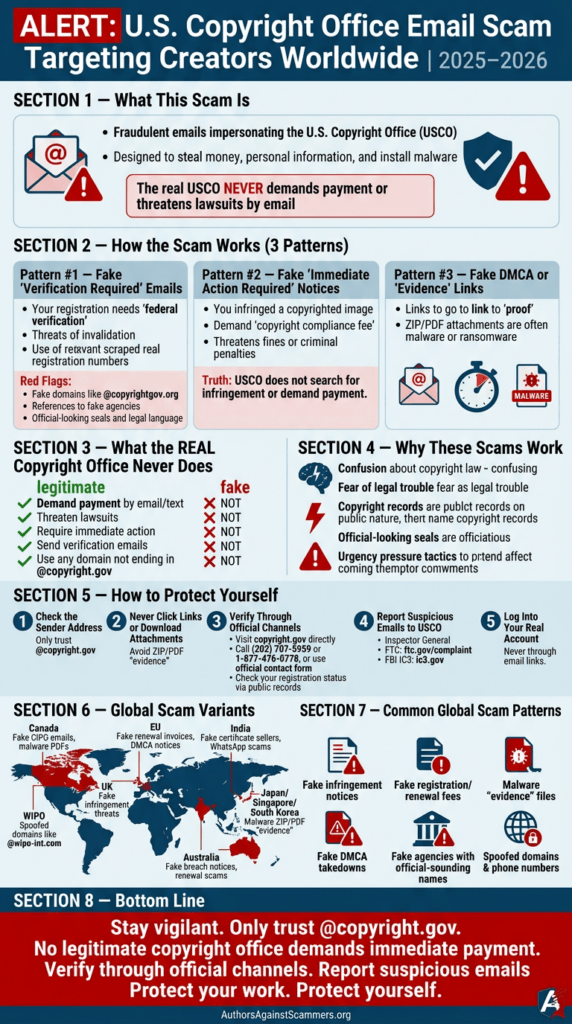
Fraudulent emails are being sent to copyright holders that impersonate the U.S. Copyright Office (USCO). These messages demand verification, payment, or urgent action—but they don’t come from the real Copyright Office at all.
Here’s the critical fact: The legitimate U.S. Copyright Office never demands payment, threatens lawsuits, or requires immediate action through email or text messages.
How the Scam Works
Across multiple reports from organizations like the Authors Guild and the American Society of Media Photographers (ASMP), the scam follows several distinct patterns:
Pattern #1: Fake “Verification Required” Emails
These fraudulent messages claim:
- Your copyright registration needs verification as part of a “routine federal record verification”
- Your registration will become invalid unless you respond
- You must confirm details “under federal law”
- The message is an “OFFICIAL COMMUNICATION”
Red flags to watch for:
- Emails come from fake domains like @copyrightgov.org instead of the legitimate @copyright.gov
- References to non-existent entities like “United States Copyright Authority” or “United States Patent and Copyright Office”
- Real copyright registration numbers (scraped from public records) to appear legitimate
- Official-looking seals, signatures, and formal legal language
Pattern #2: Fake “Immediate Action Required” Notices
These threatening emails claim:
- You’ve infringed a copyrighted image
- You must pay a “copyright compliance fee”
- You have 48 hours to avoid fines or criminal penalties
The truth: The real U.S. Copyright Office does not search for infringement or demand payment.
Pattern #3: Fake DMCA or “Evidence” Links
These dangerous emails include:
- Links to “proof” of infringement
- ZIP or PDF files containing supposed “evidence”
Warning: These links often contain malware, including ransomware that can lock your computer and demand payment.
What the REAL Copyright Office Never Does
According to the Library of Congress and the Authors Guild, the legitimate USCO does NOT:
- Demand payment by email or text
- Threaten lawsuits through unsolicited communications
- Require immediate action to “avoid penalties”
- Send routine “verification” emails after you’ve received your copyright registration certificate
- Use any email address that doesn’t end in @copyright.gov
Once you receive a copyright registration certificate, your registration is valid. No verification is needed.
Why These Scams Are So Effective
Scammers exploit several psychological and informational vulnerabilities:
- Confusion about copyright law and registration requirements
- Fear of legal consequences and financial penalties
- The public nature of copyright registration records
- Professional-looking official seals and federal language
- Urgency tactics that pressure victims into acting before thinking
How to Protect Yourself
- Check the Sender Address Carefully
Only trust emails ending in @copyright.gov. Any other domain—including @copyrightgov.org or similar variations—is fraudulent.
- Never click links or Download Attachments
Do not click any links in suspicious emails. These may lead to phishing sites or download malware onto your device.
- Verify Directly Through Official Channels
If you’re concerned about your copyright status:
- Visit copyright.gov directly by typing it into your browser (don’t use email links)
- Call the Copyright Office at (202) 707-5959 or 1-877-476-0778 (toll-free). Press 0 for the Public Information Office (Monday–Friday, 8:30 AM–5 PM ET)
- Use the official contact form on copyright.gov
- Check your registration status through the Copyright Office’s public records search
- Report Suspicious Emails
Forward fraudulent emails to:
- The U.S. Copyright Office Inspector General
- The Federal Trade Commission at ftc.gov/complaint
- The FBI’s Internet Crime Complaint Center at ic3.gov
- Log Into Your Real Account
Don’t rely on email links. Go directly to your USCO account dashboard through the official website to check your actual registration status.
This Is a Global Problem
While this article focuses on the U.S. Copyright Office scam, similar fraud patterns are hitting creators worldwide. Every major region has its own version targeting local copyright and intellectual property offices.
Canada
The Canadian Intellectual Property Office (CIPO) is currently experiencing a major spike in copyright-related phishing scams. Scammers impersonate CIPO, fake law firms, or create entities like “Canadian Copyright Authority.” The 2025–2026 wave includes particularly dangerous spear-phishing attacks with malware-laden PDF attachments.
European Union
Across the EU, scammers impersonate the European Union Intellectual Property Office (EUIPO) and national offices like the UK IPO, German DPMA, and French INPI. Common scams include fake renewal fee invoices, registration confirmations, and DMCA-style takedown notices.
International (WIPO)
The World Intellectual Property Organization (WIPO) is one of the most frequently impersonated organizations worldwide. Scammers use spoofed domains like @wipo-int.com, send fake payment requests, and even make spoofed phone calls pretending to be WIPO staff. Remember: official WIPO emails only come from @wipo.int.
United Kingdom
UK creators report fake copyright infringement emails, fraudulent renewal invoices for trademarks and copyrights, impersonation of law firms, and malware disguised as “evidence.” The UK IPO emphasizes it never sends legal threats by email.
Australia
IP Australia warns about fake copyright breach notices, fraudulent registration services charging hundreds of dollars, fake renewal reminders, and phishing emails using official-looking seals.
India
Indian creators face fake copyright registration services, fraudulent certificate sellers, legal threats demanding payment, and WhatsApp-based copyright scams targeting freelancers and small businesses.
Asia (Japan, Singapore, South Korea)
These countries report fake DMCA notices, copyright violation emails targeting businesses, malware disguised as ZIP/PDF evidence files, and fake renewal invoices.
Common Global Scam Patterns
Regardless of country, these fraud schemes fall into predictable categories:
- Fake Infringement Notices: Threats of lawsuits, fines, or account suspension
- Fake Registration or Renewal Fees: Invoices for services that don’t exist
- Fake Evidence Links: ZIP or PDF files containing malware (especially prevalent in Canada’s 2025–2026 wave)
- Fake DMCA Takedowns: Vague, threatening, and technically incorrect notices
- Fake “Official” Agencies: Scammers create convincing names like “International Copyright Authority,” “Global Copyright Protection Office,” or “Canadian Copyright Bureau”
- Spoofed Email Domains: Legitimate-looking domains and even phone numbers
Bottom Line: Stay Vigilant
Copyright scams are increasing because they work. Scammers know that creators fear legal trouble and often don’t fully understand copyright law. They exploit public records, use official-sounding language, and create a sense of urgency to bypass your critical thinking.
Remember these key points:
- The U.S. Copyright Office only uses @copyright.gov email addresses
- No legitimate copyright office demands immediate payment or threatens lawsuits via email
- When in doubt, verify directly through official channels—never through links in suspicious emails
- Report all suspected scams to protect yourself and other creators
Stay safe, verify everything, and don’t let scammers exploit your hard work and creativity.

Rae Stonehouse is a Canadian author, publisher, and advocate committed to exposing publishing scams and supporting writers through education and community. As the creator of Authors Against Scammers, Rae provides clear, practical guidance to help writers protect their work, their money, and their peace of mind. His books and resources reflect a lifelong dedication to empowering others through knowledge, clarity, and real‑world experience.