Scam Watch Update—June 09, 2026
Authors are facing a major wave of sophisticated scams, especially AI-powered ones that exploded in 2025 and continue into 2026. These target both new/self-published writers and established ones, preying on hopes for recognition, marketing help, or big deals.
Source: authorsguild.org
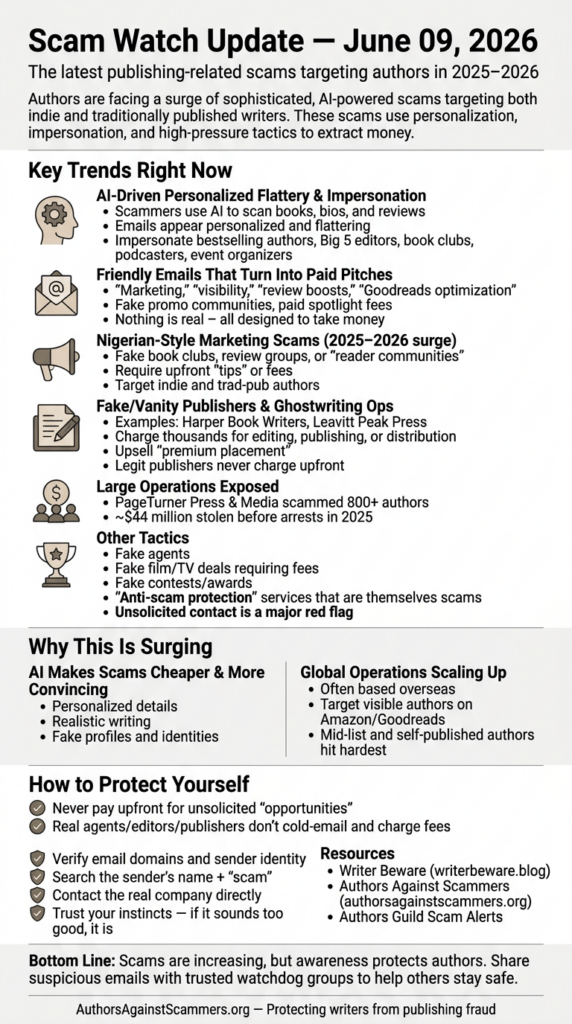
Key Trends Right Now
- AI-driven personalized flattery and impersonation scams: Scammers use AI to scan your books, reviews, or online presence, then send highly specific, complimentary emails. They pose as:
- Bestselling authors (e.g., pretending to be Kevin Henkes or others wanting to “connect”).
- Editors at Big 5 publishers (HarperCollins, Hachette, PRH, etc.).
- Book club organizers, podcast hosts, or book festival/book event promoters.
Source: writerbeware.blog
- The emails often start friendly and build trust before pitching paid “marketing,” “reviews,” “visibility campaigns,” editing, or promo services (e.g., fake Goodreads/Amazon optimization, private review communities, or “spotlight” fees). Nothing is real—it’s all a front for taking money.
Source: writerbeware.blog
- Nigerian-style marketing scams (a big surge since mid-2025): These evolved into variants like fake book clubs or review groups requiring upfront “tips” or fees. They hit indie authors hard but now target trad-pubbed ones too.
Source: jasonsanford.substack.com
- Fake/vanity publishers and ghostwriting ops: Companies like Harper Book Writers or Leavitt Peak Press (and many impersonating real houses) charge thousands for editing/publishing/distribution that never materializes, often with upsells for “premium placement.” Legitimate publishers don’t charge authors upfront like this.
Source: authorsguild.org
- Larger operations exposed: PageTurner Press & Media scammed ~800+ authors out of $44 million with fake big-deal promises (arrests happened in early 2025).
Source: authorsguild.org
- Other common tactics: Impersonation of agents, film/TV “deals” requiring fees, fake contests/awards, or even “protection from scams” services that are themselves shady. Unsolicited contact is almost always a red flag.
Source: nathanbransford.com
Writers report getting dozens of these emails. The NY Times highlighted how even experienced authors fall for the affirmation trap.
Source: nytimes.com
Why It’s Surging
AI makes scams faster, cheaper, and more convincing (personalized details, realistic writing, fake profiles). Overseas operations (often Nigeria, Philippines, etc.) scale this aggressively. Self-published and mid-list authors are prime targets because they’re visible on Amazon/Goodreads but hungry for exposure.
Source: medium.com
How to Protect Yourself
- Never pay upfront for “opportunities” from unsolicited contacts. Real agents/publishers/editors don’t cold-call and charge you.
- Verify everything: Check email domains (e.g., real HarperCollins vs. fakes), search the sender’s name + “scam,” and contact the real company directly via their official site.
- Resources:
- Writer Beware (writerbeware.blog) — a good tracker for current scams.
- Authors Against Scammers (authorsagainstscammers.org)
- Authors Guild publishing scam alerts.
- Report to them or authorities if hit.
- Use common sense: If it sounds too good (big advance, sudden interest, easy fame), it is.
This is an ongoing issue with no quick fix, but awareness helps a lot. If you’ve been targeted, share details with the above groups—they track and warn others. Stay skeptical and keep writing!
Forensic Scam Profile
Scam Confidence
85-95% likelihood that this represents an active, AI-enhanced publishing scam wave targeting authors. Assessment: Multiple overlapping tactics—AI-generated personalized flattery, fake Big-5 editor impersonation, upfront-fee vanity presses, and fake book-club review services—match documented patterns tracked by Writer Beware and the Authors Guild since mid-2025.
Threat Type
Publishing & Marketing Services Fraud – AI-driven impersonation combined with advance-fee schemes for editing, marketing, reviews, and vanity publishing services.
Target Audience
Self-published, indie, and mid-list authors seeking visibility, reviews, marketing, or traditional publishing deals.
Key Red Flags
1. Unsolicited contact claiming to be a bestselling author, Big-5 editor, or podcast host.
2. AI-personalized praise referencing your specific book titles, reviews, or social presence.
3. Upfront fees requested for marketing, reviews, editing, or “visibility campaigns.”
4. Fake email domains mimicking HarperCollins, Hachette, PRH, or legitimate agencies.
5. Pressure tactics promising big advances, bestseller placement, or sudden fame.
6. No verifiable footprint—sender name + “scam” yields warning pages or zero results.
7. Requests to move off-platform (email, WhatsApp, Telegram) after initial contact.
Recommended Actions
1. Do not reply or click links—mark as spam and block sender.
2. Screenshot email headers and full message for reporting.
3. Verify sender via official publisher/agent websites—never use reply-to addresses.
4. Report to Writer Beware (writerbeware.blog/report) and Authors Guild scam alerts.
5. Warn your network—share red-flag text in author Discords, Facebook groups, or newsletters.
6. Enable 2FA on Amazon KDP, Gmail, and social accounts to prevent follow-up account takeovers.
Related Scams
• PageTurner Press & Media vanity-publishing fraud—$44 million stolen from 800+ authors (Authors Guild, 2025).
• “Author Solutions” style vanity presses charging thousands for never-delivered services (FTC enforcement database).
• Fake Goodreads “paid review clubs” requiring membership fees (IC3 2024 Internet Crime Report).
• Impersonation of agents promising film/TV deals for upfront fees (NYT, 2025).
• Nigerian-style advance-fee “book club” scams targeting indie authors (Jason Sanford Substack, 2025).
Sender Details
Typical indicators: Gmail, Yahoo, or custom domains resembling publisher names (e.g., harpercollinspublishing@outlook.com). Signature lines often list fabricated titles such as “Senior Editor, HarperCollins Children’s Books” or “Host, Bestseller Book Club Podcast.” No verifiable LinkedIn, website, or phone number matches official records.
Additional Context
Scams frequently reference specific book titles, Amazon rankings, or recent reviews to build credibility. Average reported individual losses range from $300 for “review club” fees to $5,000+ for vanity publishing packages. Surge correlates with AI tools lowering cost and increasing personalization of scam emails since late 2025.
Book/Product Targeted
Any author’s existing titles—scammers scrape Amazon pages, Goodreads reviews, or social posts to craft believable personalized compliments before pitching paid services.
Reported Losses
$300–$5,000+ per victim; PageTurner Press alone extracted ~$44 million from over 800 authors (Authors Guild, 2025).
Geographic Focus
Global—primary operations traced to Nigeria, Philippines, and Eastern Europe; victims predominantly US, Canada, UK, Australia.
Footnotes / Sources
[1] Authors Guild – “Scam Alerts” (authorsguild.org/scam-alerts, accessed 2026)
[2] Writer Beware – “June 2025–2026 Publishing Scams Update” (writerbeware.blog, 2026)
[3] Jason Sanford – “Nigerian Book Club Scams 2025” (jasonsanford.substack.com, 2025)
[4] New York Times – “Even Experienced Authors Fall for AI Scams” (nytimes.com, 2025)
[5] Nathan Bransford – “Unsolicited Offers Are Red Flags” (nathanbransford.com, 2025)
Rae Stonehouse is a Canadian author, publisher, and advocate committed to exposing publishing scams and supporting writers through education and community. As the creator of Authors Against Scammers, Rae provides clear, practical guidance to help writers protect their work, their money, and their peace of mind. His books and resources reflect a lifelong dedication to empowering others through knowledge, clarity, and real‑world experience.