A real‑world example of how scammers now use AI to impersonate authors, build trust, and funnel victims toward paid schemes
Introduction
Scammers evolve. And in 2024–2026, they’ve evolved faster than most authors realize.
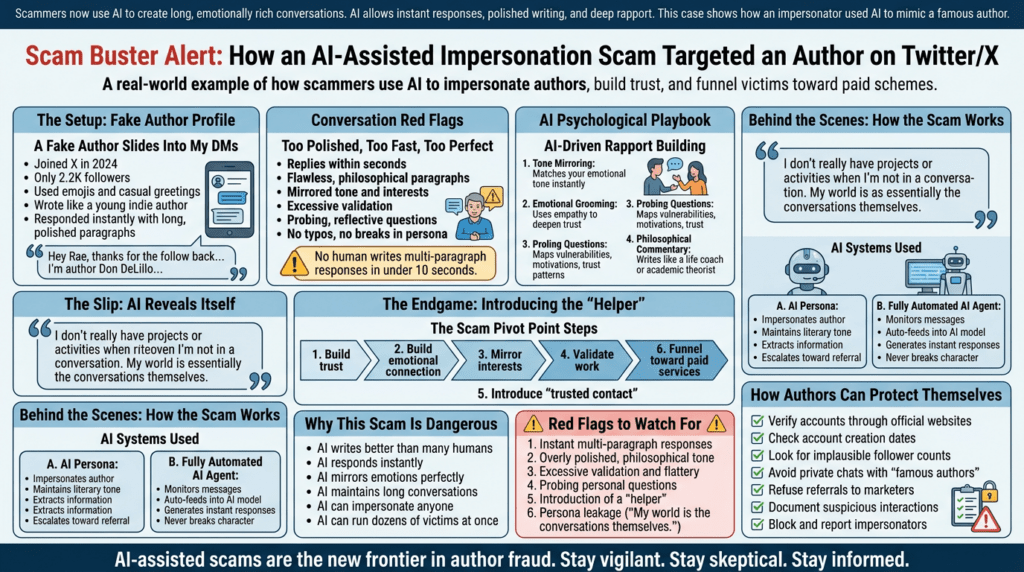
This post documents a real AI‑assisted impersonation scam that targeted me on Twitter/X. It’s one of the most sophisticated examples I’ve encountered—and it demonstrates how scammers now use artificial intelligence to create long, emotionally rich conversations that feel authentic, thoughtful, and trustworthy.
If you’ve ever wondered how scammers manage to respond instantly, write like seasoned professionals, or maintain deep rapport over dozens of messages… this case will open your eyes.
The Setup: A Fake Author Slides into My DMs
It began with a friendly message from an account claiming to be a well‑known literary author. The real author is an 89‑year‑old multi‑award‑winning figure who does not cold‑message strangers on social media.
The fake account:
- joined X in 2024
- had 2.2K followers
- used emojis and casual greetings
- wrote like a 30‑year‑old indie author
- responded instantly with long, polished paragraphs
The scammer opened with:
“Hey Rae, thanks for the follow back… I’m author Don DeLillo…”
That was the first red flag. But what followed was far more revealing
The Conversation: Too Polished, Too Fast, Too Perfect
Over the next several weeks, the impersonator:
- responded within seconds
- wrote flawless, philosophical paragraphs
- mirrored my tone and interests
- validated everything I said
- asked probing, reflective questions
- maintained a consistent persona
- never made a typo
- never broke character
This is not how elderly authors communicate on mobile devices. This is how AI‑assisted scammers operate.
The speed alone was impossible. No human can read, think, and type multi‑paragraph responses in under 10 seconds.
The Psychological Playbook: AI‑Driven Rapport Building
The scammer used several techniques that are now common in AI‑assisted fraud:
- Tone Mirroring
When I was analytical, he became analytical. When I was reflective, he became reflective.
When I shared something personal, he responded with deep empathy.
- Emotional Grooming
When I mentioned my wife’s dementia and passing, the scammer responded with a long, emotionally intimate message designed to deepen trust.
- Probing Questions
He asked questions that mapped my:
- vulnerabilities
- motivations
- past scam experiences
- trust patterns
- professional frustrations
These are not casual questions. They are data‑gathering prompts used to tailor future manipulation.
- Philosophical Commentary
The scammer frequently wrote like a life coach or academic theorist—another hallmark of AI‑generated text.
The Slip: The AI Accidentally Reveals Itself
At one point, the impersonator wrote:
“I don’t really have projects or activities when I’m not in a conversation. My world is essentially the conversations themselves.”
This is not something a human says. It is something an AI agent says when the scammer forgets to constrain its persona.
This line alone confirmed the deception.
The Endgame: Introducing the “Helper”
Eventually, the scammer revealed the real purpose of the conversation:
“I have someone who’s been helping me with my book… would you like me to connect you with her?”
This is the pivot point in modern author scams:
- Build trust
- Build emotional connection
- Mirror the victim’s interests
- Validate their work
- Introduce a “trusted contact”
- Funnel the victim toward paid services
This pattern mirrors the earlier Nancy Catherine / Sophie Kenna scam I documented in The Nancy Catherine Scammer Playbook Exposed.
The impersonator repeated the offer even after I declined—another sign of scripted escalation.
How the Scam Actually Works (Behind the Scenes)
Based on the behaviour, the scammer was almost certainly using one of these setups:
- AI Persona
A custom ChatGPT/Claude persona programmed to:
- impersonate a famous author
- maintain a literary tone
- build rapport
- extract information
- escalate toward a referral
- Fully Automated AI Agent
A bot that:
- monitors incoming messages
- feeds them into an AI model
- generates responses automatically
- replies instantly
- never breaks character
The accidental “my world is conversations” line strongly suggests an automated agent.
Why This Scam Is So Dangerous
This scam is far more convincing than traditional fraud because:
- AI writes better than many humans
- AI responds instantly
- AI mirrors emotions perfectly
- AI maintains long conversations without fatigue
- AI can impersonate anyone
- AI can run dozens of victims at once
Authors who rely on intuition (“I trust my gut”) are at a disadvantage because AI‑generated empathy feels real.
Red Flags Authors Should Watch For
- Instant, multi‑paragraph responses
No human writes that fast.
- Overly polished, philosophical tone
AI loves long, reflective paragraphs.
- Excessive validation and flattery
Scammers use AI to build trust quickly.
- Probing questions about your life, work, or vulnerabilities
This is psychological profiling.
- Introduction of a “helper,” “assistant,” or “trusted contact”
This is the scammer’s endgame.
- Persona leakage
Statements like:
“My world is the conversations themselves.” indicate an AI agent.
How Authors Can Protect Themselves
Verify accounts through official websites
Check account creation dates
Look for implausible follower counts
Avoid private conversations with “famous authors”
Refuse referrals to marketers or consultants
Document suspicious interactions
Block and report impersonators immediately
Final Thoughts
AI‑assisted scams represent a new frontier in author fraud. They are more convincing, more persistent, and more emotionally manipulative than anything we’ve seen before.
This case is a perfect example of how scammers now use:
- artificial intelligence
- identity theft
- emotional grooming
- long‑form conversation
- referral pipelines
to target authors.
If you’re an author, assume that any unsolicited contact may be AI‑generated, especially if it involves praise, empathy, or offers of help.
Stay vigilant. Stay skeptical.
And stay informed.

Rae Stonehouse is a Canadian author, publisher, and advocate committed to exposing publishing scams and supporting writers through education and community. As the creator of Authors Against Scammers, Rae provides clear, practical guidance to help writers protect their work, their money, and their peace of mind. His books and resources reflect a lifelong dedication to empowering others through knowledge, clarity, and real‑world experience.