Fake bank‑inspector scams—also known as bank examiner or bank investigator scams—are one of the longest‑running impersonation frauds still active today. They traditionally target seniors, but the tactics used in these schemes overlap heavily with the impersonation, secrecy, and urgency techniques increasingly used against authors. Even though writers are not a uniquely targeted demographic for this specific scam, understanding how it works strengthens your overall scam‑resistance in today’s publishing environment.
What Is a Fake Bank‑Inspector Scam?
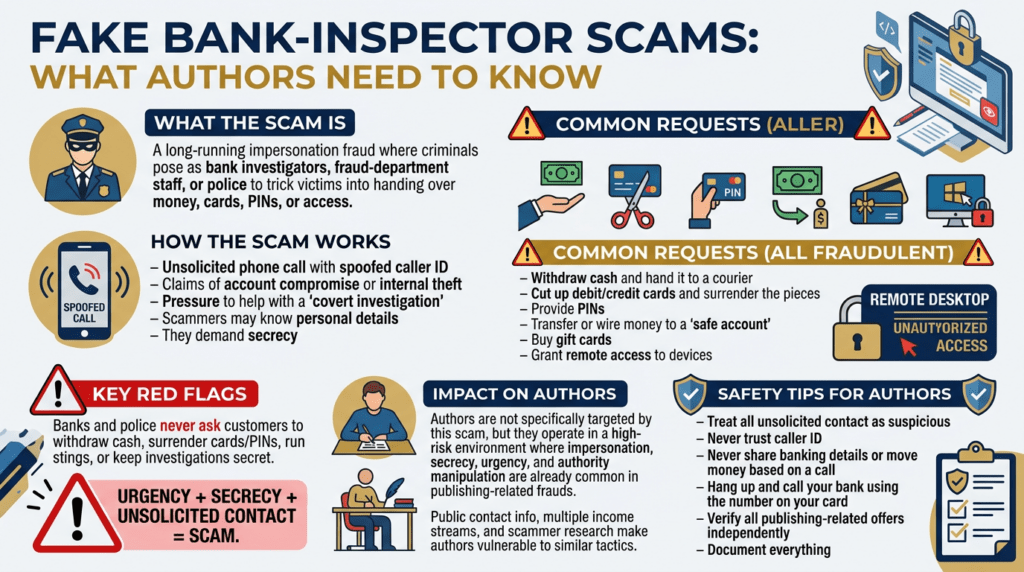
This scam involves criminals posing as bank officials, fraud‑department employees, internal investigators, or even police officers. Their goal is to convince victims that their bank account is compromised or that a bank employee is under investigation—and that the victim must help with a covert “sting.”
The scam has been documented for decades, with examples going back to the 1990s and earlier. It remains active today, with recent reports of significant losses, including more than $1 million stolen across dozens of cases in one Ontario region in a single year.
How the Scam Typically Works
Victims receive an unsolicited phone call. The caller ID is often spoofed to appear as the victim’s bank or local police. The caller claims:
- Your account has been compromised
- A bank employee is stealing
- Your branch is under investigation
- You must help with a confidential operation
Scammers may already know your name or partial account details to appear legitimate. They insist on secrecy—telling victims not to speak to bank staff or family members—and apply pressure to act immediately.
Common Requests
Fraudsters may instruct victims to:
- Withdraw a large sum of cash and hand it to a courier or “investigator”
- Cut up a debit or credit card and surrender the pieces (often keeping the chip intact)
- Provide their PIN
- Transfer or wire money to a “safe account”
- Buy gift cards as part of the “probe”
- Grant remote access to their computers or banking apps
Once the scammers obtain money, cards, or sensitive information, they disappear. Victims are told to wait for confirmation or a replacement card that never arrives.
Variations include fake deposits that victims are told to “return,” or escalation to supposed law‑enforcement involvement.
Key Red Flags
Banks, police, and legitimate investigators never:
- Ask customers to withdraw cash
- Ask for debit or credit cards
- Ask for PINs
- Ask you to help run a sting operation
- Ask you to keep an investigation secret
- Contact you unexpectedly and demand immediate action
If you receive such a call, hang up immediately. Contact your bank using the number printed on your card—not any number provided by the caller—and report the incident to the police.
Impact on Authors
There is no documented evidence that authors are specifically targeted by fake bank‑inspector scams. Searches for connections between this particular fraud and writers turn up nothing substantive. The scam primarily affects the public, especially older adults who may have substantial savings.
However, authors operate in a scam‑heavy ecosystem where impersonation tactics are already common. Even though bank‑inspector scams are not author‑specific, the psychological techniques used in them mirror those found in publishing‑related frauds.
Why Authors Should Still Pay Attention
Authors are frequently targeted by impersonation scams. These include fake agents, publishers, film scouts, marketing services, book‑fair organizers, and AI‑generated impersonations of literary figures. Scammers often begin with praise or opportunity, build trust, and then escalate to financial exploitation. A fake bank‑inspector call can easily be inserted into that chain.
Authors often have public contact information. Websites, Amazon pages, social media profiles, newsletters, and event listings make writers easy to find.
Authors manage multiple income streams. Royalties, direct sales, PayPal, Stripe, KDP, Draft2Digital, and IngramSpark create complexity that scammers can exploit. Claims like “your recent royalty payment triggered a fraud alert” sound plausible.
Scammers research their victims. They scrape bios, interviews, book themes, and social media posts to craft personalized pitches.
Authors may be juggling financial stress. Scammers exploit emotional states. A call claiming your account is compromised hits harder when you’re already worried about income or expenses.
How This Scam Fits Into the Larger Fraud Landscape for Authors
While fake bank‑inspector scams aren’t aimed at authors specifically, they share the same mechanics as publishing‑related scams:
- Authority impersonation
- Secrecy
- Urgency
- Pressure
- Emotional manipulation
The context changes, but the psychological levers remain the same. Understanding one scam helps you recognize others.
Practical Safety Tips for Authors
- Treat all unsolicited contact—phone, email, DM, WhatsApp, Telegram—as suspicious.
- Never act on urgency or pressure.
- Never trust caller ID; it can be spoofed.
- Never share banking details or move money based on a call.
- Hang up and call your bank back using the number on your card.
- Keep your author email private by using a contact form instead.
- Verify every publishing‑related offer independently.
- Document everything: screenshots, emails, timestamps.
These precautions protect you from both financial scams and publishing‑related fraud.
Bottom Line
Fake bank‑inspector scams are not specifically aimed at authors, but writers operate in a high‑risk environment where impersonation, secrecy, urgency, and authority manipulation are already familiar threats. Understanding this long‑running financial scam strengthens your overall scam‑awareness and helps you recognize similar tactics in the publishing world.

Rae Stonehouse is a Canadian author, publisher, and advocate committed to exposing publishing scams and supporting writers through education and community. As the creator of Authors Against Scammers, Rae provides clear, practical guidance to help writers protect their work, their money, and their peace of mind. His books and resources reflect a lifelong dedication to empowering others through knowledge, clarity, and real‑world experience.