Sextortion emails are hitting authors again — and they’re getting bolder. I’ve broken down a recent example to show exactly how these scams work, the fear tactics they rely on, and how you can shut them down before panic sets in.
Overview
This case study documents a common extortion scam sent to authors and other public‑facing professionals. The scammer claims to have hacked the victim’s devices, recorded compromising video, and threatens to release it unless paid in Bitcoin. The message relies entirely on fear, shame, and urgency — with no actual evidence of compromise.
Source: A fellow Linkedin author.
The Scam Message (Cleaned Text Version)
Subject: I have recorded a video of you
The sender claims to have hacked the recipient’s electronic devices, including their computer, phone, and camera. They state they have recorded a compromising video and obtained the recipient’s contact list. The message threatens to send the alleged video to all contacts unless the recipient pays $1,500 in Bitcoin within 48 hours.
The scammer provides a Bitcoin wallet address and instructs the recipient to email them after payment. They warn against contacting authorities or blocking them, claiming they “have everything.”
Key Red Flags
- No specific evidence of hacking (no passwords, device names, timestamps).
- Generic threat (“I recorded a video of you”) used in millions of identical extortion emails.
- Crypto payment demand, which is irreversible and untraceable.
- Poor grammar and formatting, indicating a mass‑produced template.
- Urgency (“48 hours”) designed to prevent rational thinking.
- Isolation tactic (“Don’t contact anyone”) to increase panic.
How the Scam Works
This is a sextortion script, not a real hack. Scammers send identical messages to large email lists harvested from public websites, newsletters, or breached databases. They rely on fear and embarrassment to coerce payment.
No device access occurs. No video exists. No contacts are compromised.
Impact on Authors
Authors are frequent targets because:
- They often have public email addresses.
- They maintain online profiles with visible contact networks.
- Many work alone, making them vulnerable to isolation tactics.
- They may fear reputational harm, which scammers exploit.
This scam mirrors other author‑targeted schemes that weaponize shame, urgency, and technical intimidation.
Recommended Response
- Do not reply.
- Do not pay.
- Do not click anything.
- Delete the message.
- Report it to the platform or email provider as extortion.**
Lessons Learned
- Fear-based scams rely on silence. Talking to others breaks the spell.
- Technical claims without evidence are meaningless.
- Crypto demands are a universal red flag.
- Public-facing professionals must expect periodic extortion attempts.
- Education reduces panic and prevents payment.
** Sextortion, impersonation, and extortion scams are global, and every country has its own reporting channel.
🌍 International Scam & Cybercrime Reporting Resources
🇨🇦 Canada
- Canadian Anti‑Fraud Centre (CAFC) For fraud, extortion, phishing, cybercrime.
- RCMP National Cybercrime Coordination Unit (NC3) For more serious cyber incidents.
🇺🇸 United States
- FBI Internet Crime Complaint Center (IC3) Primary reporting hub for online extortion, hacking claims, phishing, crypto scams.
- FTC ReportFraud For consumer scams, impersonation, and fraud attempts.
- Cybersecurity & Infrastructure Security Agency (CISA) For cyber incidents affecting systems or networks.
🇬🇧 United Kingdom
- Action Fraud (National Fraud & Cyber Crime Reporting Centre) Handles extortion, phishing, impersonation, crypto scams.
- National Cyber Security Centre (NCSC) For suspicious emails, cyber threats, and malware.
🇦🇺 Australia
- ReportCyber (Australian Cyber Security Centre) For cybercrime, extortion, hacking claims, and online threats.
- Scamwatch (Australian Competition & Consumer Commission) For consumer scams and fraud attempts.
🇪🇺 European Union
- Europol Internet Crime Reporting Cross-border cybercrime and extortion.
- National reporting portals (varies by country):
- Germany: Bundeskriminalamt (BKA)
- France: PHAROS (online abuse & cybercrime)
- Spain: Policía Nacional – Delitos Telemáticos
- Italy: Polizia Postale
🇮🇳 India
- National Cyber Crime Reporting Portal Handles extortion, impersonation, hacking claims, and digital blackmail.
- CERT‑In For cyber incidents and suspicious activity.
🇸🇬 Singapore
- Singapore Police Force – Anti‑Scam Centre
- Cyber Security Agency of Singapore (CSA) For cyber threats and suspicious emails.
🇯🇵 Japan
- National Police Agency – Cybercrime Division
- IPA Security Center For malware, phishing, and extortion attempts.
🌏 Other Regions
- New Zealand: CERT NZ
- South Africa: South African Fraud Prevention Service (SAFPS)
- Philippines: Cybercrime Investigation and Coordinating Center (CICC)
- Brazil: Polícia Federal – Cybercrime Division
- Mexico: Policía Cibernética (Cyber Police)
~~~
Original Message:
Subject: I have recorded a video of you
Hello,
I hacked your electronic devices and recorded a video of you. I have access to your computer, phone, and camera. I also have your contact list.
If you don’t pay me, I will send the video to all your contacts.
You have 48 hours to pay me $1,500 in Bitcoin.
Bitcoin Wallet Address: bc1q2q8x0t4p8x0q3q0xq8x0t4p8x0q3q0xq8x0t4
After you send the payment, email me and I will delete the video. If you don’t pay, I will send the video to everyone you know.
Don’t try to contact the police or anyone else. Don’t try to block me. I have everything.
You have been warned.
~~~
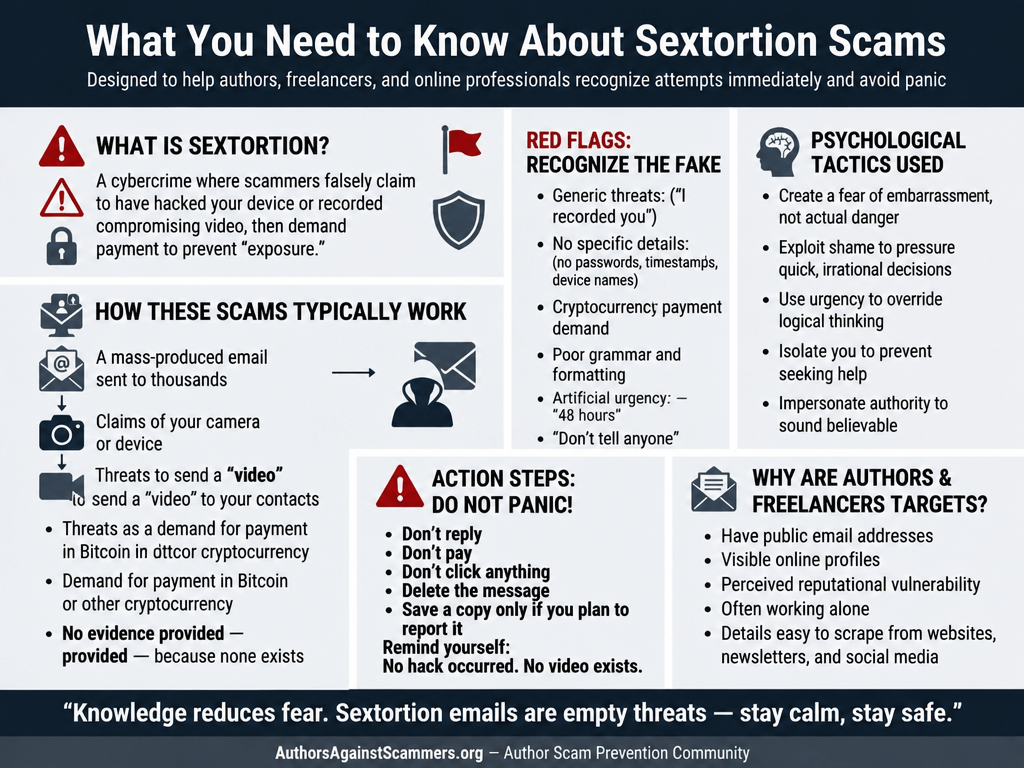
This case study examines a recent sextortion scheme targeting authors, wherein perpetrators employ deceptive emails to extort sensitive information and financial resources. The analysis highlights the methods used by scammers, the psychological impact on victims, and preventive measures authors can take to safeguard their personal and professional information. By understanding the tactics deployed in these scams, individuals can better protect themselves against such malicious activities. The findings underscore the importance of vigilance and awareness in the digital communication landscape.

Rae Stonehouse is a Canadian author, publisher, and advocate committed to exposing publishing scams and supporting writers through education and community. As the creator of Authors Against Scammers, Rae provides clear, practical guidance to help writers protect their work, their money, and their peace of mind. His books and resources reflect a lifelong dedication to empowering others through knowledge, clarity, and real‑world experience.