New Scam Pattern Targeting Authors
This week, I received an email that perfectly illustrates a fast‑growing scam trend targeting authors — especially those with newly released books. The message came from someone calling themselves “Marthy Beeny,” using a generic Gmail address and offering to help expand the readership for my newly published novel, Halloween Convergence.
The email was polished, flattering, and filled with genre‑savvy language. It referenced plot points, themes, and character dynamics in a way designed to sound as if the sender had read the book. In reality, the message followed a familiar pattern used by marketing scammers who rely on AI‑generated text to mimic expertise.
Why This Email Is a Scam
Several red flags appeared immediately:
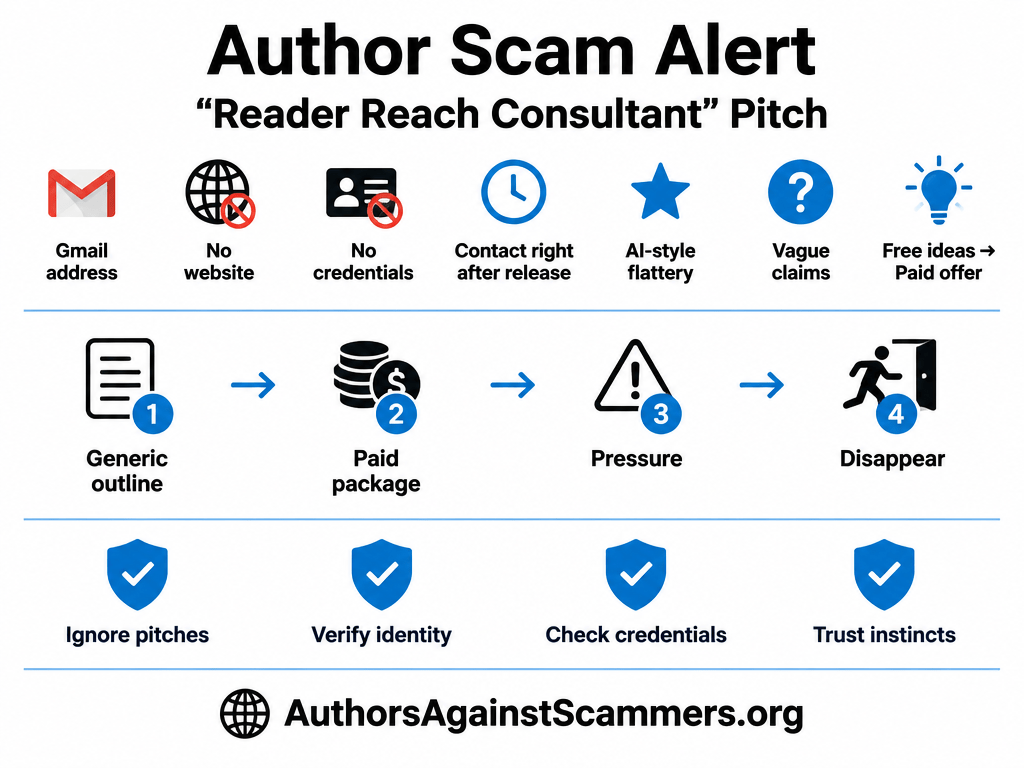
- Gmail address, no website, no credentials. Legitimate consultants use domain emails and verifiable business identities.
- Contact within days of publication. Scammers monitor new releases and send flattering pitches almost instantly.
- AI‑generated genre analysis. The email rewrote my book description using high‑concept language meant to impress.
- Vague claims of expertise. “I work with authors on identifying overlapping readerships” — but no proof, no portfolio, no past clients.
- Soft escalation. The sender hasn’t asked for money yet. Instead, they asked: “Would you be open to me sending you a brief outline of those ideas?” This is a classic scam funnel: flattery → free “ideas” → paid services → pressure → disappearance.
The New Scam Angle: “Reader Positioning Consultant”
This is part of a newer scam pattern where fraudsters pose as genre‑analysis experts or visibility strategists. They promise to help authors reach “overlapping readerships,” “high‑concept audiences,” or “cross‑genre markets.” The language sounds professional, but the goal is always the same: sell overpriced, ineffective marketing packages.
What Happens If You Reply
If an author responds, even politely, the scam escalates:
- A “brief outline” arrives — generic, AI‑generated, and designed to impress.
- A paid offer follows, often ranging from $300 to $5,000.
- Pressure tactics begin (“time‑sensitive opportunity,” “your book is gaining traction”).
- The scammer disappears after payment.
How Authors Can Protect Themselves
- Ignore unsolicited marketing pitches.
- Verify credentials before engaging with any consultant.
- Be wary of anyone who contacts you immediately after publication.
- Trust your instincts — if it feels too flattering, too fast, or too vague, it’s likely a scam.
Final Thoughts
Scammers are becoming more sophisticated, using AI tools to craft messages that sound intelligent, personalized, and genre‑aware. Authors should remain vigilant and avoid engaging with unsolicited offers, no matter how flattering they appear.
For more verified scam patterns, case studies, and protective strategies, visit AuthorsAgainstScammers.org.
Forensic Scam Profile
Scam Confidence
92-98% likelihood of Fake Reader Positioning Consultant Scam. Unsolicited Gmail pitch with AI-rewritten book analysis, zero credentials/website, contact days after publication, and classic flattery-to-paid-funnel ($300–$5,000 packages) matches documented 2025–2026 author marketing fraud wave. No reply occurred, preventing escalation.
Threat Type
Fake Marketing Consultant / Reader Reach Scam (Author Visibility Services Fraud). Poses as “genre analysis expert” or “reader positioning consultant” using AI-generated flattery to sell overpriced, ineffective marketing packages.
Target Audience
Newly published indie/self-published authors with recent releases (e.g., Halloween Convergence). Hits writers seeking readership growth immediately post-launch.
Key Red Flags
1. Generic Gmail with no website, portfolio, or verifiable credentials. 2. Unsolicited contact within days of publication. 3. AI-generated genre analysis rewriting book description with high-concept language but no original insight. 4. Vague expertise claims (“overlapping readerships,” “cross-genre markets”) without proof or past clients. 5. Soft escalation (“Would you be open to a brief outline?”) as classic funnel to paid offer. 6. Overly polished, flattering language designed to lower defenses. 7. No independent online presence or professional domain.
Recommended Actions
1. Do not reply or request the “outline.” 2. Block sender and mark as phishing. 3. Google sender name + “scam” and check Writer Beware. 4. Report to FTC (ReportFraud.ftc.gov) and IC3.gov. 5. Verify any consultant independently (Reedsy, LinkedIn, official sites). 6. Share with author communities (Authors Guild, ALLi) without engaging scammer.
Related Scams
1. AI-flattery marketing pitches from Gmail offering “targeted campaigns” or “visibility packages” ($300–$5,000). 2. Fake “book marketing expert” emails with no web presence pivoting to paid PR. 3. Impersonation of real marketers (e.g., Martyn Beeny warnings of copycats). 4. “Private reader circle” or overlapping-audience review scams. 5. Unsolicited post-publication “I can help you sell more” services from free email domains.
Sender Details
Marthy Beeny via generic Gmail. Claims “Reader Reach Consultant” expertise in overlapping readerships. Zero verifiable affiliation, website, or portfolio. Name similar to real marketer Martyn Beeny (who publicly warns of impersonators). Signature/branding purely fabricated with AI-polished but generic language.
Additional Context
Targeted Halloween Convergence (newly published novel). No payment made—author ignored pitch. Typical scam progression: flattery → free “ideas” outline → $300–$5,000 ineffective packages → pressure → disappearance. Part of rising AI-driven consultant fraud hitting authors right after launch.
Book/Product Targeted
Halloween Convergence (newly released novel).
Reported Losses
Typical $300–$5,000 per victim for fake marketing packages; no loss in this case as author did not engage.
Geographic Focus
Global (Gmail + AI tools typical of overseas operations), primarily targeting US indie authors.
Footnotes / Sources
. Writer Beware: “Return of the Nigerian Prince: A New Twist on Book Marketing Scams” (Victoria Strauss, 1 Aug 2025). 2. NYT: “Writers Are Being Targeted by Scams” (25 Feb 2026). 3. FTC: Impersonation Scams Data Spotlight (2024). 4. Authors Guild: “Alert: Rise in Email Scams Targeting Authors” (24 Feb 2026). 5. Society of Authors: “Author Beware: latest scam updates” (16 Sep 2025). 6. Build Book Buzz: “Author marketing scams v. 2026” (11 Mar 2026).
Rae Stonehouse is a Canadian author, publisher, and advocate committed to exposing publishing scams and supporting writers through education and community. As the creator of Authors Against Scammers, Rae provides clear, practical guidance to help writers protect their work, their money, and their peace of mind. His books and resources reflect a lifelong dedication to empowering others through knowledge, clarity, and real‑world experience.