How flattery, borrowed credibility, and a vague “spotlight” set the stage for a pay-to-play promotion scam
What Kind of Scam Is This?
Every author knows the lift that comes from an unexpected message from someone who says they loved the book. Scammers know it too. This alert examines an email titled “Invitation to Feature Blow Your Own Horn! at Prominent Book Club,” sent to me, the author of a personal branding guide for business professionals by a sender who signs as “Stella Sam, Co-Organizer.”
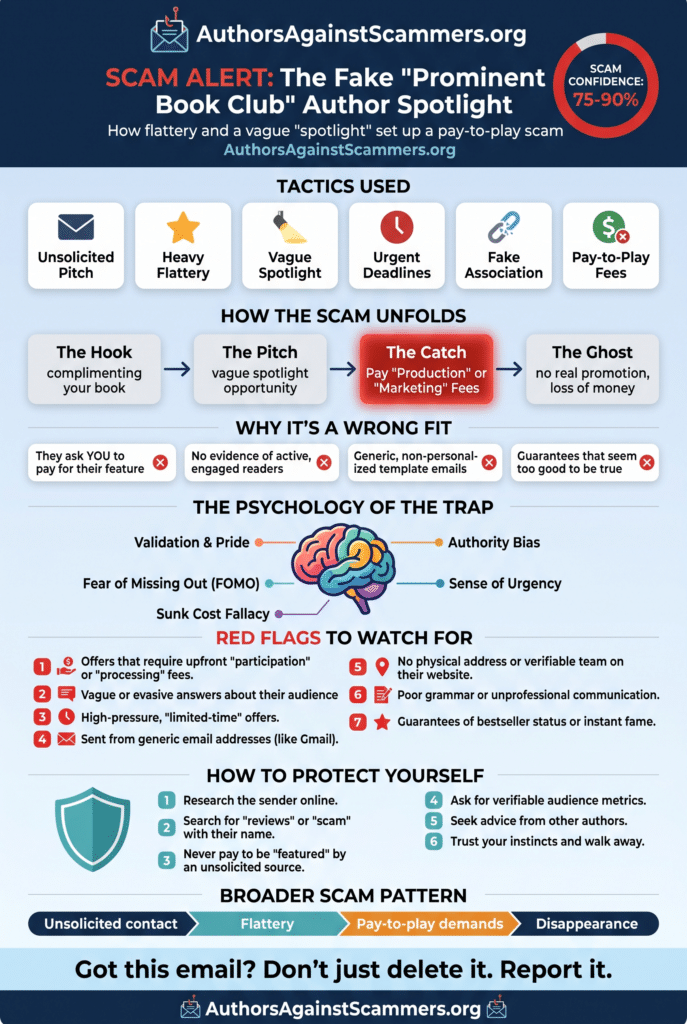
This is a fake promotional-opportunity scam, often called a pay-to-play spotlight scam. The message dangles visibility: a live “Author Spotlight,” an audience of thousands of readers, and a wave of Goodreads reviews. Notice what is missing: a request for money. That is deliberate. The first email exists only to earn a reply. The fee, usually dressed up as a “participation,” “production,” or “promotion” cost, tends to arrive in the second or third message, after the author has said yes and feels flattered, invested, and a little embarrassed to back out.
Authors make ideal targets for three reasons. Our contact details are public on Amazon, Goodreads, and personal websites. Many of us, especially independent authors, handle marketing alone. And nearly every author wants more readers, which makes us receptive to anyone who offers them.
The Scammer’s Tactics
The message layers several manipulation tactics inside a smooth, professional package.
- Targeted flattery. The longest paragraph is devoted to praising the book. It closely paraphrases the book’s description: the LinkedIn strategies, networking, job searching, reputation management, even the “squeaky wheel” opening. A genuine reader mentions a passage that stuck with them or an idea that changed their mind. This reads like a product listing polished into praise.
- False authority. “Co-organizer,” “promotional and reader-engagement platform,” “curated spotlight events,” and “over 10,000 active readers” all sound impressive. None of it can be verified from the email. There is no website, no social media, no named members, and no list of past featured authors.
- Impersonation of legitimacy. The name “Prominent Book Club” echoes real literary communities, and the mention of Goodreads borrows a trusted brand’s credibility. Yet the message comes from a free Gmail address, not a domain tied to any organization.
- A vague offer. What is a “Reader Impact Spotlight”? When is it? How many people attend? What does it cost? The email never says. Vagueness lets the author imagine the best case while the sender stays free to define the terms later.
- An engagement hook. The “curious question” about the author’s career is designed to start a personal conversation. Once the author replies, the scammer has a willing, engaged target.
- Soft urgency. The phrase “our next Reader Impact Spotlight” implies a calendar already moving and a slot waiting. Hard urgency, such as “only two openings left this quarter,” typically appears in follow-up messages.
How It Typically Unfolds
The following is an illustrative composite based on commonly reported versions of this scam, not a quote from this sender. After the author replies, a warm second message arrives: “We’re thrilled you’re interested! Our spotlight calendar is nearly full, so we’d like to confirm your slot this week. To cover event production and reader outreach, we ask authors for a one-time contribution of $350.” A third message may offer a “premium package” with extra reviews or a recorded interview. By then the author has been told in writing that they were “selected,” and declining feels like turning down an honour.
Why the Offer Is Fraudulent or Impossible
We cannot know what every recipient is asked to pay, but the claims in the email do not hold together.
The fit is wrong. The club says it introduces “diverse stories and fresh voices” and wants authors to share “the story behind their book, its inspiration, and their creative process.” That is language for fiction and memoir. The invited book is a nonfiction guide to personal branding and job-search strategy. The email praises the book in detail yet describes an event that does not suit it, which suggests one template is sent to many authors regardless of genre.
The scale is implausible. A community of 10,000 active readers across the UK, US, Australia, and West and South Africa would have a website, a social media presence, and a visible track record. Weekly live meetings spanning those time zones would also suit almost no one.
The review promise is a problem in itself. The email says members “actively share thoughtful reviews,” particularly on Goodreads. If reviews are part of a paid package, they are incentivized, and platforms such as Amazon and Goodreads prohibit manipulated reviews. They can be removed, and your account can be penalized. If no payment is involved, no one can promise reviews, because genuine readers cannot be scheduled to produce them.
The business model is missing. A club with no reader fees, advertising, or sponsors that is “absolutely delighted” to feature strangers must earn money somewhere. The only person left to pay is the author.
The Psychology Behind the Wording
The email is built on well-understood principles of persuasion, each one aimed at lowering the author’s guard.
- Reciprocity and liking. The sender gives praise before asking for anything, creating goodwill and a quiet sense of debt. Words like “genuinely,” “especially appreciate,” and “warm regards” signal friendship.
- Your own argument as the hook. The book’s thesis is that self-promotion is not bragging and that capable people must stop being shy about it. The sender quotes that idea back, then proposes a promotional event. Saying no begins to feel like contradicting your own book.
- Foot-in-the-door and commitment. The “curious question” is a small, easy ask. Each reply deepens the author’s investment, and consistency pressure makes walking away feel inconsistent.
- Authority and social proof. A title and an audience figure supply credibility without evidence.
- A low-pressure close. “Would you be open to joining us?” sounds respectful, not demanding. Pressure comes later, once the author is emotionally committed.
How This Fits Broader Industry Patterns
This is one branch of a much larger family of pay-to-play schemes. Fake literary agents charge “reading fees.” Self-described film producers claim to want your book and then ask for “development” money. Fake awards charge entry fees and sell medals. “Marketing consultants” promise bestseller status. Fake review services sell praise. The structure is always the same: compliment, credentials, opportunity, fee.
What has changed is cost. Personalization is now cheap. A scammer can lift details from a book listing and generate a convincing letter in minutes, so polish no longer signals legitimacy. Watchdogs such as Writer Beware and the Alliance of Independent Authors have documented these cycles for years. The packaging changes; the mechanics do not.
Red Flags to Watch For
- Unsolicited praise that summarizes your book’s description rather than citing a specific passage
- A free email address (Gmail, Yahoo) used by an organization claiming thousands of members
- No website, social media, or verifiable list of past featured authors
- Large audience claims with no proof
- Vague event names with no dates, costs, or terms
- Promises of reviews, rankings, or “exposure”
- A mismatch between the offer and your book’s genre
- Personal questions meant to start a chat before any details are shared
- Later messages that add fees, “limited slots,” deadlines, or payment by wire transfer, gift card, or cryptocurrency
How Authors Can Protect Themselves
- Pause before replying. A reply is what the scammer wants. Flattery should never rush you.
- Verify independently. Search the organization’s name with words like “scam” and “reviews.” Look for an official website, an email address on a matching domain, and past authors you can contact directly.
- Ask plain questions. Ask for cost, audience size, dates, and proof of previous events. A legitimate group answers directly. A scammer deflects or reassures.
- Never pay for “exposure.” Genuine reader communities do not charge authors to be considered.
- Keep records. Save every message, including the full email headers.
- Check with the watchdogs before agreeing to anything, and ask fellow authors whether they have received the same message.
Report It, Share It
If you have received this message or one like it, please do not just delete it. Send us the full email, any follow-ups, and the sender’s details through AuthorsAgainstScammers.org. Also report the message to your email provider and to any platform the sender mentions. Then share this alert with a fellow author. Scammers depend on authors facing these messages alone, and every report turns one author’s close call into a warning for everyone else. Stay curious, stay skeptical, and remember that a real opportunity will never need you to hurry or to pay.
~~~
Original Message:
Invitation to Feature Blow Your Own Horn! at Prominent Book Club from Stella Sam <stellasam710@gmail.com>
Dear Rae A. Stonehouse,
While researching books that help business professionals build visibility without feeling like they’re boasting, I found myself genuinely drawn to Blow Your Own Horn!: Personal Branding for Business Professionals. What makes your book so valuable is the belief you take on directly. Some will tell you that blowing your own horn is bragging and you argue against that, making the case that if we are to move forward and benefit from our accomplishments, we need to self-promote. That’s a genuinely important reframe, because it addresses the real obstacle many capable professionals face: not a lack of skill or ambition, but a reluctance to be seen as self-serving. Once a reader accepts that self-promotion is a legitimate professional practice rather than a character flaw, everything else becomes possible. What I especially appreciate is how practical your approach is. You note that creating an online persona is important but is only one step in a self-promotional and marketing strategy that’s a corrective to the common assumption that a good LinkedIn profile is the whole job. And your scope reflects that: strategies for personal branding and marketing, self-promotion using LinkedIn as a tool, effective networking techniques, self-promotion strategies related to job searching, online reputation management, and additional social media venues that could help develop a personal brand. That’s a complete picture rather than a single-channel fix. I also appreciate that you name the specific goals readers might have: raising prominence at work to apply for a job they’ve been eyeing, or running for political office when no one knows who they are. Naming concrete goals makes the advice feel usable rather than abstract. And your opening observation is well-chosen: the old saying about the squeaky wheel getting the grease may have been true once, but the business world is now a busy and crowded place, and standing out requires more than noise.
My name is Stella Sam, and I am a co-organizer of Prominent Book Club, a promotional and reader-engagement platform that helps authors showcase their work through curated spotlight events. We are more than just a reading group; we are a growing literary community and book discovery platform connecting readers and authors in meaningful, engaging ways. With over 10,000 active readers across the UK, US, Australia, South and West Africa, and a growing global audience, we are passionate about introducing diverse stories and fresh voices to our members. Each month, we feature new books across a wide range of genres, and at the heart of our community are our weekly virtual meetings welcoming spaces where readers discuss books, share perspectives, and explore themes, characters, and ideas in depth. We also host Author Spotlight sessions, live interactive discussions where authors share the story behind their book, its inspiration, and their creative process. Before we formally introduce a book to our community, we host a Spotlight session with the author giving readers a personal connection to the story that makes the reading experience all the more memorable. Following each Spotlight, our members actively share thoughtful reviews and reflections, helping extend the book’s visibility, particularly on platforms like Goodreads. Our goal is simple: to create a space where stories are celebrated, conversations are meaningful, and both readers and authors feel truly connected.
I’d love to ask you a curious question: You argue against the belief that self-promotion is bragging. Was there a particular moment in your own career when you had to overcome that belief yourself, and did that experience shape how you wrote the book?
I would be absolutely delighted to feature Blow Your Own Horn! in our next Reader Impact Spotlight, and I’d love to know would you be open to joining us for it?
Warm regards,
Stella Sam
Co-Organizer, Prominent Book Club
~~~
Forensic Analysis:
| Scam Confidence | 75-90% likelihood. The email shows several classic fake book club / author spotlight scam signs: a free Gmail address, praise copied from the book’s description, unverifiable authority claims (“10,000 active readers”), a vague offer, and a genre mismatch (a fiction-style “story and creative process” spotlight offered for a nonfiction business book). The range is not higher because no payment request has been documented yet. |
| Threat Type | Pay-to-Play Promotion Scam / Fake Book Club Author Spotlight (Phishing for a Reply) Subtype: Fake Marketing Services / Fake Book Promotion Mechanism: a flattering cold email earns a reply. A “participation,” “production,” or “promotion” fee typically follows. |
| Target Audience | Self-published and independent authors, especially authors of nonfiction and business books whose contact details and book descriptions are public on Amazon and Goodreads. Authors who market their own work and want more reviews are the most exposed. |
| Key Red Flags | 1. Free Gmail address (stellasam710@gmail.com) used by a “co-organizer” of a 10,000-member club 2. Flattery that paraphrases the book’s description instead of citing a specific passage 3. No website, social media, or past featured authors to verify 4. Unverifiable audience claims (10,000+ readers across the UK, US, Australia, and South and West Africa) 5. Vague offer: “Reader Impact Spotlight” has no date, format, or cost 6. Genre mismatch: a “stories and fresh voices” event offered to a nonfiction guide 7. Review promise: implies Goodreads reviews after the spotlight |
| Recommended Actions | 1. Do not reply, click links, or give personal details 2. Do not pay any “spotlight,” “production,” or “promotion” fee 3. Save the full email with headers as evidence 4. Block the sender and mark the message as phishing/spam 5. Report it to AuthorsAgainstScammers.org, Writer Beware, and the Canadian Anti-Fraud Centre or FTC 6. Warn fellow authors and check Amazon/Goodreads accounts for suspicious activity |
| Related Scams | 1. Fake literary agent “reading fee” scams. Source: Writer Beware 2. Fake book award / medal entry-fee scams. Source: Writer Beware, ALLi Watchdog 3. Fake or paid book review services. Source: FTC rule on fake reviews, Amazon and Goodreads review policies 4. Fake film/TV producer “development fee” scams. Source: Writer Beware 5. Advance-fee and imposter fraud. Source: FTC, Canadian Anti-Fraud Centre |
| Sender Details | Name used: Stella Sam Email: stellasam710@gmail.com Claimed affiliation: “Co-Organizer, Prominent Book Club” Analysis: A free email account, with no organization domain, is used to claim a large global platform. The signature gives no phone, address, website, or social links. The generic name “Prominent Book Club” echoes real literary communities. The sender’s identity and the club’s existence are unverified. |
| Additional Context | The email is highly personalized. It names the book, summarizes its LinkedIn, networking, and job-search chapters, and quotes the author’s own thesis that self-promotion is not bragging. It then asks a “curious question” about the author’s career to start a conversation. The offer is for the “next Reader Impact Spotlight,” which adds soft urgency. This pattern suggests a template, possibly AI-assisted, fed with book listing data. No fee request appears in this first message. |
| Footnotes/Sources | 1. Original email: full message and headers (primary evidence, held by the recipient) 2. FTC ReportFraud: reportfraud.ftc.gov 3. Canadian Anti-Fraud Centre: antifraudcentre-centreantifraude.ca 4. FBI IC3: ic3.gov 5. Writer Beware (SFWA): writerbeware.blog 6. ALLi Watchdog Desk (Alliance of Independent Authors): selfpublishingadvice.org 7. Amazon and Goodreads review guidelines (official policy pages) Before publishing, confirm each link and add the Wayback Machine capture date for any page you cite. |
| Book/Product Targeted | Blow Your Own Horn! Personal Branding for Business Professionals, a nonfiction personal branding and self-promotion guide by Rae A. Stonehouse |
| Fake Website | None provided. The email gives no URL for “Prominent Book Club.” Verification status: unverified. No official site, social profiles, or past author features were identified in the email. |
| Reported Losses | No losses documented for this sender. This email contains no payment request. Similar pay-to-play author promotion scams commonly ask for fees after the author replies. Collect and publish reader-reported cases and amounts as they arrive. |
| Geographic Focus | Global, with claimed audiences in the UK, US, Australia, and South and West Africa. The target is a Canada-based author, so report to the Canadian Anti-Fraud Centre as well as the FTC. |

Rae Stonehouse is a Canadian author, publisher, and advocate committed to exposing publishing scams and supporting writers through education and community. As the creator of Authors Against Scammers, Rae provides clear, practical guidance to help writers protect their work, their money, and their peace of mind. His books and resources reflect a lifelong dedication to empowering others through knowledge, clarity, and real‑world experience.
I am reporting this as I’m convinced it is a scam
I received this invitation to “author spotlight” It had a gmail address and signed just “Mary Bloomcommunity”. I contacted Bloom Community and they said it was not from them.
The emailer eventually asked for an unspecified financial contribution
“At BloomCommunity, our book club brings readers together to explore meaningful books and exchange thoughtful perspectives. We would love to feature your book in an upcoming author spotlight, especially for readers drawn to stories of personal transformation, spirituality, and hope. It may also resonate with readers interested in social justice, human relationships, and the ways unexpected encounters can reshape how we understand others.”
Thanks for your website