What This Scam Is and Why It Targets Authors
It looks like good news. An email titled “Invitation to Participate in Our 2026 Reading Challenge” lands in your inbox. The sender, Mary, says she coordinates the “Book Club Challenge,” a reading community “dedicated to discovering and celebrating books by talented authors.” She recently learned about your work. She’s inviting “a small number of authors” to suggest one or two books for her members to read. All you have to do is reply with a title.
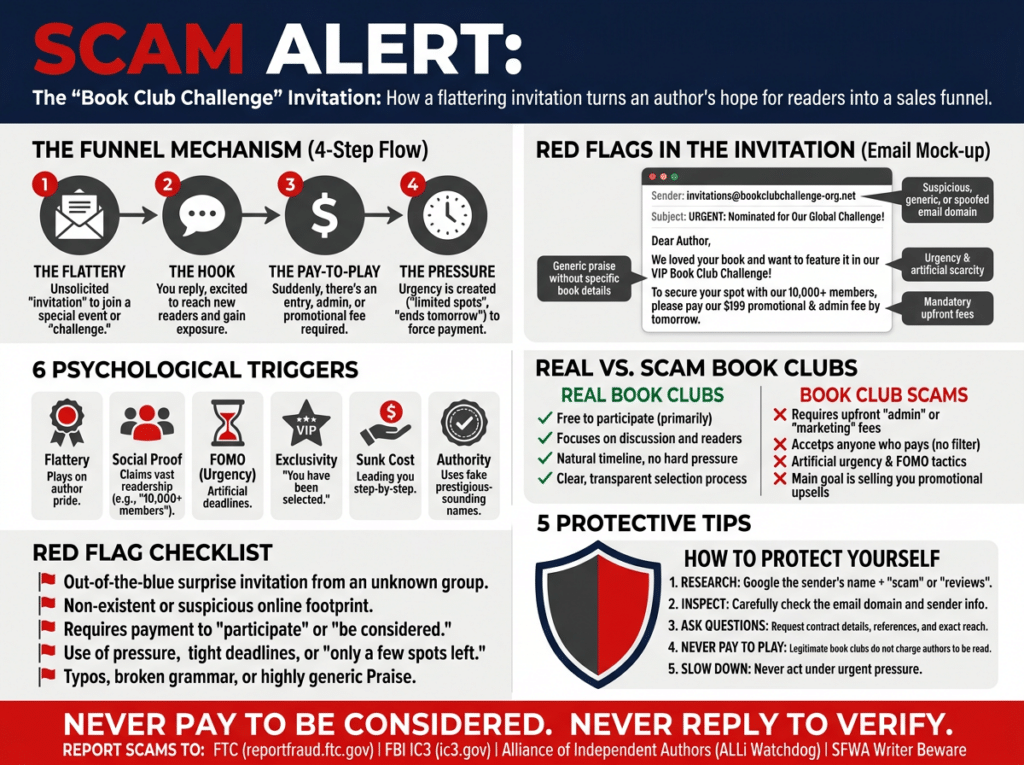
This is a fake book club solicitation, and it works like an advance-fee scam. The first message asks for nothing except a reply. Once you answer, the follow-ups bring in a “spotlight fee,” a “feature package,” a “coordination fee,” or a paid “Reading Challenge tier.” Each one promises access to readers who, as far as anyone can tell, don’t exist. The friendly invitation is only the first step in a sales funnel.
Authors are ideal targets for three reasons. First, they are easy to find. Names, titles, and contact details are public on retailer pages, Goodreads, and author websites. Second, getting noticed is a constant struggle, especially for independent and self-published writers who handle their own marketing. Third, a book club actually reading your book is one of the things authors want most. Scammers know that hope lowers our guard, and they build the offer around it.
Anatomy of the Message: The Scammer’s Tactics
Flattery and exclusivity. The email praises “talented authors” and says you are one of “a small number” of people being invited. It claims Mary “recently learned about your work,” but it never names your book, your genre, or anything you’ve written. Real interest is specific. This praise is generic because the same message has almost certainly gone to thousands of authors.
False authority. Phrases like “I coordinate,” “our community,” “our members,” and “our 2026 Reading Challenge” suggest an established organization with a yearly event. Yet the email includes no website, no social media links, no past reading lists, and no sponsoring library or bookstore. The authority comes entirely from the wording.
A shifting identity. Look closely at the sender. The display name reads “Mary Rowan,” but the email is signed “Mary wan,” with a lowercase surname. The address is marywan.com@gmail.com. Putting “.com” inside a Gmail username makes it look like a website domain at a glance, but it is still a free webmail account that anyone can create in minutes. Three versions of one name in one short email point to a made-up persona. Some versions of this scam go further and borrow the names of real reading challenges or book clubs to look credible.
Delayed urgency. This first email is patient, but the pressure comes later. In documented versions of this scam, the follow-up messages say spots are “filling fast,” the “2026 lineup closes this week,” or that a “special rate” expires soon. Urgency is held back until money is on the table, when the scammer most needs you to act without thinking.
A vague offer and a reply-first hook. The email never says how many members the club has, when or where it meets, which platform it uses, or what participation costs. Leaving those details out is deliberate, because it leaves you nothing to check. The only call to action is “simply reply with the title.” Your reply confirms that your address is active and that you’re interested, and that is what the scammer needs to move to the next stage.
Why the Offer Is Fraudulent or Impossible
Real book clubs don’t work this way. Members choose books by voting, taking turns, following a facilitator’s picks, or using a library’s collection. They don’t send cold emails to strangers asking for submissions. Libraries and bookstores that do host authors make the invitation personal and specific, and they don’t charge the author to take part. In legitimate publishing, money flows toward the author, not away from them.
There is also no way to check that the audience exists. A “community” that lives only in a Gmail account has no member list you can see, no record of past selections, and no public discussion of the books it has read. Whatever the scammer later sells will be described in terms that can’t be measured, such as “visibility,” “exposure,” “promotion to our readers,” or “featured placement.” Because none of it can be checked, the scammer never has to deliver. Even if a handful of real people were paid to read and review your book, paid reviews can break retailer policies and put your account at risk. The offer fails either way: the readers are fake, or the result could hurt you.
The Psychology Behind the Wording
Every line of this short email does a job. The polite closing (“Thank you for your time. I appreciate your consideration”) draws on reciprocity and liking. Courteous people feel rude ignoring a courteous request. The praise of your “work” and of “talented authors” offers validation, which feels especially good to writers who have worked alone for years. Inviting only “a small number of authors” creates scarcity, so the invitation feels like a privilege rather than a pitch.
The most powerful technique is the foot-in-the-door. “Simply reply” is a tiny request. Once you’ve said yes to something small, you’re more likely to say yes to something bigger, because people want to act consistently with what they’ve already done. By the time the fee appears, you’ve picked your titles, pictured readers discussing your book, and traded friendly messages with “Mary.” Paying starts to feel like the obvious next step instead of a new decision. That pull is the sunk-cost effect. The offer to “answer any questions you may have” adds an illusion of transparency, suggesting there’s nothing to hide. Finally, the email’s brevity creates cognitive ease. It’s simple, pleasant, and gives you nothing to question.
How This Scam Fits Broader Industry Patterns
The “Book Club Challenge” belongs to a large family of schemes aimed at authors. Others include fake film and TV adaptation offers, fake literary agents, unsolicited “republishing” deals, bogus book awards, paid book-fair displays, and pay-for-review programs. Many impersonate real publishers, agents, or industry figures. The props change, but the structure stays the same: unsolicited contact, flattery, a vague but valuable-sounding opportunity, a request to reply, a fee, and then a series of “upgrades” to get more money.
Author watchdogs, including Writer Beware, have documented a steady rise in these solicitations, and they are getting more polished. AI-assisted writing tools let scam operations produce clean, natural-sounding messages in volume, which removes the clumsy grammar that once gave them away. Personas rotate constantly. When one name or address gets flagged, another one shows up with nearly the same script. Payment requests often steer authors toward methods that are hard to reverse, such as wire transfers, gift cards, cryptocurrency, or “friends and family” payment transfers.
Red Flags to Watch For
- An unsolicited invitation from a book club, reading challenge, or “readers’ community” you’ve never heard of
- A free webmail address (Gmail, Yahoo, Outlook) instead of an organizational domain
- Names that don’t match between the display name, the email address, and the signature
- Generic praise that never mentions your actual book
- A generic organization name with no website, social media, or past reading lists
- No specifics about membership size, meeting dates, platform, or format
- A request to “reply first” before any details are shared
- Fees that appear only after you engage, labelled as “spotlight,” “feature,” “coordination,” or “tier” charges
- Promised results like “exposure” or “visibility” that can’t be measured
- Sudden deadlines, limited spots, or expiring discounts
- Requests for payment methods that are hard to trace or reverse
How Authors Can Protect Themselves
The best defence is a simple rule: never pay to be considered, and never reply to verify. A real opportunity can stand up to scrutiny before you engage. Build these habits into how you handle your inbox:
- Research before you respond. Search the organization name, the sender’s name, and the email address, each with the word “scam.” Look for a real website, an active social media presence, and past reading lists.
- Check the sender carefully. Compare the display name, address, and signature. Any mismatch is reason enough to stop.
- Ask for proof independently. If a club claims to be connected to a library or bookstore, contact that institution using details you find yourself, not the ones in the email.
- Consult your community. Author groups and watchdog sites can often recognize a script immediately.
- Protect your primary inbox. Consider a separate public contact address and filters for common scam phrases.
- If you’ve already replied, stop engaging and don’t send money or personal information. If you’ve paid, contact your bank, card issuer, or payment provider right away to dispute the charge.
Report It: Help Protect Other Authors
Scams like this depend on silence. Each author who quietly deletes the email is protected, but the next author may not be. Each author who reports it adds to a shared warning system. If you’ve received a “Book Club Challenge” invitation, or any similar message about a reading challenge, readers’ circle, or book club, please report it to AuthorsAgainstScammers.org. Include the sender’s name, email address, subject line, and the full message text. If you replied, include any follow-ups and fee offers you received. Every report helps us track new personas, update our alerts, and warn authors before they pay.
You can also mark the message as spam or phishing in your email program, share the warning with writers’ groups, and, if you lost money, file a report with your national anti-fraud authority, such as the Canadian Anti-Fraud Centre or the U.S. Federal Trade Commission. Your book deserves real readers, and you deserve real opportunities. Stay alert, stay skeptical, and help other authors do the same.
Forensic Analysis:
- Scam Confidence: 90–98% likelihood of a scam. The email matches the documented fake book club scam pattern targeting authors. It comes from a free Gmail address, the sender’s name appears in three different versions, the organization has no public footprint, and it uses a “reply first” hook with no details.
- Threat Type: Advance-fee fraud / fake book marketing services, a subtype of book club impersonation and fake reading challenge scams. The scammer sends a friendly invitation, waits for a reply, then reveals a fee called a “spotlight fee,” “feature package,” “coordination fee,” or paid “Reading Challenge tier.”
- Target Audience:
- Self-published and indie authors
- Traditionally published authors
- Debut and newly published authors who want readers and reviews
- Authors whose contact details are public on Amazon, Goodreads, author websites, and social media
- Key Red Flags:
- Free Gmail address (marywan.com@gmail.com) instead of an organization’s own domain
- Name mismatch: display name “Mary Rowan,” signature “Mary wan”
- Generic group name (“Book Club Challenge”) with no website, social media, or past reading lists
- Generic flattery that never names your book
- Scarcity wording: “a small number of authors”
- Reply-first hook with no details on membership, dates, or platform
- Fees revealed only after you reply, then pressure to pay quickly
- Recommended Actions:
- Don’t reply, even to ask questions or check if it’s real
- Mark it as spam or phishing and block the sender
- Report it to AuthorsAgainstScammers.org, Writer Beware, or scams@authorsguild.org
- Report it to the government: Canada at canada.ca (1-888-495-8501), U.S. at ReportFraud.ftc.gov
- If you paid, contact your bank, card issuer, or PayPal right away
- Don’t share PDFs, manuscripts, or KDP account access
- Related Scams:
- Mocha Girls Read impersonation: a real Meetup book club was impersonated to collect “spotlight fees” (Writer Beware, Sept 2025)
- Paris Anglophone Book Club impersonation: a fake “award” invitation tied to a reported €100 fee (author account, Nov 2025)
- “Central Florida Books & Brews”: a Gmail-based “book club spotlight” solicitation (author account, Oct 2025)
- “Private review communities” and Famous Author impersonation scams (Writer Beware 2025 review)
- Fake book festival invitations, such as those impersonating the Edinburgh International Book Festival (Bitdefender, 2026)
- Sender Details:
- Email:com@gmail.com. The “.com” inside the Gmail username makes it look like a website domain at a glance, but it’s still a free Gmail account.
- Display name: “Mary Rowan”
- Signature: “Mary wan” (lowercase surname)
- Claimed affiliation: “Book Club Challenge” / “2026 Reading Challenge.” No verifiable organization, website, or organizer was found.
- Phone: none provided
- Assessment: three versions of one name in one short email point to a made-up persona.
- Book/Product Targeted: No specific title is named. The email asks the author to “suggest one or two” published books. Not naming a book shows the same message went out in bulk.
- Fake Website: None provided or found. No independent website, Meetup page, or social media presence is linked to this sender. Verification status: no public footprint.
- Reported Losses: Writer Beware reports fees of $55–$350 in book club scams, including tiered “Basic, Essential, Premium” spotlight packages costing $100–$200. Payment is often requested by PayPal Friends & Family or through Upwork invoices. One author reported a €99 No losses are known for this particular email.
- Geographic Focus: Global, mainly English-speaking authors in the U.S., Canada, the U.K., and Australia. Writer Beware traces this scam wave to operators based in Nigeria. This email was received by a Canadian author.
- Additional Context:
- First reported as a fast-growing scam in September 2025.
- AI-written emails make the old warning sign of bad grammar much less reliable.
- Scammers stay persistent and switch to new personas when one gets flagged.
- Real book clubs don’t charge authors to be featured.
- Footnotes/Sources:
- Writer Beware, “Beware Book Club and Book Review Scams” (Sept 19, 2025): https://writerbeware.blog/2025/09/19/return-of-the-nigerian-prince-redux-beware-book-club-and-book-review-scams/
- Writer Beware, “Best of Writer Beware: 2025 in Review”: https://writerbeware.blog/2026/01/16/best-of-writer-beware-2025-in-review/
- Authors Guild, Publishing Scam Alerts: https://authorsguild.org/resource/publishing-scam-alerts/
- Canadian Anti-Fraud Centre, Report Fraud: https://antifraudcentre-centreantifraude.ca/report-signalez-eng.htm
- WritersWeekly, “Book Club Scam Targeting Authors”: https://writersweekly.com/ask-the-expert/book-club-scam-targeting-authors
- Bitdefender, “Author Invitation Scams”: https://www.bitdefender.com/en-us/blog/hotforsecurity/author-scams-fake-invitations-offers

Rae Stonehouse is a Canadian author, publisher, and advocate committed to exposing publishing scams and supporting writers through education and community. As the creator of Authors Against Scammers, Rae provides clear, practical guidance to help writers protect their work, their money, and their peace of mind. His books and resources reflect a lifelong dedication to empowering others through knowledge, clarity, and real‑world experience.