Summary
An unsolicited email from “Matilda Victoria,” claiming to represent a reading community called Online book discussion, invited the author to participate in an “Author Spotlight.” The message used vague praise, a personal Gmail address, and unverifiable organizational details — all common indicators of a promotional scam targeting authors. This case illustrates how scammers use flattery and fabricated book clubs to lure authors into paid promotional schemes.
Scam Type
- Fake Book Club / Author Spotlight Scam
- Vanity Promotion Scam
- AI‑Generated Outreach Scam
- Unsolicited Marketing Scam
Incident Description
Rae A. Stonehouse received an email from matilda091victoria@gmail.com, claiming to be from “Online book discussion,” a supposed reading community focused on personal transformation and self‑development. The sender praised The Personal Transformation Trilogy using generic language and invited the author to participate in an “Author Spotlight.” No website, social media presence, or verifiable organizational information was provided. The email requested confirmation to proceed — a known tactic used to introduce fees only after the author responds.
Evidence / Excerpts
Sender: Matilda Victoria Email: matilda091victoria@gmail.com Subject: Author Spotlight Invitation for The Personal Transformation Trilogy
Excerpt:
“We would be pleased to feature you and The Personal Transformation Trilogy in our upcoming Author Spotlight and introduce your work to our reading community.” “Please confirm your participation so we can proceed with the spotlight.”
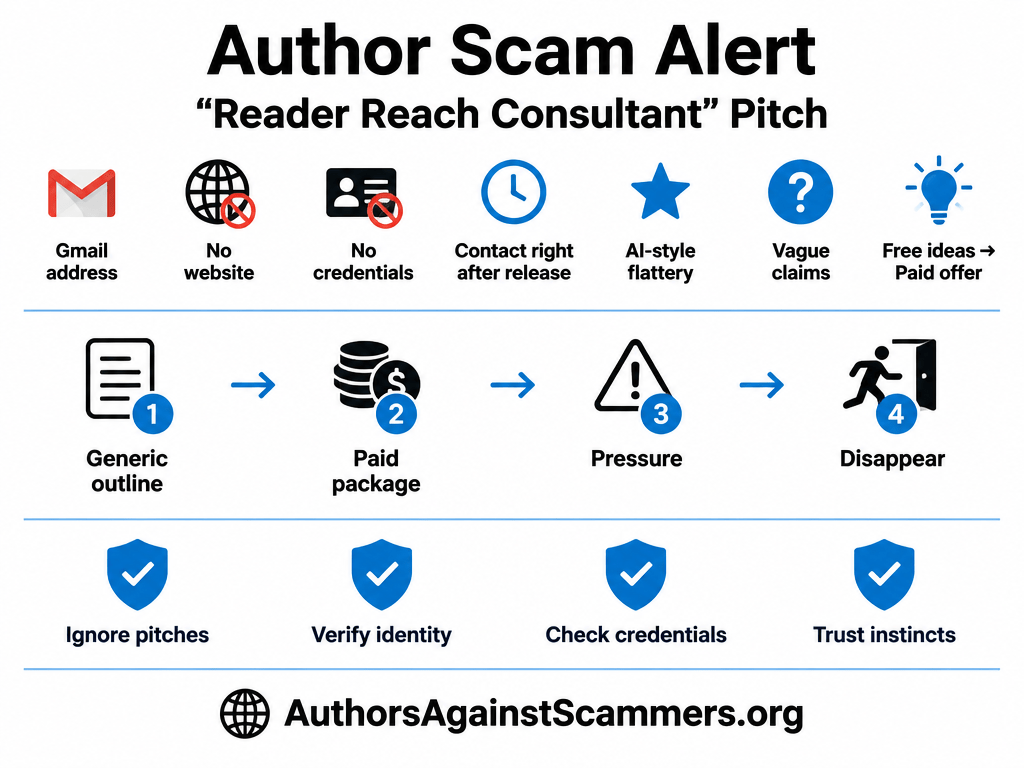
Red Flags
- Free Gmail address instead of an organizational domain
- No website or verifiable presence for “Online book discussion”
- Unsolicited outreach offering promotion
- Generic, AI‑generated praise not specific to the author’s work
- No details about the spotlight, audience size, platform, or process
- Invitation to “confirm participation” — a known precursor to fee requests
- Overly flattering tone designed to lower skepticism
Scammer Method & Tactics
- Uses flattery and thematic language to appear knowledgeable
- Presents a fake book club or reading community
- Avoids providing links or verifiable information
- Waits for the author to respond before revealing fees
- Operates through personal email accounts to avoid traceability
- Leverages AI‑generated personalization to appear legitimate
Risk Level
Medium to High While the initial email does not request money, these scams typically escalate quickly once the author replies. Authors risk financial loss, exposure of personal information, or being added to scammer mailing lists.
Recommended Action for Authors
- Do not respond to unsolicited spotlight or book club invitations.
- Verify organizations independently — never through links provided in the email.
- Avoid any promotional offer that uses a Gmail/Yahoo address.
- Report the message as spam or phishing.
- Maintain a healthy skepticism toward flattery‑based outreach.
- Share examples with other authors to raise awareness.
Status (Active / Resolved)
Active This scam pattern is ongoing and continues to target authors across genres.
Update: A second unsolicited email from “Matilda Victoria” at Online book discussion was sent to Rae A. Stonehouse, using the same template as a previous scam attempt. The sender swapped in a different book title and a new set of thematic buzzwords but retained identical structure, tone, and red flags. This repetition confirms a mass‑targeting promotional scam that uses AI‑generated personalization to lure authors into paid “spotlight” schemes.
Source: https://authorsagainstscammers.org/2026/09/12/the-reader-reach-consultant-pitch/
Forensic Scam Profile
Scam Confidence
90-95% likelihood. High-confidence assessment based on personal Gmail address, completely unsolicited outreach, vague AI-generated praise with no specific book details, total lack of verifiable organization/website/social media, and exact match to the documented author spotlight scam pattern where an initially “free” invitation leads to $50–$300 fees only after the author replies.
Threat Type
Fake Book Club / Author Spotlight Scam (primary category: Author Targeting Promotional Scam / Fake Marketing Offer). Uses flattery and fabricated reading communities to extract “spotlight fees,” participation fees, or upsells after initial contact.
Target Audience
Self-published and indie authors, especially those writing self-help, personal transformation, mindset, and nonfiction books who actively seek visibility and book-club features.
Key Red Flags
1. Free Gmail address (matilda091victoria@gmail.com) instead of official organizational domain. 2. Completely unsolicited cold email. 3. Generic, thematic praise (“broader exploration of meaningful personal change”) with zero specific content knowledge (classic AI-generated text). 4. Zero links, website, social media, or past spotlight examples for “Online book discussion.” 5. Invitation framed as free with only a confirmation request (fees appear later). 6. Exact match to Writer Beware-documented Author Spotlight pattern. 7. Overly friendly, trust-building tone designed to lower defenses.
Recommended Actions
1. Do not reply or engage with the sender. 2. Block the email and mark as spam/phishing in your provider. 3. Independently Google “Online book discussion Matilda Victoria” (expect zero legitimate results). 4. Never pay any spotlight, participation, honorarium, or promotion fee. 5. Report the message to your email provider and file at reportfraud.ftc.gov. 6. Share the alert with author communities (Writer Beware, Authors Guild, AuthorsAgainstScammers.org) to warn others.
Related Scams
• Book Club Impersonation / Spotlight Fee Scams (Writer Beware, 2025). • Fake Author Marketing & PR Offers (Authors Guild alerts). • AI-generated Impersonation of Book Clubs or Famous Authors (NYT, InsideHook). • Vanity Press / Pay-to-Publish schemes (FTC consumer warnings). • Nigerian-origin promotional scams targeting writers with Gmail accounts.
Sender Details
Email: matilda091victoria@gmail.com (personal Gmail with numeric suffix typical of mass-created scam accounts). Signature/Affiliation: Matilda Victoria, Organizer, Online book discussion. Analysis: No official domain, no verifiable organization, no digital footprint whatsoever. Classic indicator of fabricated reading-community scams originating from Nigeria or AI-assisted operations.
Additional Context
Specifically targeted The Personal Transformation Trilogy by Rae A. Stonehouse. Part of a large-scale AI-assisted promotional scam wave hitting authors across genres. Typical escalation after reply: $50–$300 “spotlight fee,” requests for unpublished files, or upsells of fake promotion packages. Delivery is either nonexistent or low-value bot-generated content. No actual book club or spotlight exists.
Book/Product Targeted
The Personal Transformation Trilogy by Rae A. Stonehouse (self-help / personal development / mindset genre).
Reported Losses
Typical range $50–$300 per victim (Writer Beware documented cases); no specific loss amount recorded for this exact Matilda Victoria incident. Fees requested only after author engagement.
Geographic Focus
Global (high volume targeting English-speaking self-published authors in the US, Canada, UK, Australia, and elsewhere).
Footnotes / Sources
1. Writer Beware: “Return of the Nigerian Prince Redux: Beware Book Club and Book Review Scams” (Sep 2025) https://writerbeware.blog/2025/09/19/return-of-the-nigerian-prince-redux-beware-book-club-and-book-review-scams/ 2. The Authors Guild: “Alert: Rise in Email Scams Targeting Authors” (Feb 2026) https://authorsguild.org/bulletin/rise-in-email-scams-targeting-authors/ 3. The New York Times: “Writers Are Being Targeted by Scams” (Feb 2026) https://www.nytimes.com/2026/02/25/books/review/publishing-scams.html 4. Build Book Buzz: “Author marketing scams v. 2026” https://buildbookbuzz.com/author-marketing-scams-v-2026/ 5. InsideHook: “AI Scammers Are Now Using Book Clubs To Target Authors” (Oct 2025) https://www.insidehook.com/books/ai-scammers-book-clubs-target-authors 6. FTC ReportFraud.ftc.gov (official consumer fraud reporting portal)
Rae Stonehouse is a Canadian author, publisher, and advocate committed to exposing publishing scams and supporting writers through education and community. As the creator of Authors Against Scammers, Rae provides clear, practical guidance to help writers protect their work, their money, and their peace of mind. His books and resources reflect a lifelong dedication to empowering others through knowledge, clarity, and real‑world experience.