
Imagine receiving a frantic call from your child’s voice, crying that they’ve been in a terrible accident and need money immediately. Your heart races, your hands shake, and you’re ready to do anything to help. There’s just one problem: your child is safe at home, and the voice you heard was an AI-generated fake.
This nightmare scenario is becoming alarmingly common. Cloned voice scams represent one of the fastest-growing forms of fraud in Canada, the United States, and worldwide, with losses climbing into the millions and complaint rates skyrocketing by 350% in just two years.
What Are Cloned Voice Scams?
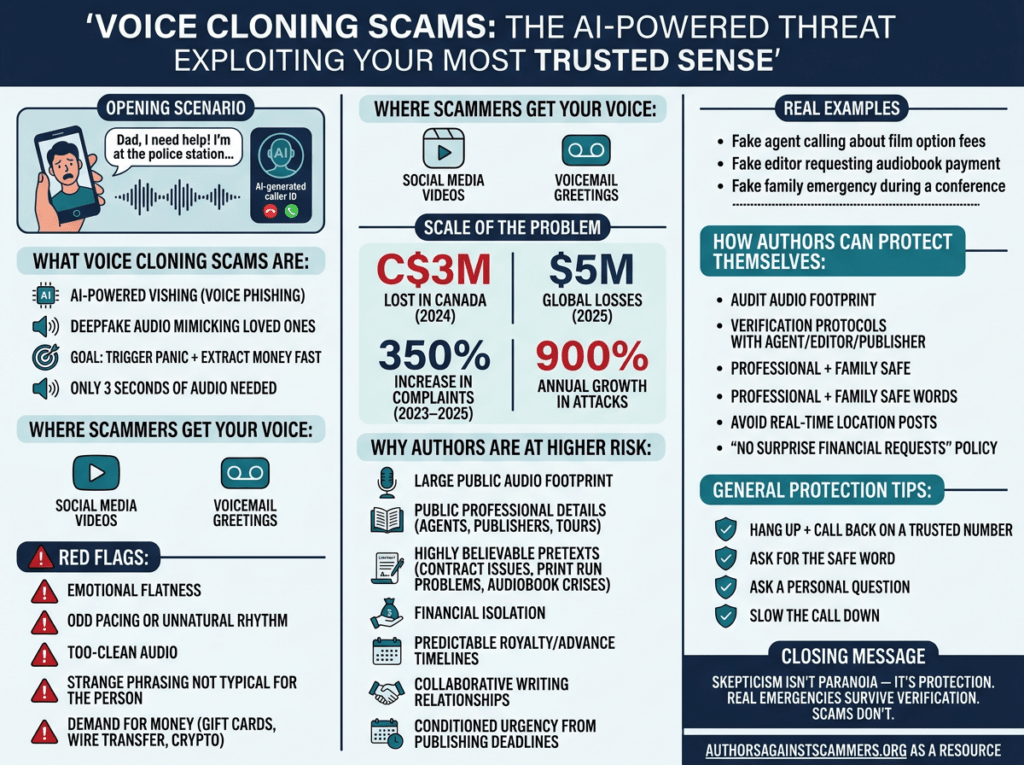
Voice cloning scams are a sophisticated form of AI-powered vishing (voice phishing) where criminals use deepfake audio technology to impersonate someone you know and trust. The goal is always the same: trigger panic, bypass your critical thinking, and extract money quickly before you have time to verify what’s happening.
The technology behind these scams is disturbingly accessible. Scammers need just three seconds of audio to clone someone’s tone, accent, and speech patterns with frightening accuracy. They often combine the cloned voice with spoofed caller ID technology, making calls appear to come from hospitals, police stations, or your family member’s actual phone number.
Where Scammers Find Your Voice
Most victims never realize their voice was publicly accessible until it’s too late. Scammers harvest audio samples from surprisingly ordinary sources:
- Social media videos on TikTok, Instagram, and Facebook
- Voicemail greetings on your phone
- Podcast appearances and interviews
- Public group voice messages
- Video calls and online meetings
If you’ve ever posted a video of yourself speaking, recorded a voicemail greeting, or appeared in any public audio content, you’ve potentially provided scammers with everything they need. Just three seconds is enough for AI tools to analyze and replicate your unique vocal characteristics.
The Anatomy of a Voice Cloning Attack
Across Canada and globally, these scams follow a disturbingly consistent pattern. Understanding the script can help you recognize it when it happens:
The call comes from an unknown or spoofed number. When you answer, you hear a panicked voice that sounds exactly like your child, spouse, parent, or close friend. They claim there’s been an accident, an arrest, a kidnapping, or some other emergency requiring immediate action.
Within moments, a second voice takes over—someone claiming to be a police officer, lawyer, doctor, or other authority figure. They provide just enough details to sound legitimate while keeping you emotionally overwhelmed. You’re told not to hang up or call anyone else to verify the story.
Then comes the demand: immediate payment via gift cards, wire transfer, or cryptocurrency. This “pressure window” is carefully designed to keep you in a state of panic, preventing the rational thinking that would expose the scam.
Red Flags: How to Spot a Cloned Voice
Even high-quality voice clones aren’t perfect. They leave subtle clues that can help you identify a scam:
Emotional flatness: AI struggles to authentically replicate real panic, strain, or distress. The voice might sound like your loved one, but the emotional texture often feels slightly off.
Unnatural pacing: Cloned voices frequently have odd pauses, strange rhythm, or awkward phrasing that doesn’t match how the person normally speaks.
Studio-clean audio: Real emergency calls from phones have background noise and breath sounds. Cloned voices often have unnaturally clean silence between words.
Language inconsistencies: The voice might use words, phrases, or expressions your loved one would never say.
One inconsistency might be easy to dismiss, but several together should raise immediate red flags.
The Staggering Scale of the Problem
This isn’t a theoretical threat or a rare occurrence. The numbers paint a disturbing picture:
- Canadians lost nearly C$3 million to family emergency voice cloning scams in 2024 alone
- Global losses exceeded $5 million in 2025 for distress call scams specifically
- Complaints to the FBI’s Internet Crime Complaint Center (IC3) jumped 350% between 2023 and 2025
- Industry data shows a 900% annual growth rate in voice clone attacks
This is no longer a niche or emerging threat. Voice cloning has become mainstream fraud, and the problem is accelerating rapidly as AI tools become more accessible and sophisticated.
Why Authors and Creative Professionals Face Heightened Risk
The creative community faces a perfect storm of vulnerabilities when it comes to voice cloning scams. If you’re an author, understanding these unique risks could save you from becoming the next victim.
You’ve created an extensive audio footprint. Authors actively build their platforms through book readings, podcast interviews, author talks, book launch videos, social media content, and virtual events. Every time you read a passage from your book on Instagram, appear on a literary podcast, or share a behind-the-scenes writing video, you’re providing scammers with high-quality voice samples. Unlike most people who might have a few scattered social media videos, authors often have hours of professionally recorded audio readily available online.
Your public information makes you a strategic target. Authors maintain detailed online profiles listing their publishing house, literary agent, editor contacts, upcoming book tours, and conference appearances. Scammers can research your professional relationships and create highly convincing scenarios. They know who your agent is, which publishing house you work with, and when you might be traveling for book events—all information that adds authenticity to their schemes.
The pretexts are uniquely believable. Consider these scenarios specifically crafted for authors:
A call from your “agent’s” voice claiming there’s an urgent contract issue that needs immediate payment to resolve, or you’ll lose the book deal. The voice sounds exactly right, and they reference specific details from your actual contract negotiations.
Your “publisher” calls saying there’s been a critical problem with your book’s print run, and you need to wire money immediately to cover unexpected costs or miss your release date. They use industry terminology and reference your actual book title and release schedule.
A cloned voice of your “child” or “spouse” calls while you’re at a writing conference or book signing, claiming an emergency back home. The scammers know exactly where you are because you posted about the event on social media.
Your “editor” contacts you with an “urgent” request to verify banking information for your royalty payments, but they need it within the hour, or the payment will be delayed for months.
Authors often work in financial isolation. Many authors are self-employed or work from home, managing their own finances without the built-in verification systems of a traditional workplace. You don’t have a colleague to check with before wiring money, and you’re accustomed to handling urgent business decisions independently. This isolation makes you more vulnerable to pressure tactics.
Book advances and royalty payments create known financial windows. When an author receives a book advance or royalty payment, it’s often publicly celebrated or at least predictable based on contract timelines and release dates. Scammers can time their attacks to coincide with periods when they know you have access to significant funds.
The writing community’s collaborative nature can be exploited. Authors regularly collaborate with other writers, participate in writing groups, and maintain relationships with beta readers and sensitivity readers. A cloned voice claiming to be a writing partner with an emergency becomes particularly convincing because these collaborative relationships are normal in your professional life.
You’re conditioned to respond quickly to publishing deadlines. The publishing industry runs on tight deadlines and urgent requests. Authors are trained to respond quickly when their agent, editor, or publisher reaches out with time-sensitive matters. Scammers exploit this conditioned urgency response, knowing that authors are accustomed to dropping everything when publishing professionals need something immediately.
Your emotional investment in your work makes you vulnerable. A scammer using your publisher’s cloned voice to claim your book release is at risk taps into deep fears about your creative work being jeopardized. The emotional manipulation becomes even more powerful when it targets something you’ve poured your heart into.
Real Scenarios Targeting Authors
These aren’t hypothetical concerns. Authors have reported variations of these scams:
An author received a call from her “agent’s” voice claiming that a film option for her book was falling through unless she could immediately cover unexpected legal fees. The scammer had researched her recent movie deal announcement and crafted a scenario that felt devastatingly real.
Another author was contacted by someone using his “editor’s” voice, claiming there was a crisis with the audiobook production that required immediate payment to the narrator. The author had recently announced his audiobook release, giving the scammer perfect timing and context.
A writer attending a conference received an “emergency call” from her “daughter,” asking for money while the author was away from home. The scammers knew her exact location from her public conference schedule and social media posts.
How Authors Can Protect Themselves
Beyond the standard protective measures, authors should take additional steps:
Audit your audio footprint. Review your social media presence and consider making some videos private. While you need to maintain your author platform, evaluate which content must be public versus what could be shared only with close followers or newsletter subscribers.
Establish verification protocols with your professional team. Talk with your agent, editor, and publisher about creating specific verification methods for urgent financial requests. Agree that all financial matters will be confirmed through multiple channels before any action is taken.
Create separate safe words for professional and personal contacts. Establish one code phrase with your publishing team and a different one with your family. This way, you can verify the authenticity of calls from either sphere of your life.
Be cautious about what you share on social media. When posting about book events, conferences, or travel, consider sharing after the fact rather than announcing your exact location in real-time. This prevents scammers from exploiting your known absences.
Educate your family about your public profile. Make sure your loved ones understand that scammers might use details from your public author presence to add credibility to emergency calls. Your family should also know to verify any urgent requests using your established safe word.
Implement a “no surprise financial requests” policy. Establish with your professional team that you never respond to urgent financial requests without independent verification, regardless of how they’re communicated. Make it standard practice to hang up and call back on known numbers for any money-related discussions.
How to Protect Yourself and Your Family
Security experts consistently recommend four core defenses against voice cloning scams:
Hang up and call back on a trusted number. This single action defeats approximately 95% of cloned voice scams. No matter how convincing the voice sounds or how urgent the situation seems, end the call and contact the person directly using a number you know is legitimate.
Establish a family safe word. Create a private code phrase that no one posts online and that only your inner circle knows. If someone calls claiming to be in trouble, ask for the safe word. If they can’t provide it, you’re dealing with a scammer.
Ask a personal question only the real person would know. Scammers and AI models rarely know small family details, inside jokes, or specific memories. A question about something only your loved one would remember can instantly expose the fraud.
Slow the call down. Real emergencies can wait three minutes while you verify information. Scammers insist you act within 30 seconds because delay gives you time to think critically. If someone is pressuring you to act immediately without verification, that pressure itself is a warning sign.
Why These Scams Are So Effective
The psychological power of voice cloning scams lies in how they exploit fundamental human biology. We’re evolutionarily wired to trust familiar voices, especially those of people we love or work closely with. When you hear your child crying, your agent sounding stressed, or your editor expressing urgency, your brain automatically fills in gaps and suppresses doubt—even when the audio is artificial.
Scammers aren’t targeting your logic; they’re exploiting your emotional wiring. The combination of a trusted voice, an emergency scenario, and time pressure creates a perfect storm that bypasses rational thought. Under stress, our brains default to protective instincts rather than skeptical analysis. For authors, this effect is amplified when the emergency involves both your creative work and your livelihood.
Taking Action: Report and Recover
If you’ve been targeted by a voice cloning scam, taking immediate action can help protect others and potentially recover lost funds:
Report the incident to the Federal Trade Commission at ReportFraud.ftc.gov and file a complaint with the FBI’s IC3 at ic3.gov. Contact your bank immediately if you’ve sent money, as quick action sometimes allows transactions to be reversed.
Share your experience with your writing community, agent, publisher, and fellow authors. Many people remain unaware of voice cloning scams, and your story could prevent someone else from falling victim. Consider discussing it with organizations like Authors Against Scammers, which work to protect writers from fraud.
The Bottom Line
Voice cloning technology is advancing rapidly, becoming more accessible and more convincing every month. But awareness and simple verification habits remain your best defenses. For authors, understanding how your public presence creates additional vulnerabilities is the first step toward protection.
The next time you receive an urgent call from your agent, editor, publisher, or a family member, remember: real emergencies can survive a three-minute verification delay, but scams cannot. Real publishing professionals will understand if you need to call them back on a known number. Real family members will wait while you verify their identity.
If a call feels off—even if the voice sounds perfect, even if they reference specific details about your books or contracts—trust your instincts and verify. Hang up. Call back on a known number. Ask for the safe word. Slow down. These simple actions stand between scammers and their next victim.
In a world where your voice can be stolen from a three-second book reading clip, and where your public author profile provides scammers with a detailed playbook, skepticism isn’t paranoia—it’s protection. Your creative work is valuable, your platform is essential, but your safety comes first.

Rae Stonehouse is a Canadian author, publisher, and advocate committed to exposing publishing scams and supporting writers through education and community. As the creator of Authors Against Scammers, Rae provides clear, practical guidance to help writers protect their work, their money, and their peace of mind. His books and resources reflect a lifelong dedication to empowering others through knowledge, clarity, and real‑world experience.