How Scammers Use Fake Prize Winnings to Drain Victims Financially
The Publishers Clearing House (PCH) brand has been around for decades, famous for its Prize Patrol, oversized checks, and surprise home visits. That long‑standing reputation is exactly why scammers love impersonating it. They know the name feels familiar, trustworthy, and nostalgic — and they weaponize that trust to steal money from unsuspecting victims.
This Scam Watch report breaks down how PCH impersonation scams work, why they’re so effective, and how you can protect yourself and your loved ones.
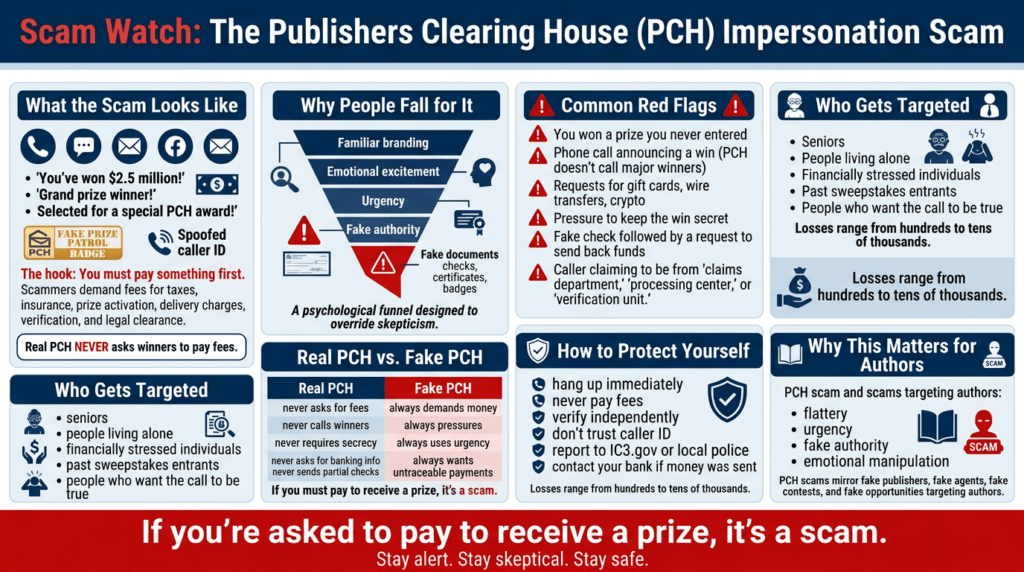
What the Scam Looks Like
Victims are contacted by phone, text message, email, social media, or even physical mail. The scammer claims:
- “You’ve won $2.5 million!”
- “You’re the grand prize winner!”
- “You’ve been selected for a special PCH award!”
They often impersonate the Prize Patrol, use official‑looking logos, or send fake documents to “prove” the win. Some even spoof caller ID so it appears the call is coming from PCH headquarters.
The hook always comes next: You must pay something first.
Scammers demand upfront fees for:
- Taxes
- Insurance
- Prize activation
- Delivery charges
- “Verification”
- “Legal clearance”
This is the moment the scam reveals itself. Real PCH never asks winners to pay anything to receive a prize.
Why People Fall for It
PCH scams work because they combine:
- Familiar branding — people recognize the name.
- Emotional excitement — the idea of winning a life‑changing prize.
- Urgency — “You must act now or lose the prize.”
- Authority — scammers speak confidently and use official‑sounding titles.
- Fake documentation — checks, letters, badges, certificates.
It’s not one big lie — it’s a psychological funnel designed to override skepticism step by step.
Common Red Flags
If you encounter any of these, it’s a scam:
- You’re told you won a prize you never entered.
- You receive a phone call about winning — PCH does not call major winners.
- You’re asked to pay fees via gift cards, wire transfer, crypto, or payment apps.
- You’re pressured to keep the win secret.
- You’re sent a check and told to deposit it, then send back part of the funds.
- The caller claims to be from the “claims department,” “processing center,” or “verification unit.”
Scammers rely on speed — they want you excited, not thinking.
Who Gets Targeted
While anyone can be targeted, scammers often focus on:
- Seniors
- People living alone
- Individuals under financial stress
- Anyone who has previously entered sweepstakes
- People who simply want the call to be true
Victims have lost anywhere from hundreds to tens of thousands of dollars
Real PCH vs. Fake PCH
Real PCH:
- Never asks winners to pay fees
- Never calls to announce major prizes
- Never requires secrecy
- Never asks for banking information
- Never sends partial checks and asks for money back
Fake PCH:
- Always demands money
- Always pressures you
- Always uses urgency
- Always wants untraceable payments
If someone says you’ve won but you must pay first, the conversation is over — it’s a scam.
How to Protect Yourself
- Hang up immediately if someone claims you’ve won unexpectedly.
- Never pay any fee to receive a prize — ever.
- Verify independently using official PCH contact information.
- Do not trust caller ID — numbers can be spoofed.
- Report the scam to IC3.gov, your local police, or consumer protection agencies.
If you’ve already sent money, contact your bank right away.
Why This Matters for Authors
Authors are often targeted by scammers who use:
- Flattery
- Urgency
- Fake authority
- Emotional manipulation
PCH scams follow the same psychological pattern as fake publishers, fake agents, fake contests,
and fake “opportunities” in the writing world. Understanding these tactics helps authors spot fraud in any form.
Final Thoughts
PCH impersonation scams are widespread, persistent, and highly convincing — but they all rely on one fatal flaw: the demand for money. If you’re ever asked to pay to receive a prize, you’re not dealing with Publishers Clearing House. You’re dealing with a scammer.
Stay alert, stay skeptical, and stay safe.

Rae Stonehouse is a Canadian author, publisher, and advocate committed to exposing publishing scams and supporting writers through education and community. As the creator of Authors Against Scammers, Rae provides clear, practical guidance to help writers protect their work, their money, and their peace of mind. His books and resources reflect a lifelong dedication to empowering others through knowledge, clarity, and real‑world experience.