Why “prestige” you have to pay for is no prestige at all
The rise of self‑publishing has empowered millions of writers—but it has also created a booming market for scammers who prey on authors’ desire for recognition. One of the most persistent schemes is the vanity award scam, also known as pay‑to‑play awards or awards‑profiteer programs. These operations don’t exist to honor books. They exist to sell the appearance of prestige.
Below is a comprehensive breakdown of how these scams work, why they’re so convincing, and how to protect yourself.
What Vanity Award Scams Are
A vanity award scam is any “contest” or “literary award” where the real business model is selling fees, badges, trophies, or publicity—not recognizing literary merit.
They target:
- Self‑published authors
- First‑time authors
- Writers hungry for credibility, validation, or marketing leverage
The pitch is simple: “Congratulations—you’ve been selected!” But the truth is simpler: you’re being sold a product, not receiving an honor.
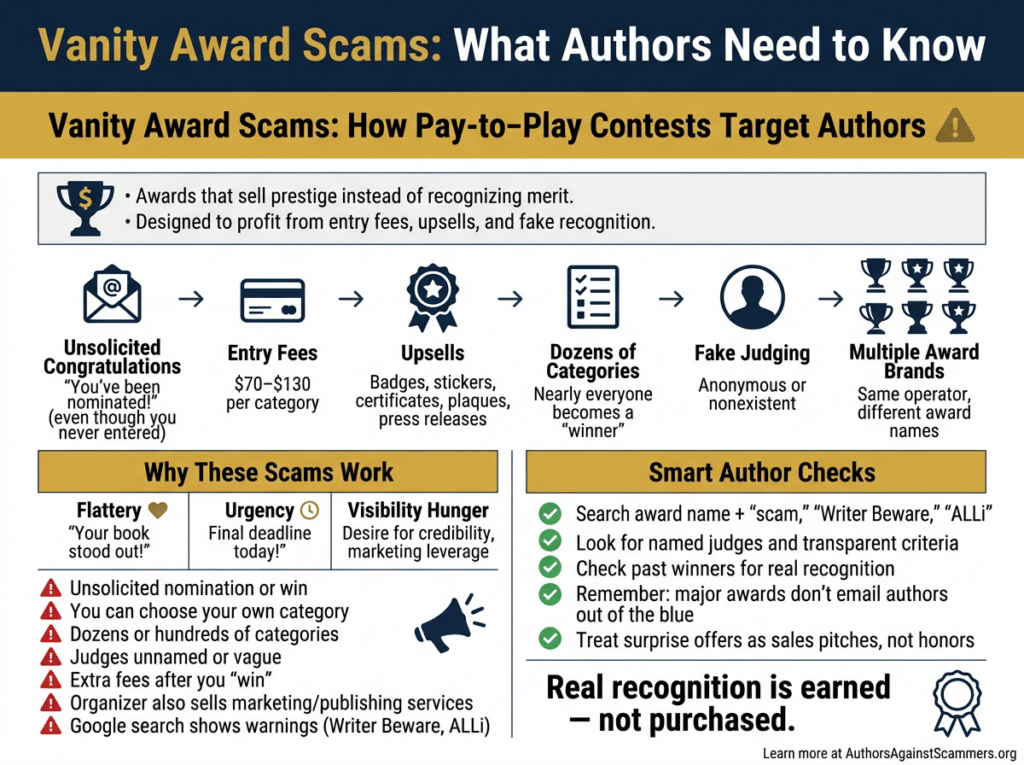
How These Schemes Typically Work
Vanity award scams follow a predictable pattern:
- Unsolicited praise
You receive an email announcing you’ve been nominated, selected, or even won—despite never entering anything. These messages are flattering, urgent, and professionally designed.
- Entry fees and upsells
Once you take the bait, you’re asked to pay:
- Entry fees (usually $70–$130 per book or category)
- Add‑ons like badges, stickers, certificates, plaques, press releases, or “winner packages”
- Website listings or “spotlight features”
Some programs even charge extra to claim your award after you “win.”
- Dozens or hundreds of categories
To maximize revenue, scammers create ultra‑broad categories:
- “Best Inspirational Fiction – Short Form”
- “Best Children’s Book – Animals”
- “Best Book Cover – Colorful”
With enough categories, almost everyone becomes a finalist or winner.
- Fake or nonexistent judging
Judging is typically:
- Anonymous
- Vague
- Unqualified
- Or entirely nonexistent
Many operators never read the books at all.
- Multiple award brands under one owner
Some scammers run entire networks of “award programs” under slightly different names. Industry watchdogs frequently flag programs associated with American Book Fest (International Book Awards, Best Book Awards, Bookvana Awards, etc.) for their high‑volume, high‑category, fee‑driven model.
Not every fee‑charging contest is a scam—but the high‑volume, everyone‑wins model is designed to extract money from authors chasing validation.
Why Authors Fall for These Scams
Vanity award scams exploit three powerful psychological levers:
Affirmation
New authors crave recognition. A “win” feels like proof their work matters.
Urgency
Emails often include countdowns or “final deadlines” to push quick decisions.
Visibility hunger
Authors hope an award will help with:
- Sales
- Reviews
- Media attention
- Speaking opportunities
But in reality, these awards rarely move the needle with readers, bookstores, or legitimate media. The money is almost always better spent on editing, cover design, or targeted advertising.
Red Flags to Watch For
If you see any of these, you’re likely dealing with a vanity award scam:
- You received an unsolicited nomination or win
- You can choose or customize your own category
- Dozens or hundreds of categories exist
- Almost everyone who enters “wins”
- Judges are unnamed or described only as “experts”
- Extra fees appear after you “win”
- The organizer also sells publishing, marketing, or anthology services
- Google “[Award Name] + scam” or “Writer Beware” and find warnings
If it feels like a sales pitch disguised as an honor—it is.
How to Protect Yourself
Before paying for any award, do a quick verification:
- Search the award name
Add keywords like:
- “scam”
- “Writer Beware”
- “ALLi”
The Alliance of Independent Authors (ALLi) maintains a watchdog database rating contests, services, and publishers. Writer Beware (run by SFWA) tracks scams and questionable practices across the industry.
- Check for transparency
Legitimate awards have:
- Named judges with real credentials
- Clear criteria
- A limited number of winners
- A track record of past winners who gained real recognition
- Know which awards matter
Major awards—Pulitzer, Booker, National Book Award, major genre awards—are not open to self‑entry. They don’t email authors out of the blue. They don’t charge winners for badges.
- Default to skepticism
If an offer arrives out of nowhere promising prestige for a fee, treat it as a sales pitch, not an honor. The safest response is to ignore it.
Bottom Line
Vanity award scams thrive because they look legitimate and feel flattering. But the “award” they’re selling is meaningless—designed to profit from authors’ hopes, not celebrate their achievements.
Real recognition is earned, not purchased.
If you’ve been targeted by a suspicious award program, share your experience at AuthorsAgainstScammers.org. Your story may help another writer avoid the same trap.

Rae Stonehouse is a Canadian author, publisher, and advocate committed to exposing publishing scams and supporting writers through education and community. As the creator of Authors Against Scammers, Rae provides clear, practical guidance to help writers protect their work, their money, and their peace of mind. His books and resources reflect a lifelong dedication to empowering others through knowledge, clarity, and real‑world experience.