Overview
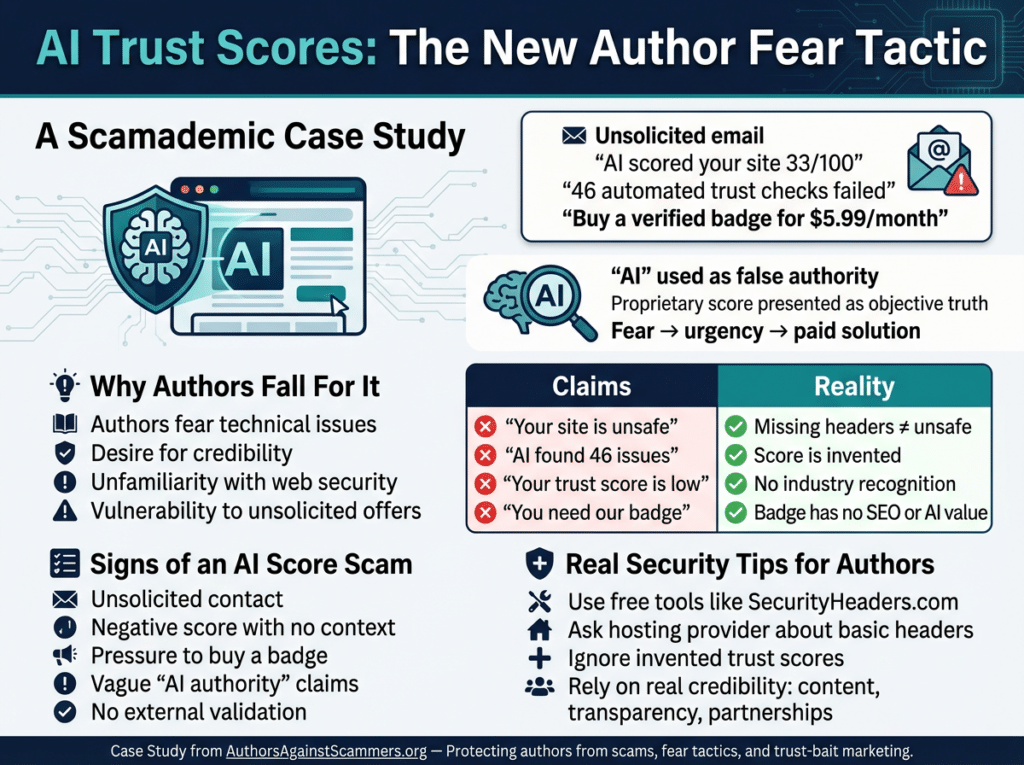
In September 2026, an unsolicited email arrived claiming that “AI” had evaluated AuthorsAgainstScammers.org and assigned it a 33/100 trust score. The message warned that the site failed “46 automated checks,” and encouraged the recipient to purchase a monthly AI‑verified badge to improve credibility.
This case study examines the tactics used in this pitch, why it targets authors and small creators, and how to evaluate similar “AI trust score” offers.
- The Initial Contact
The email arrived without prior interaction, using a subject line engineered to provoke concern:
“How AI sees authorsagainstscammers.org: 33/100.”
The body of the message followed a familiar pattern:
- A negative score designed to trigger anxiety
- A list of technical-sounding failures
- A paid solution (a $5.99/month badge)
- A claim of AI authority (“AI performed 46 trust checks”)
This structure mirrors the same psychological funnel used by many author‑targeted scams: create fear → present problem → sell solution.
- The Claims
The email listed three missing security headers:
- Content-Security-Policy
- X-Frame-Options
- X-Content-Type-Options
These are legitimate web security headers — but their absence does not mean a site is untrustworthy, unsafe, or at risk. Many small websites operate without them, and their presence or absence has no connection to author credibility, book marketing, or scam prevention.
The email’s framing suggests urgency and reputational harm, but provides no evidence that:
- search engines use their score
- AI systems rely on their badge
- authors or readers judge sites by these metrics
- failing these checks creates any real‑world risk
The “AI trust score” is a proprietary metric, not an industry standard.
- Why This Targets Authors
Authors — especially self‑published ones — are routinely targeted with:
- “Your book has errors — pay us to fix it.”
- “Your Amazon listing is broken — pay us to repair it.”
- “Your metadata is wrong — pay us to optimize it.”
- “Your website is unsafe — pay us to secure it.”
This email is the AI‑era version of the same tactic.
It leverages:
- fear of technical issues
- insecurity about online presence
- lack of familiarity with web security
- desire to appear credible
The pitch is designed to make authors feel they must purchase a badge to appear trustworthy — even though the badge has no recognized value.
- The Tactic: AI Authority Laundering
This case introduces a new Scamademic concept:
AI Authority Laundering
Using “AI” as a veneer of legitimacy to sell something that isn’t actually authoritative.
The email uses phrases like:
- “AI trust profile”
- “AI performed 46 checks”
- “AI sees your site as 33/100”
None of these claims have external validation. They are invented metrics presented as objective truth.
This is not illegal — but it is manipulative marketing.
- Is This a Scam?
This is not an outright scam. It does not:
- steal money
- impersonate a known organization
- make fraudulent claims
- threaten legal consequences
However, it does use:
- fear‑based persuasion
- misleading framing
- invented authority
- upsell pressure
This places it squarely in the gray zone of trust‑bait tactics that authors should learn to recognize.
- How Authors Can Evaluate These Offers
Red Flags
- Unsolicited contact
- Negative score with no context
- Vague claims of “AI authority”
- Pressure to buy a badge
- No industry recognition
- No clear explanation of how the score is calculated
Safe Questions to Ask
- Is this metric recognized by any professional body?
- Does this badge improve SEO, indexing, or ranking?
- Does any major AI system use this score?
- Can I verify these claims independently?
- What happens if I ignore this message?
If the answer to most of these is “no,” it’s marketing — not a security risk.
- What Authors Should Do Instead
Authors can:
- use free tools like SecurityHeaders.com to check their site
- ask their hosting provider about basic security headers
- avoid paying for badges that have no recognized value
- rely on established credibility signals:
- transparency
- consistent content
- community trust
- partnerships with reputable organizations
A paid badge from a small AI startup does not meaningfully improve trust.
Conclusion
This case illustrates a growing trend: AI‑themed trust‑bait marketing aimed at authors and small creators. While not fraudulent, it uses the same psychological levers as many author scams — fear, urgency, and invented authority — to sell a product of questionable value.
Understanding these tactics helps authors stay confident, informed, and protected in an increasingly AI‑driven digital landscape.

Rae Stonehouse is a Canadian author, publisher, and advocate committed to exposing publishing scams and supporting writers through education and community. As the creator of Authors Against Scammers, Rae provides clear, practical guidance to help writers protect their work, their money, and their peace of mind. His books and resources reflect a lifelong dedication to empowering others through knowledge, clarity, and real‑world experience.