Social media has always been a fertile hunting ground for scammers, but in 2026 the landscape has shifted dramatically. With AI tools now capable of generating polished, emotionally intelligent dialogue, scammers no longer rely on clumsy scripts or broken English. They can impersonate real authors, agents, editors, and publishers with frightening accuracy — and they’re doing it at scale.
Last week, I encountered yet another example of this growing trend: a Twitter/X account impersonating Pulitzer Prize–winning author Marilynne Robinson.
The Setup
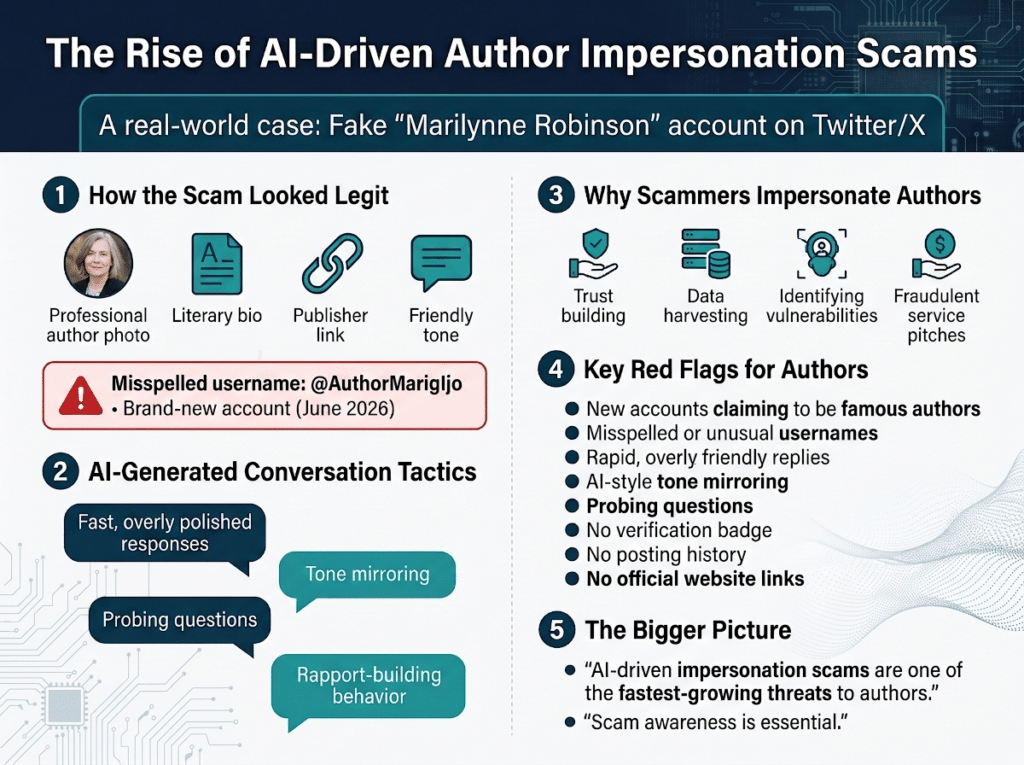
The account looked legitimate at first glance:
- Professional author photo
- Literary bio
- Link to a publisher page
- Warm, friendly tone
But the handle was wrong: @AuthorMarigIjo — a misspelled, lookalike username. The account was also brand new, created in June 2026. That alone should have been enough to raise suspicion.
The Conversation
The impersonator opened with a casual, AI‑style greeting:
“Hey Rae, thanks for the follow back! By the way, I’m author Marilynne Robinson…”
Within minutes, they were asking about my writing, my projects, and my scam‑prevention work. The responses were fast — too fast — and polished in a way that felt algorithmic. They mirrored my tone, praised my work, and asked probing questions designed to build rapport.
This is exactly how modern AI‑assisted scam accounts operate.
Why This Matters
Scammers have learned that impersonating real authors gives them instant credibility. They use stolen photos, scraped bios, and AI‑generated dialogue to:
- Build trust
- Gather personal information
- Identify vulnerabilities
- Eventually pitch fraudulent services
This impersonator followed the same pattern I documented in The Nancy Catherine Scammer Playbook Exposed and Scamademic. The only difference? The AI polish is getting better.
Key Red Flags Authors Should Watch For
- New accounts pretending to be famous authors
- Misspelled or unusual usernames
- Rapid, overly friendly responses
- AI‑style mirroring of your tone
- Probing questions about your work or finances
- No verified badge
- No long‑term posting history
- No cross‑linked official website or publisher confirmation
If you see these signs, block and report immediately.
The Bigger Picture
AI‑driven impersonation scams are now one of the fastest‑growing threats to authors. They’re harder to spot, more convincing, and capable of adapting to your responses in real time.
This incident is yet another reminder that authors must stay vigilant — and that scam awareness is no longer optional. It’s essential.
Scam Forensics:
Field Name Expanded Value
Scam Confidence 90-95% likelihood this is a sophisticated AI-driven impersonation scam. Assessment based on brand-new June 2026 account, misspelled lookalike handle, stolen professional photo/bio, unnaturally rapid polished AI responses that mirror the victim’s tone, and probing questions about writing/projects/finances—classic prelude to pitching fraudulent services. No verified badge or authentic history confirms high-confidence fraud.
Threat Type AI-Driven Author Impersonation Scam (Social Media Celebrity Impersonation / Advance-Fee Marketing Fraud targeting writers on Twitter/X). Scammers use generative AI for convincing dialogue to build trust before selling fake editing, marketing, or publishing services.
Target Audience Self-published and indie authors, especially those active on Twitter/X discussing writing, publishing journeys, or scam awareness. Pulitzer-winner impersonation adds instant credibility to lure aspiring or mid-list writers seeking connections or promotion.
Key Red Flags 1. Brand-new account created June 2026 with zero long-term history. 2. Misspelled lookalike username (@AuthorMarigIjo vs. real name). 3. Stolen professional author photo and scraped literary bio. 4. Rapid, overly polished AI-style responses that unnaturally mirror tone. 5. Probing questions about writing projects, finances, or scam work. 6. No verified badge, official website link, or publisher confirmation. 7. Warm, friendly greeting claiming to be the famous author immediately after follow.
Recommended Actions 1. Block and report the X account immediately for impersonation. 2. Do not reply, click links, or share personal/writing details. 3. Report to FTC at ReportFraud.ftc.gov. 4. File complaint with FBI IC3 at ic3.gov. 5. Warn writing communities (e.g., author groups, Writer Beware). 6. Enable 2FA and review privacy settings on all social accounts.
Related Scams 1. Famous-author impersonations on X referring victims to fake agents/marketing (Writer Beware, 2025). 2. AI-generated emails impersonating editors/agents for paid services (NYT, 2026). 3. Social-media author impersonation for crypto/giveaway fraud (ScribeCount). 4. FTC-reported business/government impersonation scams ($2.95B losses in 2024). 5. Nigerian AI scams targeting writers with hyper-personalized pitches (Writer Beware).
Sender Details Twitter/X handle: @AuthorMarigIjo (misspelled “Marilynne”). Created June 2026. Uses stolen professional photo of real Pulitzer-winner Marilynne Robinson, scraped literary bio, and AI-generated warm dialogue. No email, phone, or verified affiliation. Analysis: Classic lookalike account designed for instant credibility; no official X presence exists for the real author.
Additional Context Encounter targeted the victim’s writing projects and scam-prevention work. Follows documented pattern of rapport-building then fraudulent service pitch. Unique 2026 evolution: AI polish makes dialogue far more convincing than earlier clumsy scripts. No financial loss in this case as red flags were recognized quickly. Real Marilynne Robinson has no official Twitter/X account.
Geographic Focus Global, primarily targeting English-speaking authors in the US, UK, Canada, and Australia via Twitter/X.
Book/Product Targeted Authors’ unpublished manuscripts, self-published books, and writing careers (no specific title named; general “projects”).
Footnotes/Sources 1. FTC Impersonation Scams Data Spotlight (2024): https://www.ftc.gov/news-events/data-visualizations/data-spotlight/2024/04/impersonation-scams-not-what-they-used-be 2. Writer Beware: Anatomy of Famous Author Impersonation Scam (Nov 2025): https://writerbeware.blog/2025/11/14/if-a-famous-author-calls-hang-up-anatomy-of-an-impersonation-scam/ 3. New York Times: Writers Targeted by AI Impersonation Scams (Feb 2026): https://www.nytimes.com/2026/02/25/books/review/publishing-scams.html 4. FBI IC3 Warning on Impersonation (Apr 2025): https://ic3.gov/PSA/2025/PSA250418 5. FTC Actions Against Impersonation Scams (Apr 2025): https://www.ftc.gov/news-events/news/press-releases/2025/04/ftc-highlights-actions-protect-consumers-impersonation-scams 6. Writer Beware: Two New Impersonation Scams (Jan 2026): https://writerbeware.blog/2026/01/30/two-new-impersonation-scams-to-watch-for/

Rae Stonehouse is a Canadian author, publisher, and advocate committed to exposing publishing scams and supporting writers through education and community. As the creator of Authors Against Scammers, Rae provides clear, practical guidance to help writers protect their work, their money, and their peace of mind. His books and resources reflect a lifelong dedication to empowering others through knowledge, clarity, and real‑world experience.