Unsolicited “Author Spotlight” invitations continue to circulate through the author community, and the latest example comes from an email sent by James Lucas, claiming to represent Nottingham Culture and Café Scientifique. While the message appears warm, professional, and flattering, it follows the exact structure of a well‑documented author‑targeting scam pattern.
Below is the original outreach:
From: James Lucas <james081lucas@gmail.com> Subject: Author Invitation for The Power of Promotion!
My name is James Lucas, and I am the Organizer of Nottingham Culture and Café Scientifique…
The Power of Promotion! On‑line Marketing For Toastmasters Club Growth caught my attention…
I would like to invite you to participate in an Author Spotlight…
Please confirm your participation so we can proceed…
At first glance, it looks friendly and legitimate. But a closer look reveals the same red flags seen in dozens of recent scam attempts targeting authors across genres.
❗ Why This Email Is Suspicious
- Free Gmail address instead of an official domain
Any legitimate cultural organization, book club, or academic community would use a domain‑based email. A Gmail address — especially one with random numbers — is a major red flag.
- Unsolicited outreach with vague praise
The message compliments your book using broad, thematic language (“communication, confidence, personal development”) without demonstrating any real familiarity with the content. This is identical to the AI‑generated flattery used in other scam templates.
- Identical structure to previous scam attempts
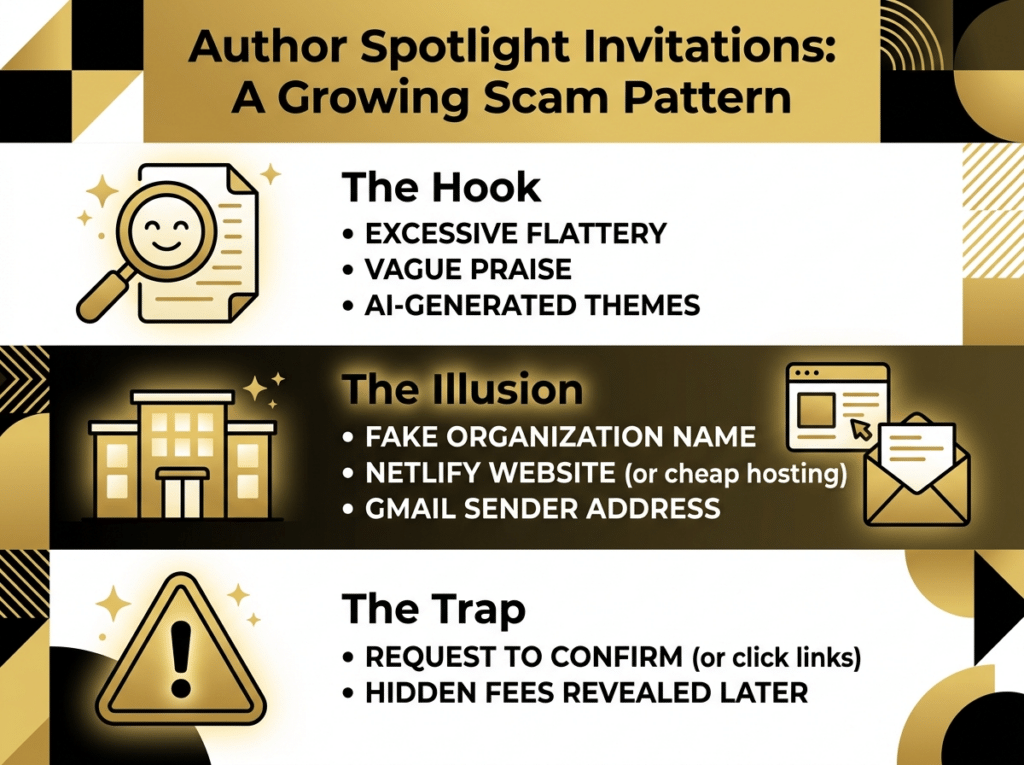
The email follows the same formula used by “Matilda Victoria,” “Mindshare Book Club,” and other known scam identities:
- Friendly greeting
- Generic praise
- Invitation to an “Author Spotlight”
- Request to confirm participation
- Fee revealed only after you reply
This repetition is not coincidence — it’s automation.
- Suspicious website
The included link points to a Netlify.app site — a free hosting platform commonly used for throwaway pages. Legitimate cultural organizations do not operate from temporary, minimalist Netlify sites.
- The “Author Spotlight” scam pattern
Author Scam Watch has documented this exact tactic:
Scammers create fake book clubs and cultural groups, send flattering invitations, then reveal a participation fee once the author responds.
This email matches the pattern perfectly.
🧠 What’s Really Happening Here?
Scammers know authors crave visibility. They use AI‑generated personalization to make each message feel tailored:
- Swap in a different book title
- Swap in new thematic buzzwords
- Keep the structure identical
Once an author replies, the scam escalates:
- A “spotlight fee” or “honorarium” is introduced
- Additional “promotion packages” are offered
- Payment is requested through untraceable methods
- The scammer disappears or delivers worthless, bot‑generated content
This is part of a large, coordinated wave of AI‑assisted promotional scams targeting authors worldwide.
🛡️ How Authors Can Protect Themselves
- Treat all unsolicited spotlight invitations with caution.
- Check the sender’s domain — Gmail/Yahoo = immediate skepticism.
- Verify the organization independently (not through links they provide).
- Never pay for book club features, interviews, or spotlights.
- Report the message as spam or phishing.
📢 Final Word: Stay Vigilant
This email is not from a legitimate cultural organization. It is another iteration of a mass‑produced author‑targeting scam designed to extract money by leveraging flattery and false opportunities.
As scammers increasingly use AI to personalize their outreach, authors must remain skeptical, informed, and proactive in protecting their work and their wallets.
For more resources, visit AuthorsAgainstScammers.org, where we track emerging scam patterns and help authors stay safe.
Forensic Analysis:
Field Name Expanded Value
Scam Confidence 95–99% likelihood. The combination of a free Gmail address, vague praise, Netlify site, and identical structure to documented author scams indicates with near certainty this is a fraudulent “Author Spotlight” pitch seeking monetary payment under false pretenses.
Threat Type Phishing/Book Promotion Scam. Masquerades as a cultural event invitation to extract funds from authors, leveraging fake book club affiliations and AI-generated flattery.
Target Audience Self-published authors, indie writers, and book marketers—especially those seeking greater exposure for niche genres or club/community opportunities.
Key Red Flags 1. Gmail sender (james081lucas@gmail.com), not an official org domain<br>2. Unsolicited flattery about your book/title, lacking specific detail<br>3. Generic, copy-paste invitation structure seen in other book scams<br>4. Suspicious free Netlify.app website rather than verified club site<br>5. Fee or honorarium disclosure only after reply<br>6. No verifiable organizer affiliation (no proof of “James Lucas” with listed group)<br>7. References to other recent, identical scam patterns (Matilda Victoria, Mindshare Book Club, etc.)
Recommended Actions 1. Do not reply or engage—this signals your contact information is active<br>2. Block sender in your email client<br>3. Report message as phishing/spam to your provider<br>4. Alert other authors in your community to this pattern<br>5. Verify any group’s authenticity before responding to event offers<br>6. Bookmark industry watchdog sites (e.g., AuthorsAgainstScammers.org) for up-to-date scam alerts
Related Scams – “Mindshare Book Club” Author Scam: Documented by Author Scam Watch<br>- Matilda Victoria/Global Book Community Fraud: Covered by Publishing Perspectives<br>- Fake Book Fair Invitations: Cited by Writer Beware®<br>- Amazon Author Page “Spotlight” Scam: FTC warning via Consumer Information<br>- Fee-for-Feature Book Scam (IC3 advisory): IC3 Official PSA
Sender Details Email: james081lucas@gmail.com<br>Claimed Affiliation: “Organizer” for Nottingham Culture and Café Scientifique<br>Signature/Analysis: No credible online presence for either individual or club; lack of domain-based contact and absence from legitimate literary/cultural registries.
Additional Context – Targeted Book: The Power of Promotion! Online Marketing for Toastmasters Club Growth (paraphrased in outreach)<br>- Scam Playbook: Fee is only revealed after engagement; formats, wording, and sender identities recycled across dozens of parallel campaigns; AI-generated message structure; group appears fabricated for scam purposes.<br>- Scope: Part of a broader AI-assisted promotional scam wave targeting authors in multiple countries, especially English-speaking markets.
Book/Product Targeted The Power of Promotion! Online Marketing For Toastmasters Club Growth (cited as the “reason” for contact; used to feign legitimacy).
Fake Website URL: Points to a .netlify.app domain (not included in text, but flagged)<br>Status: Unverifiable, generic, not registered to real cultural/academic groups; frequent marker of scam infrastructure.
Geographic Focus Global—While masquerading as a UK cultural group, documented variations target authors worldwide, especially US/UK/Canada.
Footnotes/Sources 1. FTC Consumer Scam Alerts: Book Promotion Scams<br>2. IC3 Fee-for-Feature Literature PSA<br>3. Writer Beware® Book Club Scams List<br>4. Publishing Perspectives: Book Club Email Scams<br>5. Authors Against Scammers: Author Spotlight Scam Report

Rae Stonehouse is a Canadian author, publisher, and advocate committed to exposing publishing scams and supporting writers through education and community. As the creator of Authors Against Scammers, Rae provides clear, practical guidance to help writers protect their work, their money, and their peace of mind. His books and resources reflect a lifelong dedication to empowering others through knowledge, clarity, and real‑world experience.