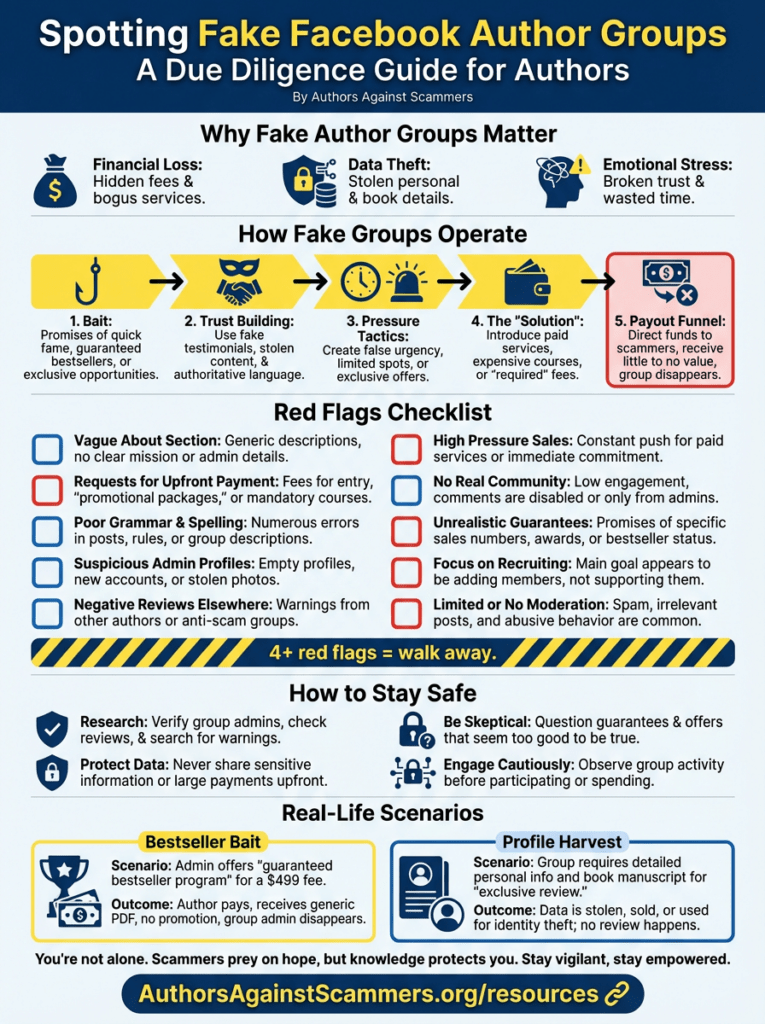
Spotting Fake Facebook Author Groups: Your Due Diligence Guide
Hey, fellow authors! If you’ve ever scrolled through Facebook and stumbled upon a group promising “book promotion heaven” with tens of thousands of members, you’re not alone. These spaces can feel like a goldmine for networking, feedback, and visibility—especially when you’re navigating the wild world of publishing as a new or indie author. But here’s the truth: not all that glitters is legitimate. Today, we’re diving into how to spot fake or low-trust Facebook author groups, using a real-world example to arm you with the knowledge to stay safe.
At Authors Against Scammers, our mission is simple: empower you to focus on your writing, not worry about predators. Scammers aren’t smarter than you—they’re just opportunistic. Let’s break it down step by step so you can spot the fakes and thrive in genuine communities.
Why Fake Author Groups Matter: Protecting Your Time, Money, and Dreams
Authors, freelancers, and creatives are prime targets because we’re passionate dream-chasers in a fragmented industry. Publishing is confusing—traditional vs. indie, agents vs. self-pub, marketing on a shoestring budget. Scammers exploit this with emotional hooks like “Finally get published!” or “Skyrocket your Amazon sales!”
Real-world consequences? They’re steep:
- Financial loss: Upfront “fees” for fake editing, covers, or “bestseller packages” that deliver nothing (average hit: $1,000–$5,000, per Alliance of Independent Authors reports).
- Data theft: Harvested emails, book details, and profiles lead to spam, phishing, or identity theft.
- Emotional toll: Wasted time, dashed hopes, and self-doubt that pulls you from your manuscript.
- Opportunity cost: While you’re dodging DMs from “agents,” real opportunities pass you by.
You’re not naive for hoping—scammers are pros at manipulation. But with due diligence, you reclaim control.
How the Scam Works: The Scammer’s Playbook
Fake groups aren’t random; they’re engineered funnels. Here’s the step-by-step process, drawn from patterns we’ve tracked:
- Setup the bait: Create a group with a keyword-stuffed name like “New Author’s, Promoting and Publishing Group.” Inflate to 39k members via bots, bought accounts, or auto-adds (this one gained 2,280 in a week).
- Draw you in: Post engagement bait—”Drop your book link!” or “Share your WIP!”—to harvest profiles and make it look buzzing (156 posts/day, but mostly spam).
- Build false trust: Generic “About,” section with AI word salad (e.g., “This group is a term used to describe individuals who have accomplished something notable…”). No real rules or pinned intros.
- Hook and extract: Spam comments/DMs offer “help” from shady admins (e.g., recent profiles with marketing backgrounds, not authors; one runs five similar groups).
- Funnel to payout: Redirect to vanity presses, fake agents, or “packages” via WhatsApp/Telegram. Pay up, get ghosted.
Psychological tactics:
- Social proof: Big numbers scream legitimacy.
- Reciprocity: “Free promo!” makes you share first.
- Authority: Admins pose as “industry pros.”
- Scarcity: “Limited spots for my editing service!”
Common patterns mirror thousands of reports to the FTC and ALLi: rapid growth, low-effort content, no moderation.
Warning Signs and Red Flags: Your Spot-the-Fake Checklist
Scan any group with this list. Four or more flags? Walk away. We’ve used “New Author’s, Promoting and Publishing Group” (39k members, 1-year-old) as our example — it hits seven.
- Vague or nonsense “About” section: AI-generated fluff unrelated to authors (this group’s is pure motivational mush—no purpose, rules, or admin info).
- Inflated membership with dead engagement: 39k sounds great, but check for emoji comments, the same 3-5 posters, or “DM me” spam.
- Suspicious admins: No photos, recent creation (3/5 here were days old), non-author backgrounds, multiple similar groups, or scam-hotspot locations.
- Spammy posting patterns: Endless “promote here!” bait, AI quotes, memes—no craft discussions or critiques.
- Unrealistic promises in comments: “Guaranteed bestseller!” or bundled services (editing + covers for cheap).
- Unverifiable credentials: Admins with zero publishing history (search their names—nothing on Amazon or QueryTracker? Red flag).
- Sudden urgency or pressure: “Join my WhatsApp NOW for exclusive help!”
- Requests for upfront payment: Any “package” fees via DM.
- No governance: Zero pinned rules, welcomes, or moderation.
- External funnels: Links to untraceable sites or apps.
Pro tip: Tools like GPTZero flag AI descriptions; Facebook’s Group History reveals merges.
Practical Guidance: Actionable Steps to Stay Safe
Knowledge is power—here’s how to verify, protect, and respond without stress:
- Verify legitimacy:
- Check admins on LinkedIn, Amazon author pages, or ALLi’s BeWatchful list.
- Search “[group name] scam” on Reddit (r/selfpublish, r/scams) or Google.
- Test with a burner account: Lurk for 48 hours, note DM patterns.
- Document evidence:
- Screenshots of profiles, posts, and DMs (include dates/URLs).
- Note the growth stats from Group History.
- Respond safely:
- Never share personal/book details.
- Politely decline: “Thanks, but I’m all set.”
- Report via Facebook: Group → Report → Scam/Fraud.
- What NOT to do:
- Click links or join external chats.
- Pay anything upfront.
- Engage spammers—it feeds the algorithm.
- Protect yourself long-term:
- Stick to vetted groups like “20BooksTo50K” or ALLi forums.
- Use privacy settings: Limit profile visibility.
- Build a scam-spotting habit—our free checklist download helps.
Real-Life Scenarios: How It Unfolds (Anonymized)
Scenario 1: The Bestseller Bait
New author Jane joins a 50k-member “Indie Success” group. Posts her blurb—gets 20 “Amazing! DM for promo help.” Admin offers a $2k “bestseller package.” She pays, gets a crappy cover and zero sales. Red flags missed: Vague rules, bot comments.
Scenario 2: The Profile Harvest
Mike shares his WIP excerpt. Flood of “Agent here—send manuscript!” from new profiles. Leads to phishing emails stealing his PayPal. Key flags: Engagement bait, unverifiable creds.
These aren’t rare — we’ve documented many like the “New Author’s” group, which funnels to predatory services.
You’re Not Alone—Take Control Today
Scammers prey on hope, but you’re smarter. Falling for one doesn’t define you; spotting the next one does. Authors Against Scammers has your back with resources, community, and updates on the latest tactics.
Ready to level up?
- Download our free “Facebook Group Checklist” at AuthorsAgainstScammers.com/resources.
- Explore our guides on evaluating agents, publishers, and promo sites.
- Join our newsletter for scam alerts—stay one step ahead.
Share your close calls in the comments (anonymously if you like). Together, we keep the writing world safe. Now go write that book!
Stay vigilant, stay empowered.
Authors Against Scammers

Rae Stonehouse is a Canadian author, publisher, and advocate committed to exposing publishing scams and supporting writers through education and community. As the creator of Authors Against Scammers, Rae provides clear, practical guidance to help writers protect their work, their money, and their peace of mind. His books and resources reflect a lifelong dedication to empowering others through knowledge, clarity, and real‑world experience.
0 Comments