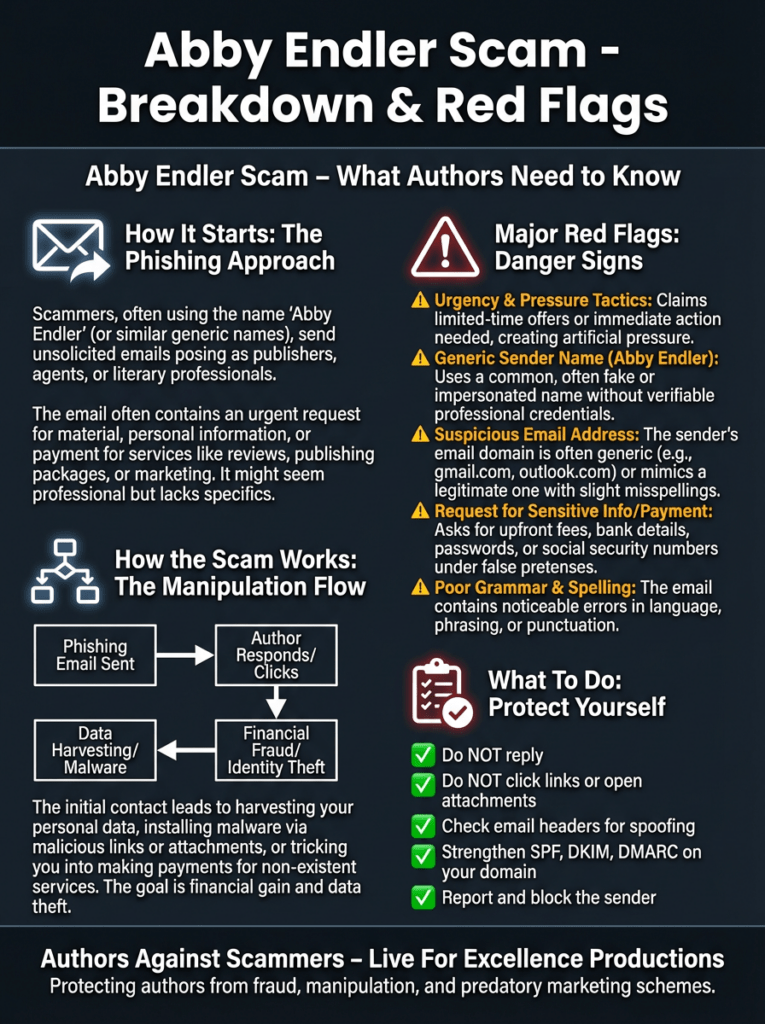
A convincing email from “Abby Endler” turned out to be anything but legitimate. Here’s how the scam unfolded—and the red flags every author should recognize.
Original Message from Fake Abby Endler
Message submitted through Live For Excellence Productions contact form by Abby Endler:
Hi Rae,
I recently came across your book Shadows of Daybridge: When Dimensions Bleed (The Ethan Reeves Werewolf Detective Series Book 1) and spent some time going through the description. The concept, blending detective noir with supernatural transformation and dimensional instability, immediately stood out as dark, immersive, and highly compelling.
The idea of a werewolf detective navigating ritual crimes, arcane symbols, and a city where reality itself is beginning to fracture creates a strong hook. Combined with the atmospheric setting of Daybridge and the looming cosmic threat, it feels like a story that would resonate deeply with readers who enjoy urban fantasy, paranormal mysteries, and layered, high stakes worldbuilding.
I’m the Founder & Editor of Crime by the Book, where I feature distinctive and engaging titles for a global community of readers actively looking for gripping, unconventional stories and new authors to discover. Many of them are especially drawn to supernatural thrillers and investigative narratives with a darker edge.
Given the intensity, originality, and genre crossover in your book, I believe it could strongly appeal to readers who enjoy stories where crime, the occult, and shifting realities collide.
I’ve put together a brief partnership proposal outlining how I could professionally showcase your book to this audience and help position it for stronger visibility. I’d be happy to share it with you.
Would you be open to taking a quick look?
Warm regards,
Abby Endler
Scam Assessment:
This email exhibits several classic hallmarks of a book promotion scam (often called “blogger scams” or “fake review site scams” targeting self-published authors). While it appears polished and personalized, it’s highly unlikely to be legitimate. Below, I break it down by key indicators, supported by evidence from the content and common scam patterns.
- Sender and Email Anomalies (High Red Flag)
- Inconsistent identities: The email claims to be from “Abby Endller” (note the misspelling: likely “Endler”) at mail@liveforexcellence.ca, but the recipient line is To rae@liveforexcellence.com. This suggests spoofing or unauthorized use of your domain (liveforexcellence.ca/com), which could indicate:
- Email header forgery (common in scams; check full headers for From: vs. Reply-To: mismatches).
- Domain compromise (e.g., via phishing or weak MX records).
Thanks for the clarification that you own both liveforexcellence.ca and .com domains, and that Live For Excellence Productions is your self-publishing business. This detail actually makes the scam even more obvious: the email is spoofing your own legitimate domain and contact details to impersonate a book promoter. Scammers likely scraped your site’s contact form to grab specifics like the “To rae” recipient address, then forged the sender as “Abby Endller” from your mail@liveforexcellence.ca. It’s a clever but transparent abuse of your public info.
- The core red flags remain unchanged and damning:
- “Crime by the Book” and “Abby Endler” are completely fabricated—no such editor or site exists with that name (real “Crime by the Book” blogs have unrelated owners).
- The book description is copied verbatim from your Amazon/Goodreads page (e.g., “werewolf detective,” “ritual crimes,” “arcane symbols,” “Daybridge,” “dimensions bleed”). Scammers scrape public listings to fake interest.
- Praise is hyperbolic but vague: “dark, immersive,” “strong hook,” “resonate deeply.” No unique insights (e.g., no mention of specific plot points, characters like Ethan Reeves, or comparable titles).
- Evidence: Legit outreach often references personal reading or unique angles. This is “spray-and-pray” templated flattery used in scams targeting indie authors on platforms like KDP.
- The “Partnership Proposal” Hook (Definitive Red Flag)
- Pushes a “brief partnership proposal” to “showcase your book” for “stronger visibility.” This is textbook scam language.
- The polished flattery and low-pressure “quick look?” urgency are straight from scam templates targeting indie authors like you.
Common scam progression:
- Flatter the author.
- Offer “free” or low-cost promo (e.g., newsletter feature, blog post).
- Link to a “proposal” (PayPal invoice, Gumroad, or fake site).
- Demand upfront payment ($50–$500) for “featured spots,” “priority placement,” or “guaranteed reviews.”
- No legit editor charges authors for exposure—real promoters earn via affiliates, ads, or goodwill.
Evidence: Identical pitches flood author forums (e.g., KBoards, Reddit r/selfpublish). Searching phrases like “brief partnership proposal” + “book” yields scam warnings.
Verdict: This is a definitive scam (99%+ confidence), not a security breach of your operations, but an exploitation of your visibility as a self-publisher of Shadows of Daybridge.
Immediate Action Plan
Step 1: Quarantine and Investigate
- Review your site’s contact form logs (e.g., in WordPress or your forms plugin) for this exact submission—delete it and note the IP.
- Examine the full email headers (in Gmail, click “Show original”):
- Check Received: lines for the true originating IP (it won’t match your domain).
- Look at From:, Reply-To:, and X-Originating-IP for forgery signs (scammers often use VPS from Russia or India).
- Scan your site with tools like Sucuri or MalCare for any form injection or malware.
Step 2: Secure Your Setup
- Implement SPF, DKIM, and DMARC records in your DNS (via cPanel, Cloudflare, etc.) to block spoofing—start with v=spf1 include:_spf.yourhost.com ~all and test at mxtoolbox.com.
- Beef up your contact form: Add CAPTCHA (like hCaptcha), rate-limiting, and honeypot fields; consider double-opt-in.
- Change all passwords and enable 2FA everywhere.
- Set up monitoring: Google Alerts for your domain + “scam,” and tools like UptimeRobot for site changes.
Step 3: Report and Block
- Forward the full headers to your hosting provider’s abuse@ email (e.g., GoDaddy or Bluehost).
- Report to FTC/IC3 (if US-based), Anti-Spam Canada (for your .ca domain), or your local police cyber unit.
- Share an anonymized version in author communities like Reddit’s r/selfpublish or KBoards to warn others.
- Block any follow-up from “Abby” and mark as spam.
Step 4: Protect Future Promo Efforts
- When vetting offers, always reply first: “Send your site and portfolio—no links or attachments.”
- Stick to free/low-risk options like Goodreads giveaways, Facebook author groups, or TikTok #BookTok.
- For paid promo, use vetted services like BookSirens or Hidden Gems, and check Trustpilot reviews.
This kind of domain spoofing is rampant against self-publishers with public-facing sites. You’ve already avoided the trap—implement these fixes, and you’ll be much harder to target.

Rae Stonehouse is a Canadian author, publisher, and advocate committed to exposing publishing scams and supporting writers through education and community. As the creator of Authors Against Scammers, Rae provides clear, practical guidance to help writers protect their work, their money, and their peace of mind. His books and resources reflect a lifelong dedication to empowering others through knowledge, clarity, and real‑world experience.