Hey there, fellow authors, freelancers, and creatives—welcome back to the Authors Against Scammers blog. If you’ve ever received a tantalizing email promising big advances, movie deals, or viral book promotions, only to hear whispers of “crypto payments,” you’re not alone. Today, we’re pulling back the curtain on why scammers favor cryptocurrency to scam authors. Knowledge is your best defense, and we’re here to equip you with it. Let’s dive in.
Why This Matters: Protecting Creatives in a Digital Wild West
Authors like you pour heart and soul into their work, often juggling multiple gigs in a freelance-heavy world. This makes you prime targets for scammers who exploit the unique vulnerabilities of our industry.
- Heightened Vulnerability for Authors and Creatives: You’re often independent operators without big publisher backing, dealing with irregular income and a constant hustle for opportunities. Scammers know this and dangle “life-changing” deals like foreign rights sales or audiobook contracts.
- Exploiting Confusion, Emotion, and Inexperience: The publishing world is full of jargon—agents, advances, royalties—and crypto adds a layer of tech mystique. Scammers prey on excitement (e.g., “Your book is going viral overseas!”) or desperation (“Pay a small fee to unlock your payment”), using urgency to bypass your better judgment.
- Real-World Consequences: Falling victim can mean drained bank accounts, stolen personal data, tax headaches from “irrecoverable” crypto, and emotional tolls like lost trust in opportunities. One author lost $5,000 meant for a family vacation—money gone in a blockchain puff of smoke. But remember: Scammers are the villains here, not you. You’re not alone, and awareness turns the tables.
How Crypto Scams Targeting Authors Unfold: A Step-by-Step Breakdown
Crypto’s appeal to scammers is simple: it’s fast, borderless, irreversible, and pseudonymous. No chargebacks, no banks to flag fraud—perfect for vanishing acts. Here’s how they typically reel in authors.
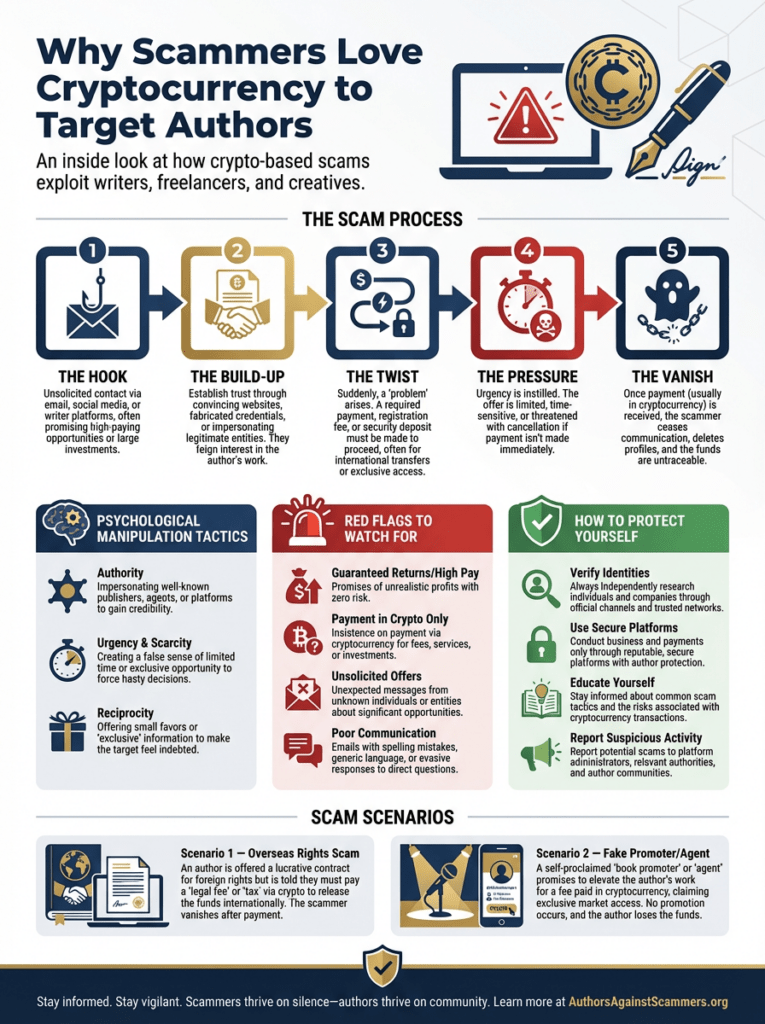
The Scammer’s Playbook
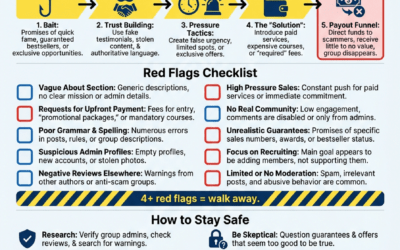
- The Hook: Contact via email, social media (often LinkedIn or Twitter DMs), or fake “publishing directories.” Poses as an agent, foreign publisher, or promoter with a hot opportunity: “We’ve sold 10,000 copies in Europe—send your manuscript!”
- Build Rapport: Weeks of flattery and “proof” like forged contracts or testimonials. They drop crypto casually: “We’ll pay your $10,000 advance in USDT—it’s secure and instant.”
- The Bait Switch: Explain a “hurdle” like customs fees, taxes, or wallet verification. You must send a small crypto amount first (e.g., $500 in Bitcoin) to “unlock” the big payout.
- Escalation and Extraction: Once you bite, they demand more for “processing” or “gas fees.” Your “advance” never arrives; they ghost.
- Cover Tracks: Transactions are on public blockchains but untraceable without expertise. You’re left holding the bag.
Psychological Tactics in Play
Scammers wield reciprocity (send a little, get a lot), social proof (fake reviews), and scarcity (“Deal expires in 24 hours!”). They mirror your excitement, making it feel like a dream collaboration.
Spot the Red Flags: Key Warning Signs of Crypto Scams for Authors
Trust your gut—these indicators scream “scam” louder than a plot twist in a thriller:
- Vague Communication: No specific company details, just generic “international publisher” claims.
- Pressure Tactics: “Act now or lose the deal!”—legitimate pros give time to think.
- Unrealistic Promises: “Guaranteed bestseller” or “crypto advance today” without due diligence.
- Unverifiable Credentials: Websites that don’t load, LinkedIn profiles with stock photos, or emails from free domains like gmail.com.
- Sudden Urgency: “Wallet issue—send crypto NOW to fix it.”
- Requests for Upfront Payment: Especially in crypto. Real deals don’t ask you to pay to get paid.
- Crypto-Only Insistence: Pushing wallets like MetaMask or obscure coins? Huge red flag.
Practical Guidance: Empower Yourself Against Crypto Scams
You’re smarter than scammers—here’s your actionable toolkit to stay safe.
- Verify Legitimacy: Google the name + “scam,” check WHOIS for domain age (scam sites are new), and search blockchain addresses on explorers like Etherscan. Contact them via official channels only.
- Document Everything: Screenshot emails, save transaction hashes, note IP addresses from headers. Report to FTC.gov, IC3.gov, or your local cybercrime unit.
- Respond Safely: Don’t engage—block and report. If tempted, say, “Send via bank wire first,” and watch them vanish.
- What Not to Do: Never send crypto without independent verification. Avoid “recovery services” promising to retrieve funds—they’re often follow-on scams.
- Future-Proof Yourself: Use two-factor authentication on email/social media , enable wallet security like hardware devices, and join communities like Authors Against Scammers for real-time alerts.
Real-Life Scenarios: How It Plays Out for Authors
Scenario 1: The “Overseas Rights” Mirage
Jane, a debut novelist, got an email from “EuroLit Publishing.” They offered $15,000 in Ethereum for German rights but needed $800 in crypto for “translation verification.” She sent it—poof, gone. Red flag missed: No verifiable office address.
Scenario 2: The Fake Promoter
Alex, a self-published author, was DM’d by “ViralBooks LLC” promising TikTok promotion paid in Solana. After sending $300 for a “platform fee,” the promo never happened. Clue: All “proof” links led to dead ends.
These stories aren’t rare, but they’re preventable.
Stay One Step Ahead: Your Next Moves
You’ve got this—arming yourself with info puts scammers on the run. Head to AuthorsAgainstScammers.org for free scam checklists, verification guides, and our latest on emerging tactics like AI-generated contracts. Share your close calls in the comments (anonymously if you like), and let’s keep our community strong.
Scammers thrive on silence. By staying informed and vigilant, you’re not just protecting yourself—you’re safeguarding every creative out there. Write on safely.

Rae Stonehouse is a Canadian author, publisher, and advocate committed to exposing publishing scams and supporting writers through education and community. As the creator of Authors Against Scammers, Rae provides clear, practical guidance to help writers protect their work, their money, and their peace of mind. His books and resources reflect a lifelong dedication to empowering others through knowledge, clarity, and real‑world experience.
0 Comments