Gift‑card scams are exploding across creative industries — and authors are now squarely in the crosshairs. While these scams may look simple on the surface (“Buy a few cards and send the codes”), the implications for authors are far more serious than most realize.
Gift cards function like untraceable cash, and scammers pair them with impersonation, urgency, and borrowed trust — tactics already widely used against writers. Below is a breakdown of how these scams operate, why authors are uniquely vulnerable, and what to do if you’ve been targeted.
🚨 1. Authors Are Uniquely Vulnerable to Impersonation – Based Gift Card Scams
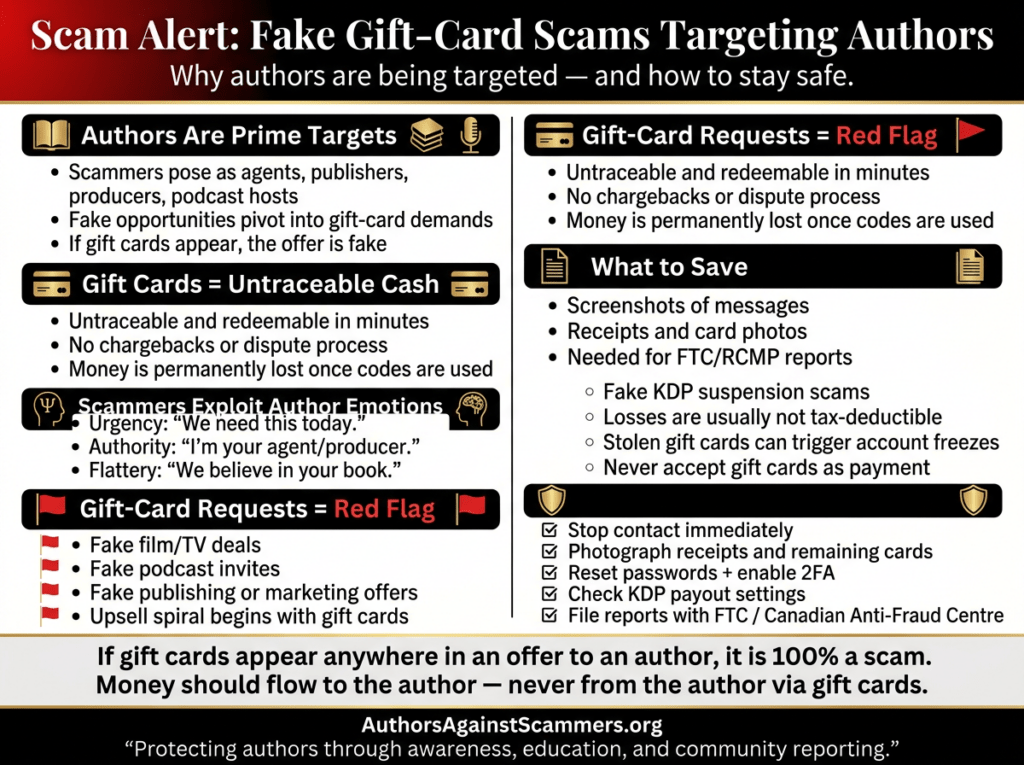
Gift‑card scams almost always begin with impersonation. Scammers pose as:
- Literary agents
- Publishers
- Podcast hosts
- Film scouts
- Book reviewers
- Fellow authors
Because impersonation scams are already rampant in the writing community, authors are more likely than average to trust a message that appears to come from a legitimate industry contact.
Why this matters: Scammers can pivot effortlessly from:
“We want to adapt your book,” to “We need you to purchase gift cards to secure your slot / pay a verification fee / cover a processing cost.”
If gift cards enter the conversation, the opportunity is fake, no exceptions.
💸 2. Gift‑Card Payments Remove All Financial Protection
Gift cards are:
- Untraceable
- Redeemable in minutes
- Irreversible once the code has been used
For authors, this means:
- No chargebacks (unlike credit cards)
- No dispute process
- No recovery once the balance is drained
Implication: If you pay a scammer with gift cards, the money is gone permanently — even if you later prove fraud.
🧠 3. Scammers Exploit Author Psychology
Gift‑card scams succeed because they combine:
- Urgency — “We need this today to secure your interview slot.”
- Authority — “I’m your agent / producer / editor.”
- Emotional leverage — “We believe in your book.”
These are the same psychological levers used in publishing‑related scams.
Implication: Authors who are emotionally invested in their work are easier to manipulate into fast, irreversible payments.
🛡️ 4. Gift‑Card Scams Damage Author Reputation
When scammers impersonate authors or their teams, they may:
- Ask readers to buy gift cards
- Run fake giveaways
- Pretend to be the author requesting emergency funds
Implication: Readers may believe the real author is involved, harming trust and brand credibility.
📉 5. Gift‑Card Requests Often Signal Larger Fraud Schemes
Gift‑card demands frequently appear inside broader scams:
- Fake film/TV adaptation offers
- Fake podcast invitations
- Fake publishing deals
- Fake marketing packages
These scams often escalate into an upsell spiral, where gift‑card payments are just the first step.
Implication: A gift‑card request is a red‑flag indicator that the entire offer is fraudulent.
🧾 6. Authors Must Document Evidence Differently
Because gift‑card transactions are irreversible, the only meaningful protection is documentation:
- Screenshots of messages
- Receipts showing card purchase
- Photos of the card numbers
- A timeline of communication
Implication: This evidence is critical for reporting to the FTC, RCMP, or card issuer — even when the money cannot be recovered.
Additional Implications Authors Often Overlook
Gift‑card scams affect authors in ways beyond the immediate financial loss.
If You Are the Target
Common pitches aimed at writers include:
- “Amazon/KDP needs you to buy gift cards to unlock royalties or restore your account.”
- “A film producer needs iTunes or Google Play cards to process your adaptation.”
- “Pay a marketing or review fee with Amazon, Steam, or Google cards.”
- “Your KDP account is suspended — send codes to reinstate it.”
Important: Amazon, KDP, and legitimate publishers never ask for gift cards. KDP is free. Anyone demanding gift cards is not Amazon.
If You Pay
- The money is almost always unrecoverable.
- In the U.S., scam losses generally aren’t tax‑deductible after 2018.
- You still owe tax on legitimate royalties — scam losses don’t cancel income.
- If you handed over KDP, PayPal, or bank logins, scammers can reroute your royalties.
This becomes an account‑takeover problem, not just a lost $200 card.
If Your Name or Book Is Used in the Scam
Scammers sometimes impersonate authors or use book titles in fake invoices.
You are not automatically liable for the fraud.
You should:
- Report impersonation to the platform
- Notify your domain/email host
- File with ReportFraud.ftc.gov (U.S.) or antifraudcentre-centreantifraude.ca (Canada)
- Monitor KDP for password changes or new payout accounts
If You Accept Gift Cards as Payment
Do not accept gift cards for book sales, services, or “bulk orders.”
Accepting stolen or fraudulent cards can make you appear complicit in laundering them — even if you thought it was legitimate.
Platforms may:
- Freeze accounts
- Hold payouts
- Initiate fraud reviews
This is not a “publishing dispute.” It can escalate into federal wire‑fraud territory.
What To Do If It Already Happened
- Stop contact immediately.
- Photograph receipts and remaining cards.
- Call the card issuer’s fraud line.
- Change passwords for KDP, Amazon, email, and banking.
- Turn on two‑factor authentication everywhere.
- Check KDP payout and tax settings.
- File reports with the police, FTC, or the Canadian Anti‑Fraud Centre.
Paper trails matter — even when the money is gone.
Bottom Line
Gift‑card scams hit authors harder than the general public because they intersect with:
- impersonation scams
- fake publishing opportunities
- emotional manipulation
- irreversible payment methods
If gift cards appear anywhere in an offer to an author, it is 100% a scam — no exceptions.
Money flows to the author through normal royalty or invoice channels. Anyone who needs you to buy gift cards first is running a scam — not a book deal.

Rae Stonehouse is a Canadian author, publisher, and advocate committed to exposing publishing scams and supporting writers through education and community. As the creator of Authors Against Scammers, Rae provides clear, practical guidance to help writers protect their work, their money, and their peace of mind. His books and resources reflect a lifelong dedication to empowering others through knowledge, clarity, and real‑world experience.