Overview
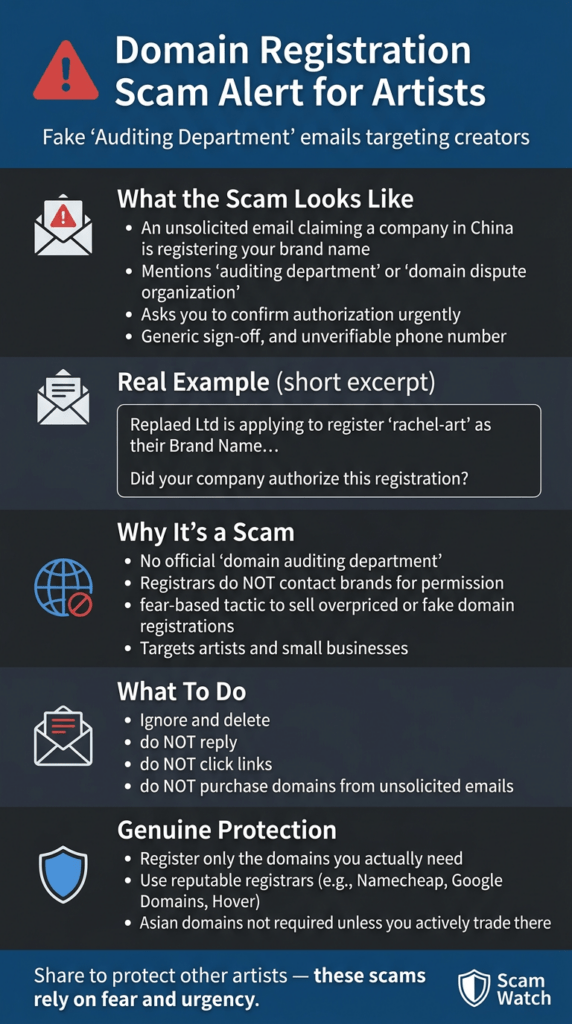
A new wave of domain‑registration scams is circulating, targeting artists, small businesses, and independent creators. These emails appear formal and urgent, claiming that a company in China is attempting to register your brand name as a domain. The goal is to frighten you into purchasing unnecessary (and often fake) domain registrations at inflated prices.
Below is a real example submitted to Scam Watch, followed by analysis and recommended actions.
The Scam Email
This is the exact text the artist received:
Dear CEO,
This is a formal email. We are the auditing department of a professional domain name registration and dispute solution organization in China. Here I have something to confirm with you. Today we formally received an application that a company claimed “Replaed Ltd” were applying to register “XXX” [name redacted for confidentiality] as their Brand Name and some “XXX” Asian countries top-level domain names through our firm. Now we are handling this registration, and after our initial checking, we found the name were similar to your company’s, so we need to check with you whether your company has authorized that company to register these names. If you authorized this, we would finish the registration at once. If you did not authorize, please let us know as soon as possible. Thank you!
Best Regards, Charles He Tel:+86.551-65331804
Why This Is a Scam
This message follows a well‑known pattern used by domain‑name scammers worldwide. The email is designed to sound official, urgent, and bureaucratic — but every element is fabricated.
Key Red Flags
- “Auditing department” — no such department exists in legitimate domain registrars.
- Unsolicited warning about another company registering your brand — a classic fear tactic.
- Pressure to “confirm authorization” — scammers want you to panic and respond.
- Asian top‑level domains — these are frequently used in fraudulent domain‑upsell schemes.
- Generic sign‑off and unverifiable phone number — typical of mass‑sent scam templates.
The Real Goal
Once you reply, scammers attempt to:
- Sell you overpriced or fake domain registrations
- Extract personal or business information
- Pull you into a prolonged “urgent” negotiation
- Charge “processing fees” or “protection fee
They rely on fear, urgency, and the assumption that artists may not be familiar with domain‑registration processes.
What You Should Do
- Ignore and delete the email
- Do not reply
- Do not click any links
- Do not call the number
- Do not purchase any domains from unsolicited contacts
If you genuinely want to protect your brand:
- Register only the domains you actually need
- Use reputable registrars (e.g., Namecheap, Google Domains, Hover)
- You do not need Asian domains unless you actively conduct business there
Why Artists Are Targeted
Scammers know:
- Artists often operate solo
- Many do not have IT departments
- Brand names are personal and emotionally important
- Fear of losing a name can trigger quick reactions
This makes creators a prime target for domain‑based social engineering.
Share to Protect Others
These scams thrive on urgency and confusion. Sharing real examples helps other artists recognize the pattern before they fall into the trap.
If you receive a similar message, forward it to AuthorsAgainstScammers.org for verification and documentation.

Rae Stonehouse is a Canadian author, publisher, and advocate committed to exposing publishing scams and supporting writers through education and community. As the creator of Authors Against Scammers, Rae provides clear, practical guidance to help writers protect their work, their money, and their peace of mind. His books and resources reflect a lifelong dedication to empowering others through knowledge, clarity, and real‑world experience.