Why Scammers Target Self-Published Authors — And How to Protect Yourself
Sarah’s heart raced when she opened the email. A “senior acquisitions editor” from what looked like a legitimate publishing house had discovered her debut novel and wanted to discuss “opportunities for expanded distribution and award consideration.” The catch? A $2,500 “editorial assessment and submission package” — refundable if they didn’t move forward. Three months and $7,800 later, Sarah had a generic critique, no distribution deal, and an inbox full of excuses about “changing market conditions.”
Sarah isn’t real, but her story is painfully common. Self-published authors face a perfect storm of vulnerability: emotional investment in deeply personal work, hunger for validation in a crowded market, and a service ecosystem with almost no regulatory oversight. Scammers know this, and they’ve built an entire playbook around it.
This article breaks down why authors make such attractive targets, how psychological manipulation works in publishing scams, and what you can do right now to protect yourself and your work. Whether you’re drafting your first manuscript or launching your tenth title, understanding these tactics isn’t paranoia — it’s professional self-defense.
Why Authors Are Attractive Targets
Self-published authors occupy a unique economic and emotional space that scammers exploit with surgical precision. Unlike traditionally published authors who work through vetted gatekeepers, indie authors navigate a vast, largely unregulated marketplace of services — editing, cover design, marketing, distribution, awards, reviews — where legitimate providers and sophisticated fraudsters operate side by side.
The emotional vulnerability is real. You’ve spent months or years pouring yourself into a manuscript. Your work matters to you in ways a widget or software product never could. Scammers recognize this attachment and weaponize it, positioning themselves as the bridge between your current obscurity and the recognition you deserve. They’re not selling editing services; they’re selling hope, validation, and the promise that someone finally sees your potential.
The structural barriers are low. Self-publishing democratized book creation, but it also removed traditional quality filters. Anyone can claim to be a publisher, publicist, or literary consultant. There’s no licensing board for book marketers, no bar exam for “acquisition editors.” Scammers create professional-looking websites, mint impressive-sounding titles, and operate until enough complaints accumulate — then rebrand and start again.
The market is monetizable at every stage. From manuscript evaluation to award submissions, from blog tours to Hollywood pitch packages, every step of an author’s journey has been turned into a purchasable service. Some are legitimate and valuable. Others are vanity presses charging $15,000 for offset printing you could get for $3 per unit through print-on-demand. Some are fake PR firms that promise media coverage and deliver a single paragraph on an untrafficked blog they own. Still others are pay-to-play “best of” lists and fake literary awards designed to look prestigious while generating thousands in submission fees.
The self-publishing market in the United States alone represents billions in annual revenue. When that much money flows through an industry with minimal regulation, predators follow.
The Psychological Hooks Scammers Use
Understanding why these scams work requires looking at the psychological techniques scammers deploy. These aren’t random tactics — they’re engineered manipulation strategies that exploit cognitive biases and emotional needs.
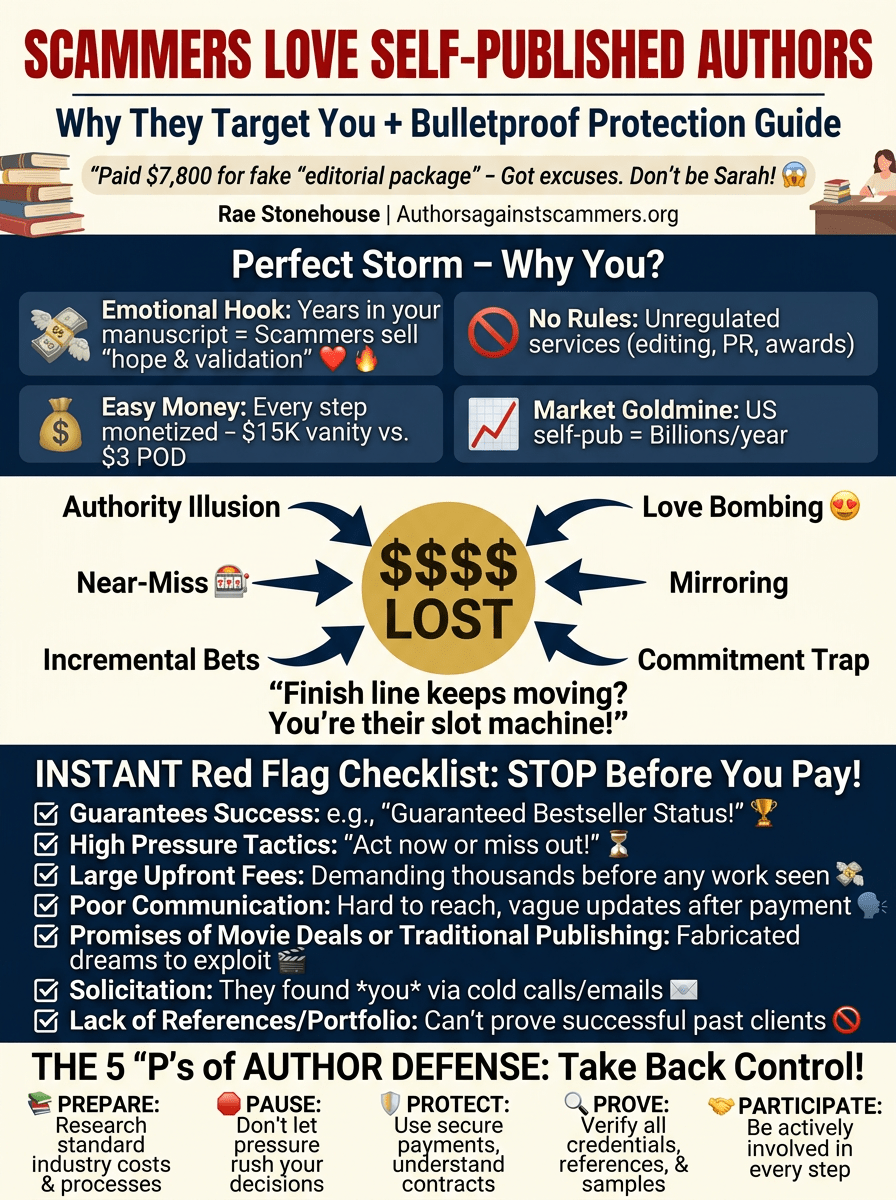
Authority Illusion: Scammers wrap themselves in the trappings of legitimacy. They use official-sounding company names (“International Literary Foundation”), create websites with stock photos of diverse “staff,” and pepper communications with industry jargon. One author reported receiving contract paperwork with a logo nearly identical to that of a major trade publisher — different by two letters, easily missed in excitement. The lesson: impressive credentials mean nothing if you can’t independently verify them.
Love Bombing: The initial contact is intoxicating. “Your prose is luminous.” “We rarely see such sophisticated character work.” “This could be the next Gone Girl.” After months of form rejections or silence, this targeted praise feels like oxygen. One author described it as “finally being seen” — which made the subsequent $4,000 pitch for “essential editorial refinement before acquisition” seem reasonable, even necessary.
Mirroring: Sophisticated scammers research their targets. They reference your genre, compliment specific elements from your book description or sample chapters, and even mention other authors you’ve praised on social media. This creates false intimacy and credibility. When someone demonstrates they’ve “really read your work” (even if they’ve only skimmed your Amazon blurb), skepticism evaporates.
Commitment and Consistency: Once you’ve paid for one service, you’re psychologically primed to continue. You’ve already invested $1,500 in “manuscript development” — don’t you want to protect that investment with their $2,200 “strategic marketing launch package”? Each payment becomes justification for the next. You’re not throwing good money after bad; you’re “seeing it through.”
Near-Miss Hope: The finish line keeps moving. “We’re so close to securing that film option; we just need one more pitch refinement.” “Your book is on the verge of landing on that curated list — a small promotional boost will push it over.” This strategy mirrors slot machine psychology: you’re always one pull away from the jackpot.
Incremental Bets: Legitimate services quote fixed prices. Scammers start small — maybe $299 for a “market analysis” — then introduce urgent new opportunities. Before you realize it, you’ve spent $8,000 across nine “essential” services, each positioned as the missing piece of your success puzzle.
Pull Quote: “If the finish line keeps moving, you’re not a client — you’re a player at their machine.”
Common Red Flags and a Practical Checklist
Recognizing scams in real time requires knowing what to look for. Print this checklist and keep it visible when evaluating any author service or opportunity:
Red Flag Checklist
Communication patterns:
- Unsolicited contact praising your work, especially with urgent timelines
- Excessive flattery followed by requests for payment
- Pressure to “act now” or risk losing an opportunity
- Resistance to questions or deflection when you ask for specifics
- Communication only through personal email addresses (Gmail, Yahoo) rather than company domains
Business practices:
- Vague or shifting deliverables (“comprehensive marketing push,” “industry exposure”)
- No verifiable portfolio, client list, or references
- Requests for payment before providing detailed contracts or scope of work
- Pay-to-unlock models: “Pay us first, then we’ll tell you what you’ve won”
- Refund promises that evaporate when you try to claim them
- Requests to sign away rights or grant exclusive authority over your work
Credentials and verification:
- Impressive titles, but no verifiable employment history
- Company websites created in the last six months (check WHOIS lookup)
- Stock photos labeled as “staff” (reverse image search these)
- “Awards” or “memberships” in organizations that don’t appear in independent searches
- Claims of relationships with major publishers, agents, or media without proof
What to Ask (Copy and Use This Script)
When anyone approaches you about services or opportunities, send this:
“Thank you for reaching out. Before we proceed, could you please provide:
- Three verifiable references from authors you’ve worked with in the past year, with contact information
- A detailed scope of work document outlining specific deliverables, timelines, and payment terms
- Your company’s physical business address and primary business email domain
- Examples of measurable results from previous clients (sales data, media placements with links, etc.)”
Legitimate providers answer these questions easily and completely. Scammers dodge, deflect, or disappear.
How to Protect Yourself and Next Steps
Protection comes from combining healthy skepticism with practical verification tools. Here’s your action plan:
Verify independently. Check company domains with WHOIS lookup (many services are free) to see when websites were registered. Brand-new sites claiming years of industry presence are immediate red flags. Use reverse image search on “staff” photos — legitimate companies don’t need stock photos. Look for the company name + “scam” or “complaint” in search engines, but remember absence of complaints doesn’t prove legitimacy.
Demand verifiable references. Legitimate service providers happily connect you with past clients. Contact those references directly — not through email addresses provided by the company. Ask specific questions: What were the deliverables? Were timelines met? What measurable results did you see? Would you hire them again?
Insist on detailed written agreements. Everything should be documented: specific deliverables, timelines, payment schedules, termination clauses, refund policies, and rights retention. Vague promises aren’t contracts. If a provider resists putting commitments in writing, that’s your answer.
Get a second opinion. Before paying for any significant service, consult author communities, professional organizations like the Authors Guild or Alliance of Independent Authors, or experienced publishing professionals. Many scams evaporate under informed scrutiny. Share the company name and offer details in writer forums — someone else has likely encountered them.
Trust the “too good to be true” instinct. If someone promises guaranteed bestseller status, Hollywood options, or major media coverage for a few thousand dollars, they’re lying. Publishing success is unpredictable. Legitimate professionals discuss possibilities and strategy, not guarantees.
Save everything. Document all communications, agreements, and payment records. If you encounter a scam, this documentation is essential for potential legal action, credit card disputes, or reporting to authorities like the Federal Trade Commission.
The self-publishing landscape includes thousands of ethical, talented professionals who genuinely help authors succeed. Protecting yourself doesn’t mean trusting no one — it means verifying everyone.
Learn the Full Playbook
If you want to dive deeper into scammer tactics, recognition strategies, and protection protocols that saved me from losing even more than $2,947.93, The Nancy Catherine Scammer Playbook Exposed: The Essential Author’s Guide to Spotting and Stopping Scammers provides comprehensive, practical guidance drawn directly from my painful experience and forensic investigation.
The book includes the exact 2-minute profile verification checklist that would have saved my $3,000 if I’d known it on September 18, 2025; detailed analysis of the 14 psychological hooks scammers weaponize (like the 87% effective “Legit Link Priming” that Sophie Kenna’s real Amazon link triggered); step-by-step instructions for reading Gmail headers to trace scammer origins across platforms; the complete federal reporting arsenal (FTC/IC3 case number scripts that pressure payment processors); DMCA takedown templates that nuked Nancy’s Strikingly website; chargeback recovery tactics (including why Payoneer denied my claim but Visa succeeded); and real-world examples of every scam variant targeting authors in 2025—from fake book marketing conferences to AI-impersonation threats.
It’s designed as both a prevention manual (master the red flags before contact) and a response guide (fight back after you’ve been hit, like I did). You’ve worked too hard on your book to let someone exploit your dreams the way Nancy Catherine exploited mine during my wife’s final months.
Your work deserves better than predators. Protect it with the tactics that work.

Rae Stonehouse is a Canadian author, publisher, and advocate committed to exposing publishing scams and supporting writers through education and community. As the creator of Authors Against Scammers, Rae provides clear, practical guidance to help writers protect their work, their money, and their peace of mind. His books and resources reflect a lifelong dedication to empowering others through knowledge, clarity, and real‑world experience.
0 Comments