Summary
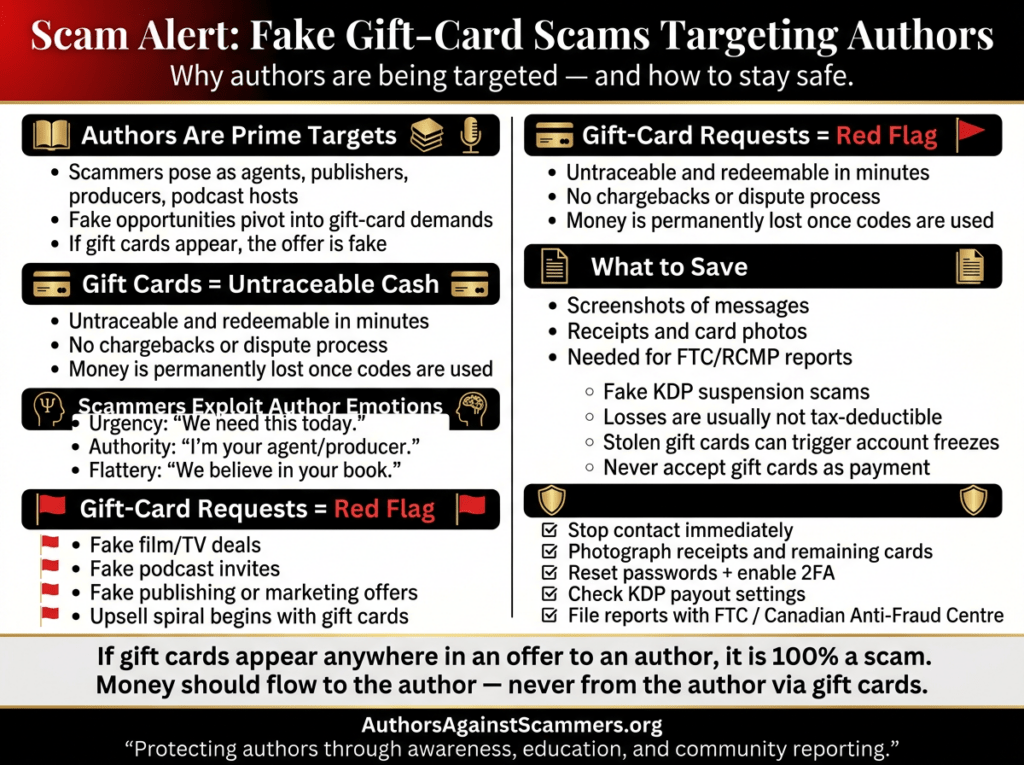
Gift card scams targeting authors typically combine impersonation of literary industry professionals with requests for untraceable gift card payments. These scams exploit authors’ professional aspirations, emotional investment in their work, and existing patterns of impersonation fraud in publishing. Payments via gift cards are irreversible, leaving victims with permanent financial loss and potential secondary risks such as account takeover or reputational harm. The blog post emphasizes that any request for gift cards in connection with a publishing, adaptation, marketing, or interview opportunity is fraudulent.
Scam Type
Gift card scam combined with impersonation (literary agents, publishers, podcast hosts, film scouts, book reviewers, or fellow authors). Related categories include fake film/TV adaptation offers, fake podcast invitations, fake publishing deals, and fake marketing packages.
Incident Description
Not provided. The source material is a general educational alert describing common patterns rather than a single documented incident involving a specific author or date.
Evidence / Excerpts
Quoted examples of scammer language from the source material:
- Pivot from “We want to adapt your book” to “We need you to purchase gift cards to secure your slot / pay a verification fee / cover a processing cost.”
- Urgency phrasing: “We need this today to secure your interview slot.”
- Authority claims: “I’m your agent / producer / editor.”
- Emotional leverage: “We believe in your book.”
Common pitches cited:
- “Amazon/KDP needs you to buy gift cards to unlock royalties or restore your account.”
- “A film producer needs iTunes or Google Play cards to process your adaptation.”
- “Pay a marketing or review fee with Amazon, Steam, or Google cards.”
- “Your KDP account is suspended — send codes to reinstate it.”
Key statement: “If gift cards appear anywhere in an offer to an author, it is 100% a scam — no exceptions.”
No screenshots or additional primary evidence (emails, receipts, or card images) are included in the source material.
Red Flags
- Any request to purchase and send gift card codes (Amazon, iTunes, Google Play, Steam, or similar).
- Impersonation of agents, publishers, producers, reviewers, or other authors.
- Combination of urgency (“needed today”) with authority and flattery.
- Claims that gift cards are required for verification, processing, royalties, account reinstatement, or “securing a slot.”
- Absence of standard professional payment channels (invoices, contracts, royalty statements).
- Requests that begin as an opportunity and quickly introduce an irreversible payment method.
- Use of the author’s name, book title, or likeness in fake invoices or giveaways.
Scammer Method & Tactics
Scammers first impersonate trusted industry contacts to establish borrowed credibility. They then present a desirable opportunity (adaptation, interview, publishing deal, or marketing package) and introduce gift cards as a supposed fee, deposit, or processing requirement. Psychological tactics include manufactured urgency, appeals to authority, and emotional investment in the author’s work. Gift cards function as untraceable cash that can be redeemed within minutes, eliminating chargebacks or recovery. The request often serves as the first step in an upsell sequence. Additional tactics include impersonating the author themselves to solicit cards from readers or using book titles in fraudulent communications. Amazon, KDP, and legitimate publishers never request gift cards.
Risk Level
High
Recommended Action for Authors
- Treat any gift-card request as an automatic scam indicator and cease contact immediately.
- Never purchase or send gift-card codes for publishing, marketing, adaptation, royalty, or account-related purposes.
- Do not accept gift cards as payment for books, services, or bulk orders (risk of appearing complicit in fraud and triggering platform holds or investigations).
- If already targeted or paid: photograph receipts and remaining cards; contact the card issuer’s fraud line; change all passwords (KDP, Amazon, email, banking); enable two-factor authentication; review KDP payout and tax settings; file reports with local police, FTC (ReportFraud.ftc.gov), or Canadian Anti-Fraud Centre.
- Report impersonation of yourself or your work to the relevant platform, domain/email host, and authorities.
- Document all communications, receipts, and timelines even if funds cannot be recovered.
- Remember that scam losses are generally not tax-deductible (U.S., post-2018) and do not offset royalty income.
Status (Active / Resolved)
Active
Source: https://authorsagainstscammers.org/2026/09/01/fake-gift-card-scams-targeting-authors-what-you-need-to-know/
Forensic Scam Profile
Scam Confidence
95-100% likelihood. Assessment: This is an extremely high-confidence gift card impersonation scam. No legitimate publisher, agent, Amazon/KDP, film scout, or industry contact ever requests gift cards for fees, verification, royalties, or processing. The combination of untraceable payments, borrowed trust via impersonation, and urgency matches documented FTC patterns with zero exceptions per the submitted content.
Threat Type
Gift Card Impersonation Scam / Publishing Fraud. Primary category: Imposter scam using untraceable gift cards (Amazon, iTunes, Google Play, Steam) as payment for fake literary agent deals, publisher contracts, film/TV adaptations, podcast slots, KDP account recovery, or marketing packages. Escalates from flattery to irreversible payment demands.
Target Audience
Self-published authors and aspiring writers, especially KDP users, first-time authors, and those pitching books for traditional publishing, film/TV rights, or reviews. Hits emotionally invested creatives seeking validation, with extra risk for U.S. and Canadian writers via email/social outreach.
Key Red Flags
1. Unsolicited impersonation of literary agents, publishers, Amazon KDP, film producers, or fellow authors. 2. Immediate gift card demand (Amazon/iTunes/Google Play/Steam) for "fees," "verification," "royalty unlock," or "processing." 3. Urgency tactics ("Need this today to secure your slot/interview"). 4. Emotional flattery ("We believe in your book") paired with authority claims. 5. Gmail or spoofed domains instead of official emails. 6. No chargebacks or recovery once codes are sent. 7. Escalation into larger fake deals or account credential requests.
Recommended Actions
1. Stop all contact immediately—do not send codes or reply. 2. Document evidence: Screenshot messages, photograph receipts/cards, note timeline. 3. Contact gift card issuer fraud line right away and request refund (some companies assist). 4. Secure accounts: Change KDP/Amazon, email, PayPal, and bank passwords; enable 2FA everywhere. 5. Check KDP settings for payout/tax changes or unauthorized access. 6. Report to authorities: FTC at ReportFraud.ftc.gov, local police, Canadian Anti-Fraud Centre (antifraudcentre-centreantifraude.ca), and notify platforms of impersonation.
Related Scams
1. FTC-documented gift card imposter scams (government/business impersonation demanding untraceable cards). 2. Publishing impersonation rings targeting authors with fake agent/publisher emails (Authors Guild alerts, NYT reporting). 3. Fake KDP/Amazon account recovery demanding payments/credentials. 4. Manuscript phishing impersonating agents/editors (e.g., 2023 Bernardini case). 5. Fake film/TV adaptation offers escalating to fees. All use similar urgency + irreversible payments.
Sender Details
Typically Gmail or lookalike domains (not official publisher/agent emails) impersonating literary agents, publishers, Amazon KDP support, film scouts, or podcast hosts. Signatures claim affiliations like "Amazon Partner," "Literary Agency," or "Production Company" but lack verifiable contact, websites, or industry directories. No legitimate phone/email; often urgent, poorly formatted, or AI-generated flattery. Never from @amazon.com or real agency domains.
Additional Context
Scams uniquely exploit author psychology (hope for deals + emotional investment in books) and KDP royalties. Gift cards are irreversible cash; losses unrecoverable, not tax-deductible (U.S. post-2018). Can lead to account takeover if logins shared, royalty diversion, or reputation damage if author's name/book used in fake giveaways. Authors must never accept gift cards as payment (risks fraud holds). Specific pitches: "Unlock KDP royalties," "Film processing fees," "Account reinstatement." Money only flows via royalties/invoices—never gift cards first.
Book/Product Targeted
Authors' self-published books, KDP accounts/royalties, film/TV adaptation rights, podcast appearances, and marketing/review packages. Scammers use real book titles in impersonation.
Reported Losses
General FTC gift card scam losses: $212 million in 2024 reports (median ~$1,000+ per victim). Author-specific unquantified but overlap with $48 million+ Philippines publishing scams (800+ victims) and broader impersonation fraud. Individual author losses typically $200–$3,000+ in gift cards, plus potential royalty theft.
Geographic Focus
Primarily U.S. and Canada (FTC, RCMP, CAFC reporting emphasized), with global email reach targeting English-speaking self-published authors.
Footnotes / Sources
1. FTC: Avoiding and Reporting Gift Card Scams (consumer.ftc.gov/articles/avoiding-and-reporting-gift-card-scams). 2. Authors Guild: Publishing Scam Alerts (authorsguild.org/resource/publishing-scam-alerts/). 3. NYT: Writers Are Being Targeted by Scams (nytimes.com/2026/02/25/books/review/publishing-scams.html). 4. Amazon KDP: Account Security and Avoiding Scams (kdp.amazon.com/help/topic/GWAJ6TKCFEA6D8SL). 5. Writer Beware: The Impersonation List (writerbeware.blog/2024/03/15/the-impersonation-list/). 6. Canadian Anti-Fraud Centre (antifraudcentre-centreantifraude.ca). 7. FTC: Gift Cards Top Scammers’ Wish Lists (ftc.gov/news-events/data-visualizations/data-spotlight/2020/12/gift-cards-top-scammers-wish-lists).
Rae Stonehouse is a Canadian author, publisher, and advocate committed to exposing publishing scams and supporting writers through education and community. As the creator of Authors Against Scammers, Rae provides clear, practical guidance to help writers protect their work, their money, and their peace of mind. His books and resources reflect a lifelong dedication to empowering others through knowledge, clarity, and real‑world experience.