Summary
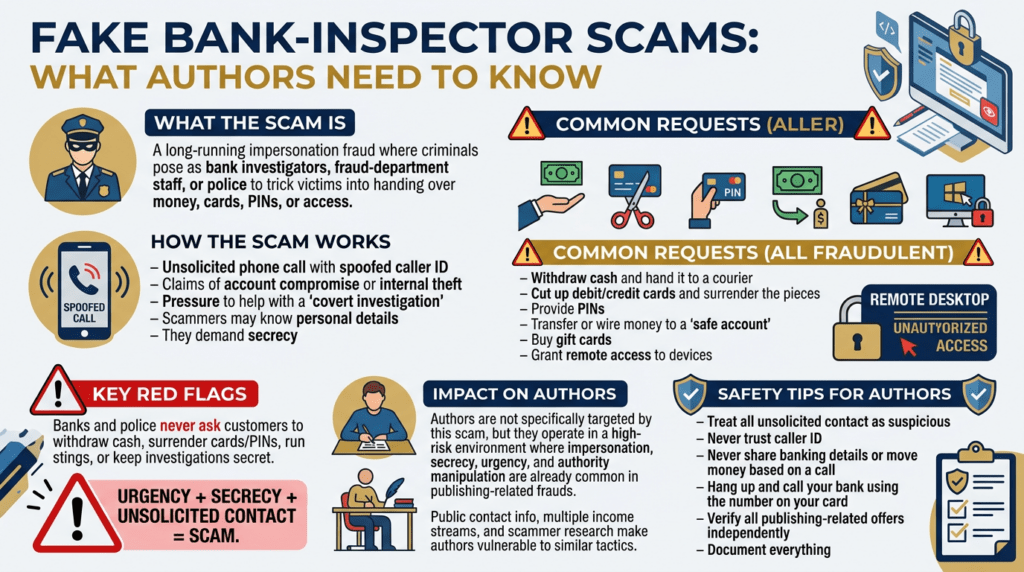
Fake bank inspector scams (also known as bank examiner or bank investigator scams) involve criminals impersonating bank officials, fraud investigators, or police to convince victims that their accounts are compromised or that they must assist in a covert investigation. Victims are pressured to withdraw cash, surrender cards or PINs, transfer funds, or grant remote access. The scam has operated for decades and remains active, primarily targeting the general public (especially older adults). There is no documented evidence that authors are a uniquely targeted demographic for this specific fraud. However, the core tactics—authority impersonation, secrecy, urgency, and emotional pressure—overlap with impersonation scams commonly directed at writers in the publishing industry. Understanding the mechanics improves overall scam resistance.
Scam Type
Impersonation (Fake Bank Inspector / Bank Examiner Fraud)
Incident Description
Not provided. The source material describes the typical operation of the scam rather than any specific incident involving an author or a named victim. General pattern: An unsolicited phone call (often with spoofed caller ID appearing as the victim’s bank or local police) claims the victim’s account is compromised, a bank employee is stealing, or the branch is under investigation. The victim is told they must help with a confidential “sting” operation and is instructed not to contact the bank or family. Requests follow for cash withdrawals handed to a courier, surrender of cards (sometimes with the chip intact), PINs, wire transfers to a “safe account,” gift-card purchases, or remote computer access. Once assets or information are obtained, contact ceases. Variations include fake deposits that must be “returned” or escalation to purported law-enforcement involvement. The scam has been documented since at least the 1990s and continues, with one cited regional example of more than $1 million stolen across dozens of cases in a single year in Ontario.
Evidence / Excerpts
- Typical caller claims: “Your account has been compromised”; “A bank employee is stealing”; “Your branch is under investigation”; “You must help with a confidential operation.”
- Common instructions: Withdraw a large sum of cash and hand it to a courier or “investigator”; cut up a debit or credit card and surrender the pieces; provide PIN; transfer or wire money to a “safe account”; buy gift cards; grant remote access to computers or banking apps.
- Historical note: Documented for decades (examples from the 1990s and earlier); remains active with recent significant losses reported.
- No screenshots, emails, or author-specific correspondence are included in the source material.
Red Flags
- Unsolicited contact claiming an urgent, secret investigation.
- Requests to withdraw cash, surrender physical cards, provide PINs, or move money.
- Instructions to keep the matter secret from bank staff or family.
- Pressure to act immediately and not independently verify.
- Spoofed caller ID appearing as a bank or police number.
Legitimate banks, police, and investigators never ask customers to withdraw cash, surrender cards or PINs, participate in sting operations, or maintain secrecy about an investigation.
Scammer Method & Tactics
- Authority impersonation (bank officials, internal investigators, or police).
- Caller-ID spoofing.
- Pre-gathered personal details (name or partial account information) to build credibility.
- Secrecy and isolation (do not tell anyone).
- Urgency and high-pressure demands for immediate action.
- Emotional manipulation (fear of account compromise or desire to “help” catch a thief).
- Escalation after initial compliance (further requests or purported law-enforcement involvement).
These psychological levers—authority, secrecy, urgency, and pressure—are the same ones used in many publishing-related impersonation scams (fake agents, publishers, film scouts, marketing services).
Risk Level
Medium (for authors). The specific scam is not documented as targeting writers, but authors operate in a high-impersonation-risk environment with public contact details, multiple income streams (royalties, KDP, PayPal, etc.), and frequent unsolicited offers. The overlapping tactics make recognition valuable.
Recommended Action for Authors
- Treat all unsolicited contact (phone, email, DM, WhatsApp, Telegram) as suspicious.
- Never act on urgency or secrecy demands.
- Never trust caller ID.
- Never share banking details, PINs, cards, or move money based on a call.
- Hang up immediately and contact your bank using the number printed on your card (not any number supplied by the caller). Report the incident to police.
- Keep author email addresses private (use a contact form).
- Independently verify every publishing-related offer.
- Document all suspicious contact (screenshots, timestamps, emails).
These steps protect against both this financial scam and common publishing impersonation frauds.
Status
Active
Source: https://authorsagainstscammers.org/2026/08/14/fake-bank-inspector-scams-what-authors-need-to-know/

Rae Stonehouse is a Canadian author, publisher, and advocate committed to exposing publishing scams and supporting writers through education and community. As the creator of Authors Against Scammers, Rae provides clear, practical guidance to help writers protect their work, their money, and their peace of mind. His books and resources reflect a lifelong dedication to empowering others through knowledge, clarity, and real‑world experience.