Summary
This case study documents a common impersonation scam in which fraudsters pose as legitimate literary agents or agencies to target aspiring authors. Scammers spoof or intercept query communications, praise submitted work, request full manuscripts, and then demand upfront fees (typically $500–$5,000) under the guise of processing, editing, or marketing costs. The scam exploits authors’ hopes for representation after rejections, leading to financial losses, potential data theft, and eroded confidence. Two illustrative scenarios are described. Authors are advised to verify all contacts independently and never pay fees to agents.
Scam Type
Impersonation (Fake Literary Agent)
Incident Description
The blog post describes a typical, scripted impersonation process rather than a single unique incident with named dates or victims beyond examples. Scammers monitor or spoof legitimate agency query emails/portals. They respond using slight domain variations or free email services, adopt real agents’ names/photos/bios, request the full manuscript after initial praise, then introduce a fee demand after offering “representation.” Payment is requested via untraceable methods, after which the scammer may demand more money or disappear.
Two example scenarios are provided:
- An author (Sarah) queried a real agency and received an enthusiastic response from a spoofed address requesting a $1,200 “submission fee” to a publisher. Verification via the agency’s phone confirmed no such contact.
- An author (Mike) received an unsolicited representation offer from a near-identical but fake domain demanding an $800 “editing deposit,” accompanied by urgency about an upcoming “auction.” Cross-checking public databases showed no matching deals.
Evidence / Excerpts
No screenshots or original documents are provided. The following excerpts and example communications are quoted or paraphrased from the blog post:
- Typical bait response: “We’ve loved your sample chapters! Send the full manuscript.”
- Insider-sounding language: “This has bestseller potential for [real publisher].”
- Fee demands described as “processing fee,” “editing deposit,” or “marketing setup cost” of $500–$5,000.
- Scenario 1 example: Response from “Sarah.Johnson@AgencyXAgents.com” insisting on a $1,200 “submission fee” to HarperCollins (real domain was AgencyX.com).
- Scenario 2 example: Email from “JaneDoe@PrestigeLiterary.net” (real agency: PrestigeLiterary.com) stating “We’re offering representation—an $800 editing deposit secures your spot!” and “Auction next week!”
- Additional pressure language noted: “Limited slots—sign now!” and “Sign today or lose this opportunity!”
Red Flags
- Vague or unverifiable credentials (name-dropping real agencies without matching official website, LinkedIn, or public records).
- Any request for upfront payment (“reading,” “submission,” “legal,” “processing,” “editing,” or “marketing” fees). Legitimate agents work on commission (typically 15% of sales) after a deal.
- Pressure tactics and artificial urgency (“Sign today or lose this opportunity!”).
- Unrealistic promises (“Guaranteed publishing deal” or “bestseller status in months”).
- Domain or email discrepancies (e.g., agent@legitagency.com vs. agent.legitagency@gmail.com or similar spoofed addresses).
- Evasiveness about past sales, client lists, or verifiable agency events.
- Use of free email services, mismatched photos, poor grammar in contracts, or unprofessional tools (e.g., Google Docs instead of agency templates).
Scammer Method & Tactics
Scammers follow a four-step playbook designed to mimic the legitimate querying process:
- Bait: Intercept or spoof a query to a real agency and respond enthusiastically, requesting the full manuscript.
- Building Trust: Impersonate a real agent’s name, photo, and bio; use insider publishing terminology.
- Hook: Offer representation with praise, then introduce an upfront fee presented as recoupable.
- Extraction and Ghosting: Collect payment via wire transfer or cryptocurrency, then demand additional fees or vanish.
Psychological tactics employed include reciprocity (the scammer “reviewed” the work), scarcity (limited slots), and authority (impersonating known names). Common supporting patterns include free email addresses, domain spoofing, and contracts with poor grammar.
Risk Level
High
Recommended Action for Authors
- Independently verify every contact: Search the official agency website, QueryTracker, Manuscript Wishlist, and Publishers Marketplace. Call the agency’s publicly listed phone number and ask for the agent by name.
- Never pay any upfront fee to an agent or agency.
- Document all communications (screenshots, email headers, timelines). Use a dedicated query email address.
- Do not click links, download attachments, share bank details, or send full manuscripts until legitimacy is confirmed. Reply only to verified official domains.
- Avoid untraceable payment methods (wire transfers, gift cards, cryptocurrency).
- Join author communities (e.g., Absolute Write, 20BooksTo50K) for scam alerts and maintain a query tracking spreadsheet that includes official agency URLs.
- Report suspicious offers to AuthorsAgainstScammers.org and relevant forums.
Status (Active / Resolved)
Active
Source: https://authorsagainstscammers.org/2026/04/09/beware-the-fake-literary-agent/
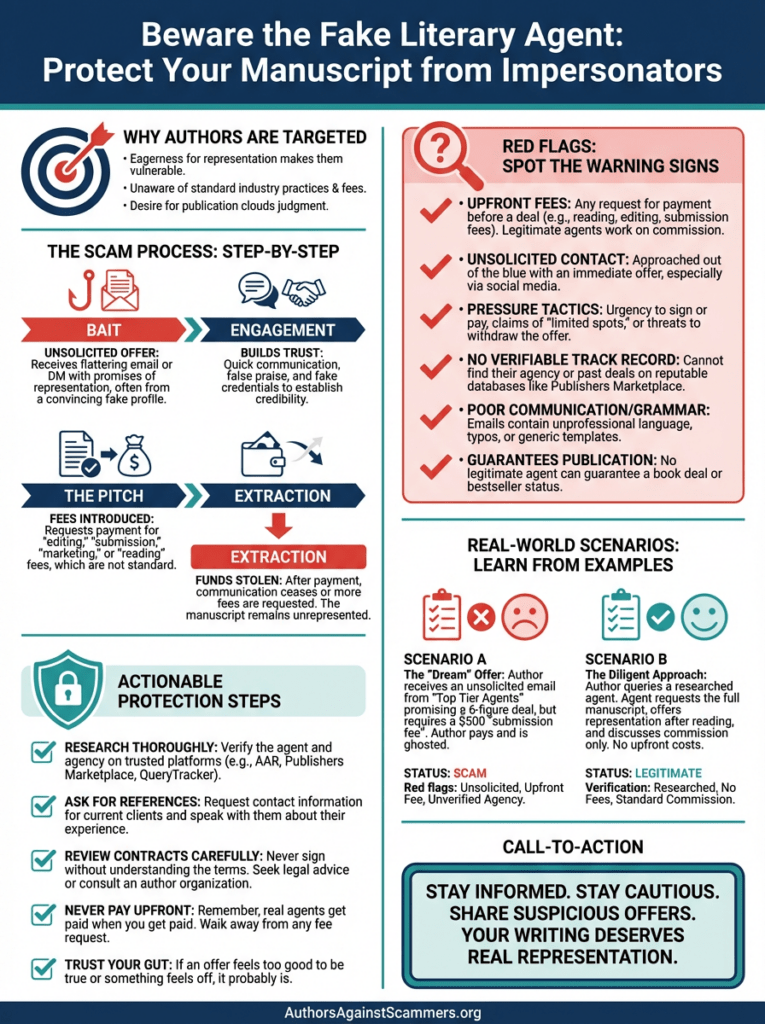
Infographic guide to spotting scam literary agents, red flags, scam process, real-world examples, and actionable protection steps from AuthorsAgainstScammers.org.

Rae Stonehouse is a Canadian author, publisher, and advocate committed to exposing publishing scams and supporting writers through education and community. As the creator of Authors Against Scammers, Rae provides clear, practical guidance to help writers protect their work, their money, and their peace of mind. His books and resources reflect a lifelong dedication to empowering others through knowledge, clarity, and real‑world experience.