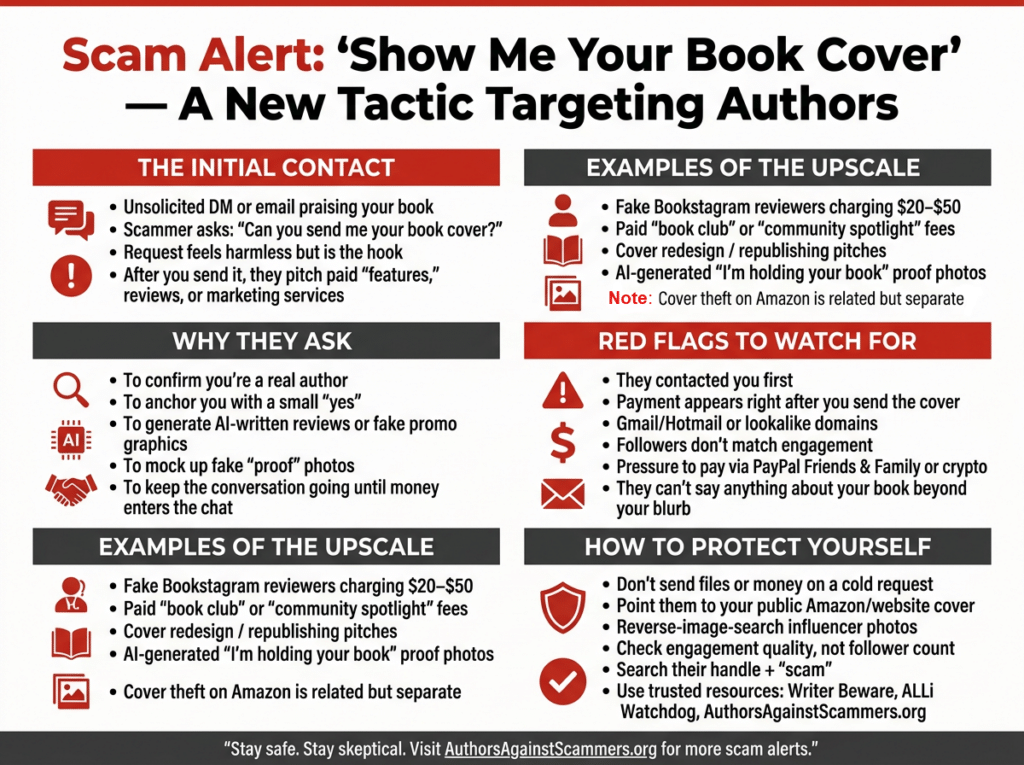
Self‑published and indie authors are facing a new wave of low‑effort, AI‑assisted scams built around a simple request: “Can you send me your book cover?” It sounds harmless. It feels flattering. And that’s exactly why scammers use it.
While there isn’t a single named scam built around this phrase, it has become a common opening move in multiple fraud patterns—fake reviewers, fake book clubs, fake marketers, fake agents, and fake “republishing” services. The request is designed to get you talking, lower your guard, and funnel you toward paid services that don’t exist.
This Scam Alert breaks down how the pitch works, why scammers want your cover, and how to protect yourself.
🚨 How the Scam Usually Starts
A stranger contacts you out of the blue—email, Facebook, Instagram, Twitter/X, or WhatsApp.
Their message follows a predictable pattern:
- They “love” your book, your genre, your blurb, or your “writing voice.”
- They claim they want to feature, review, promote, or showcase your book.
- Then they ask: “Can you send me your book cover?”
This request feels safe. After all, your cover is already public. But the goal isn’t the image—it’s the conversation.
Once you send the cover, the scammer escalates into a paid offer.
🧩 Why Scammers Ask for Your Book Cover
Scammers use the cover request as a psychological and practical foothold:
- To anchor you with a small “yes” Sending a cover feels harmless. That tiny compliance makes you more likely to accept the next request.
- To confirm you’re a real, active author Your cover proves you have a published book—and therefore a marketing budget to exploit.
- To personalize their pitch using AI With your cover, scammers can:
- scrape your Amazon listing
- generate AI‑written “reviews”
- create fake “analysis reports”
- mock up fake promotional graphics
- impersonate legitimate publishers more convincingly
- To prepare a fake “proof of work” They may send back a fabricated image of your book “featured” on their page or “held” in their hand.
- To keep the conversation going until money enters the chat The cover request is the bait. The upsell is the trap.
🎭 Common Scam Variants Using the Cover Request
- Fake Bookstagram / Reviewer Accounts
These accounts often have:
- thousands of followers but almost no real engagement
- the same stock background in every photo
- AI‑generated “reviews” pulled from your blurb
- stolen profile photos
They ask for your cover so they can “share it,” then reveal a fee: $20–$50+ via PayPal, CashApp, or crypto.
Legitimate reviewers:
- rarely cold‑DM authors
- don’t lead with a price
- don’t need your cover—they can find it online
- Paid “Feature” or Book‑Club Scams
A “reading community,” “book club,” or “marketing team” praises your book and asks for the cover to “show members.”
Then comes:
- a spotlight fee
- an admin fee
- a “token of thanks” for reviewers
- or a bundle of paid “placements”
Real book clubs do not charge authors to appear.
- Cover Redesign / “Republish for Discoverability” Pitches
The scammer claims:
- your cover is hurting sales
- they need to see it to “evaluate market positioning”
- they can “relaunch” your book for better visibility
This leads to:
- paid redesigns
- paid republishing
- paid “distribution” packages
These services are almost always fake or worthless.
- Fake Proof Photos
If you ask for proof they have your book, scammers may send:
- a photo of themselves “holding” your book
- an AI‑generated image with warped text or mismatched lighting
- a photo identical to their profile picture but with your cover pasted in
One documented case involved a marketer sending a badly generated “I’m reading your book” selfie.
- Cover Theft (Related but Separate)
Some scammers steal published covers and slap them onto:
- blank notebooks
- low‑content books
- counterfeit listings on Amazon
This is copyright infringement against you—not a pitch to you—but it often overlaps with the same scam ecosystem.
⚠️ Red Flags to Watch For
- They contacted you first.
- They immediately ask for your cover.
- Payment appears right after you send the file.
- Gmail/Hotmail/AOL or lookalike domains.
- Followers that don’t match engagement.
- Covers in their feed pasted onto identical backgrounds.
- Pressure to pay via PayPal Friends & Family or crypto.
- They can’t name anything specific about your book beyond your blurb.
🛡️ How to Protect Yourself
- Don’t send files or money on a cold request. If someone truly needs your cover, point them to your Amazon or website listing.
- Verify accounts with reverse image search. Fake influencers often use stolen photos.
- Check their engagement, not their follower count. Real reviewers have comments from real readers.
- Search their handle + “scam.” Many repeat offenders are already documented.
- Use trusted resources:
- Writer Beware
- ALLi Watchdog
- AuthorsAgainstScammers.org
- Never pay upfront for reviews, features, or “visibility.” Real opportunities don’t require author payment.
📌 Bottom Line
The “show me your book cover” request is not about your cover. It’s about:
- establishing contact
- building false trust
- creating a fake sense of legitimacy
- and funneling you toward paid services that don’t exist
Sending a publicly available cover isn’t dangerous. Paying for anything that follows is.
If someone needs your cover to “use” it, you’re not being offered an opportunity—you’re being sold a funnel.

Rae Stonehouse is a Canadian author, publisher, and advocate committed to exposing publishing scams and supporting writers through education and community. As the creator of Authors Against Scammers, Rae provides clear, practical guidance to help writers protect their work, their money, and their peace of mind. His books and resources reflect a lifelong dedication to empowering others through knowledge, clarity, and real‑world experience.