Case Study: Anatomy of a Book Club Spotlight Invitation
Some scams announce themselves with misspellings and impossible prizes. This one arrives as admiration. In this case study, AuthorsAgainstScammers.org examines an unsolicited email from “Stella Sam” (stellasam710@gmail.com) inviting the author of Blow Your Own Horn!: Personal Branding for Business Professionals to appear in a “Reader Impact Spotlight” hosted by Prominent Book Club. The message fits a family of approaches in which a stranger offers an author recognition and an audience, while the commercial terms arrive later, if at all. Authors are natural targets: they want readers, they expect to hear from readers, and promotional offers are hard to verify from the outside.
A note on method and fairness. We have the invitation, the sender’s Gmail address, and the public pages of the club’s website. We do not have the message headers or any follow-up correspondence, and we have no evidence that anyone has paid money. This case study therefore describes what the evidence shows, compares it with documented patterns, and flags the questions an author should still ask. Where we describe what might happen next, we say so plainly.
Case Background: A Message Written to Be Believed
The email is addressed to Rae A. Stonehouse and signed “Stella Sam, Co-Organizer, Prominent Book Club.” It was sent from stellasam710@gmail.com, a free consumer address rather than one tied to a club domain. The message has three movements. The first is a long, detailed appreciation of the book: its argument that self-promotion is not bragging, its point that an online persona is only one step in a marketing strategy, its coverage of LinkedIn, networking, job searching and reputation management, and the “squeaky wheel” opening. The second describes the club as a “promotional and reader-engagement platform” with more than 10,000 active readers in the UK, US, Australia, and South and West Africa, plus weekly virtual meetings and Author Spotlight sessions. The third asks a personal question about the author’s career and invites participation in the next Reader Impact Spotlight.
Equally important is what the email leaves out. It contains no event date, no link to the club’s website or past sessions, no named previous authors, no evidence of attendance, and no explanation of what participation costs. There is no payment request, deadline, or demand for account access. Those omissions do not prove wrongdoing, but they leave every factual claim in the message resting on the sender’s word alone.
Findings: Three Tactics, One Paragraph at a Time
Paragraph one: flattery through specificity. Generic praise is easy to dismiss. Detailed praise is harder to doubt, because it implies someone read closely. Here the sender restates the book’s thesis, then calls it a “genuinely important reframe.” That is validation aimed at the author’s core belief, delivered in the author’s own vocabulary. But repeating information from a book description, sample pages, or an automated summary requires no real reading. Authors Guild has warned that book-club scammers may use AI-generated summaries for exactly this purpose, so accurate detail should not be treated as proof of sincerity.
Paragraph two: authority by assertion, offers by vagueness. “Co-organizer,” “curated spotlight events,” “over 10,000 active readers,” and “a growing global audience” create an impression of an established institution. Each is a claim without independent support. Much of this paragraph also closely follows the wording on the club’s own home page, so it repeats the club’s marketing rather than confirming it. The phrasing contains a quiet tell: the club calls itself a “promotional” platform that “helps authors showcase their work,” which describes a service for authors, not readers independently choosing a book. The email adds that a Spotlight with the author happens before a book is formally introduced, making the author’s participation a prerequisite for the very exposure on offer.
Paragraph three: curiosity, then a small ask. The sender poses a thoughtful question about the author’s career, which invites a reply and starts a conversation. The final request, “would you be open to joining us?”, asks for interest, not money. This is the low-friction step. A reply confirms that the address is active, marks the author as engaged, and makes any later fee feel like a logistical detail instead of a fresh decision. Urgency and impersonation, common escalation tactics in this scam family, are not present in this message.
Evidence Review: The Sender Address and the Website
The Gmail address. A Gmail address does not make a sender dishonest; plenty of small, genuine reading groups use free email. But an organisation claiming 10,000 active members across several continents and a programme of curated events could easily have a club-domain address, and Writer Beware has noted that the book-club solicitations it has tracked come from Gmail addresses. The name “Stella Sam” and the numeric suffix also tell us nothing, because anyone can create such an account in minutes. We cannot say who controls it. We can say that the address offers no verification of the person, the role, or the club.
The website. Prominent Book Club does have a website, and the description in the email appears there almost word for word. The home page names Ashley Mason as founder; in the pages we reviewed, we did not see Stella Sam identified as a co-organizer, so an author should ask the club to confirm her role. A “High Attendance Sessions” page asserts strong attendance and invites authors to “Apply for a Spotlight Feature,” which sits oddly with an email presenting the author as specially selected. An automated ScamAdviser scan rated the domain’s trust as low, noting a recent registration, owner details hidden on WHOIS, and free email contacts. That is an automated indicator, not proof of fraud. The phrase “Reader Impact Spotlight” also appears on an apparently unrelated site, The Inner Chapter Society. We have not established any link between the two, but copied wording is a reason to verify.
Assessment: Why the Offer Cannot Be Taken at Face Value
A virtual author discussion is entirely possible, and legitimate paid promotion exists. The problem is that the central term of this offer, “feature,” is undefined. Does it mean a free reader-led discussion, a paid advertising slot, or a package of services? The website’s “Apply for a Spotlight Feature” language suggests an application funnel for authors, which makes that question more pressing. Fraud would require that someone knowingly misrepresent their identity, audience, or the service on offer to obtain money or information. The invitation alone does not demonstrate that, but its vagueness is where a deceptive version of this offer would hide.
One claim deserves particular scrutiny. The email says members “actively share thoughtful reviews and reflections” after each Spotlight, “particularly on platforms like Goodreads.” No organiser can honestly guarantee what independent readers will write. If a follow-up promised a set number of positive reviews or a ranking boost, that would be a materially different, and far more serious, proposition. Goodreads guidelines call for authentic reader reviews and treat artificial manipulation of ratings and undisclosed commercial reviews as grounds for removal, so purchased enthusiasm can damage an author rather than help.
Psychology: Why It Works on Thoughtful Authors
The message is especially well fitted to this book. An author who argues that professionals must be seen is offered visibility. The invitation therefore matches what the author already believes, which encourages confirmation bias: supportive details receive attention while missing ones go unnoticed. It also grants the author status, the sense of being selected and understood, which is a stronger motivator than a discount or a deadline.
Reciprocity and commitment do the rest. When someone appears to have spent time on your work, replying feels like good manners. Imagine, as an illustration and not as something documented here, that the author answers the career question, agrees to a date, and prepares talking points. When an “administration fee” or “spotlight package” then appears, paying feels like completing an arrangement rather than making a new purchase. This is why capable, careful authors are caught. The technique relies on social decency, not gullibility.
Industry Context: A Documented Pattern
This case matches a pattern others have recorded. Writer Beware reported in September 2025 on fake book clubs, and on impersonations of real ones, charging “spotlight,” participation, or place-securing fees of roughly $55 to $350, typically from Gmail addresses and with AI-style personalised praise. Author Catherine Lynwood described the same sequence: several friendly exchanges, then a $199 “administrative fee” she had not been told about. WritersWeekly reported authors being asked for about 99 euros and refusing to share previous write-ups. The Authors Guild has likewise warned of book-club solicitations, upfront charges, and AI-written summaries. These reports establish the pattern, but they do not establish a fee or outcome in the present case.
The underlying structure is familiar across publishing scams: recognition first, relationship second, monetisation last. Whether the product is a fake film option, a paid “discovery” interview, or a promotional spotlight, the author is made to feel chosen before learning the price. Unsolicited contact, polished writing, or a modest audience is not proof of dishonesty on its own. What matters is whether identity, claims, terms, and delivery can be independently verified.
Red Flags Revealed by This Case
- An unsolicited invitation from a free Gmail address instead of an address on the club’s own domain.
- Very detailed praise from a stranger who offers no verifiable details about their own organisation.
- A self-described “promotional platform” presented as an ordinary reading group.
- Large audience figures with no independent evidence of attendance, past events, or named past guests.
- An undefined “feature” or “spotlight” whose cost and deliverables are never stated.
- A signatory whose role cannot be matched to the founder named on the club’s website.
- A request that the author appear before the book is introduced to members.
- Any promise of reviews, ratings, or sales outcomes the organiser cannot control.
- Later pressure involving deadlines, fees, passwords, or verification codes.
Lessons Learned: How to Respond
The first lesson is to verify before you reply. Search for the club independently, and look for a sustained record of meetings, named past authors, and real member discussion. Ask the club to confirm, from an address on its own domain, that the sender belongs to it and what her role is. Do not rely on a polished website, because a website proves very little on its own.
The second lesson is to ask direct questions in writing. What does a feature include? What is the event date and expected attendance? Is there any cost, now or later? Can you speak with two past guests? A legitimate organiser will answer calmly. Never share account passwords or authentication codes, and do not send payment before you have confirmed identity and terms. If the answers stay vague, you can stop replying with no obligation.
Call to Action: Add Your Case File
Every reported message makes the pattern easier to recognise. If you receive a similar invitation, keep the original email, headers, follow-ups, invoices, and payment details, and note the sender address. Report suspected impersonation to the real organisation and suspicious messages to the platform involved. The Authors Guild accepts reports at scams@authorsguild.org, including from non-members. If you have paid, contact your payment provider promptly and report to the appropriate fraud authority. Then share your experience with AuthorsAgainstScammers.org, removing private details and separating what you can document from what you suspect. Recognition should never require abandoning verification, and a genuine opportunity can withstand scrutiny.
~~~
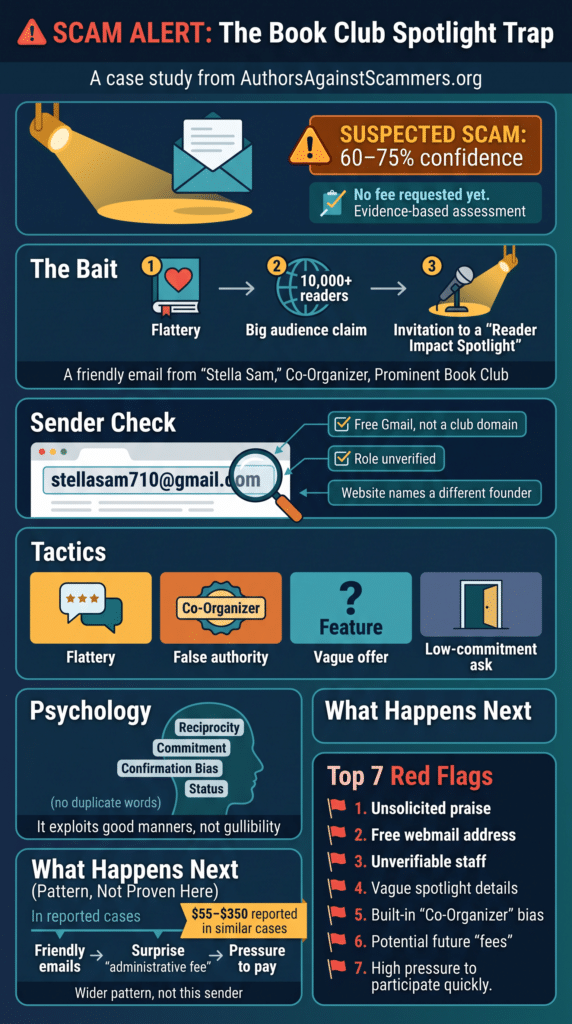
Forensic Analysis:
Scam Confidence: 60-75% likelihood. The Gmail sender, flattery, unverified audience claims, an undefined “feature,” and a website that invites authors to apply all match documented book club scams. No fee has been requested yet, so this is a suspected scam, not a confirmed one.
Threat Type: Suspected fake book club scam / paid author promotion fraud (Phishing/Marketing Services). The pattern is an author spotlight scam: flattery and an invitation first, with possible undisclosed “spotlight” or “administrative” fees later. Related search terms: book club scam, fake book club spotlight, Prominent Book Club scam, Stella Sam scam.
Target Audience: Self-published and independent authors, especially nonfiction and business authors with public Amazon and Goodreads listings. Authors seeking readers, reviews, and visibility are most exposed because the offer matches what they want. In this case the target is the author of a personal branding book.
Key Red Flags: Top indicators in this case:
- Free Gmail address instead of a club-domain email.
- Detailed flattery that proves little about the sender.
- Unverified 10,000-reader claim with no past events or named guests.
- Undefined “feature” with no stated cost or deliverables.
- Self-described “promotional platform” posing as a reading group.
- Signatory not matched to the founder named on the website.
- Review promises about Goodreads that no organiser can guarantee.
Recommended Actions: Immediate steps for authors:
- Do not pay or agree to any spotlight, feature, or package until terms are written down.
- Reply only with verification questions: cost, event date, attendance, past guests.
- Keep the email and headers and screenshot the club website.
- Never share passwords, authentication codes, or account access.
- Block the sender if answers stay vague, and report it to the Authors Guild, Writer Beware, and your email provider.
- If you paid, contact your payment provider immediately and file a fraud report.
Related Scams: Documented parallels, each with its source:
- Fake book club fee scam: Writer Beware, September 2025, reporting $55 to $350 spotlight and participation fees.
- Impersonated book clubs: Writer Beware, September 2025, describing real clubs’ names copied by outside senders.
- Administrative fee after friendly exchanges: Catherine Lynwood’s author blog, describing a $199 charge.
- Paid spotlight request: WritersWeekly report of an approximately 99-euro charge.
- AI-written praise and upfront charges: Authors Guild scam alert, February 2026.
Sender Details: Stella Sam, stellasam710@gmail.com, signing as Co-Organizer, Prominent Book Club. The address is a free Gmail account, not a club domain, and the numeric suffix suggests a quickly created account. The signature gives no phone number, website, social media link, or postal address. In the pages reviewed, the club’s website names a different founder and does not identify Stella Sam. Her role is therefore unverified.
Additional Context: The message is long, flattering, and shaped around the book’s own argument. Its closing request asks only whether the author is open to joining, which is the low-commitment first step typical of an author spotlight scam. In reported cases, costs appeared only after several friendly exchanges. The sender also promises that members will review the book on Goodreads. No organiser can guarantee honest reader reviews, and purchased or arranged reviews can breach platform rules. Headers and follow-up emails would strengthen this assessment.
Footnotes/Sources: Primary, verifiable sources only. Please confirm each link and date before publishing.
- Writer Beware (Science Fiction and Fantasy Writers of America): September 2025 report on fake and impersonated book clubs charging spotlight fees.
- Authors Guild: February 2026 scam alert on book club solicitations, upfront charges, and AI-written summaries. Reports go to scams@authorsguild.org.
- WritersWeekly: report of authors asked for about 99 euros and refused previous write-ups.
- Catherine Lynwood author blog: first-hand account of a $199 administrative fee after friendly exchanges.
- ScamAdviser: automated trust report on the Prominent Book Club domain.
- Prominent Book Club website (home and High Attendance Sessions pages): archive these pages and save screenshots before they change.
- Goodreads review guidelines: rules on authentic and compensated reviews.
Book/Product Targeted: Blow Your Own Horn!: Personal Branding for Business Professionals, a nonfiction personal branding and self-promotion title. The sender discusses its themes in detail, which makes the approach feel personal. The topic also suits the pitch, because an author writing about visibility is offered visibility.
Fake Website: The Prominent Book Club website exists, but its claims are unverified. Its wording closely matches the email. The home page names a founder other than Stella Sam, and a High Attendance Sessions page invites authors to Apply for a Spotlight Feature. An automated ScamAdviser scan gave the domain a low trust score, citing recent registration, hidden WHOIS owner details, and free email contacts. Treat that as an indicator, not proof. Verification status: suspicious, not confirmed fraudulent.
Reported Losses: None confirmed in this case. No fee has been requested in the message reviewed. In comparable fake book club reports, authors were asked for roughly $55 to $350, including a reported $199 administrative fee and a request of about 99 euros. These figures describe the wider pattern, not this sender.
Geographic Focus: Global. The club claims readers in the UK, US, Australia, and South and West Africa. The email does not state where the targeted author is based. Similar book club scam reports come from US, UK, and European authors, so authors in any country should treat the approach as relevant.

Rae Stonehouse is a Canadian author, publisher, and advocate committed to exposing publishing scams and supporting writers through education and community. As the creator of Authors Against Scammers, Rae provides clear, practical guidance to help writers protect their work, their money, and their peace of mind. His books and resources reflect a lifelong dedication to empowering others through knowledge, clarity, and real‑world experience.