How One Author Lost $50,000 to a Fake Publisher — And How You Can Avoid the Same Trap
Scams in the publishing world aren’t new, but their sophistication is growing. Every week, authors—especially indie authors—share stories of being targeted by fake agents, predatory publishers, and “marketing experts” who promise the world and deliver nothing. One recent case stands out: an author who lost $50,000 to a fraudulent publisher operating under a polished brand, professional‑sounding emails, and fabricated royalty reports.
This isn’t an isolated incident. It’s a wake‑up call.
At Authors Against Scammers, our mission is to empower writers with knowledge—not fear—so you can protect your creative work, your finances, and your peace of mind. This case study breaks down how the scam unfolded, why authors are vulnerable, and how you can stay one step ahead.
Why This Topic Matters?
Authors are prime targets.
Writers, freelancers, and creatives often work independently, navigating a complex industry without a built‑in support system. That makes us vulnerable to:
- Confusion about standard publishing practices
- Emotional manipulation, especially when someone praises our work
- Inexperience with contracts, royalties, and industry norms
Scammers know this. They exploit ambition, hope, and the desire for validation.
How Scammers Exploit Authors
Fraudsters use a blend of:
- Flattery (“Your book is incredible—we want to publish it immediately!”)
- Authority theater (fake credentials, fake staff, fake offices)
- Urgency (“This offer expires today!”)
- Complexity (invented fees, confusing royalty structures)
When you’re juggling writing, marketing, and life, it’s easy to miss the red flags.
The Real‑World Consequences
Falling for a scam isn’t just about losing money. Authors report:
- Financial loss—sometimes thousands
- Identity theft
- Emotional exhaustion
- Loss of confidence in their work
- Delayed publishing timelines
- Fear of trusting legitimate professionals
The author in this case lost $50,000—but the emotional toll was just as heavy.
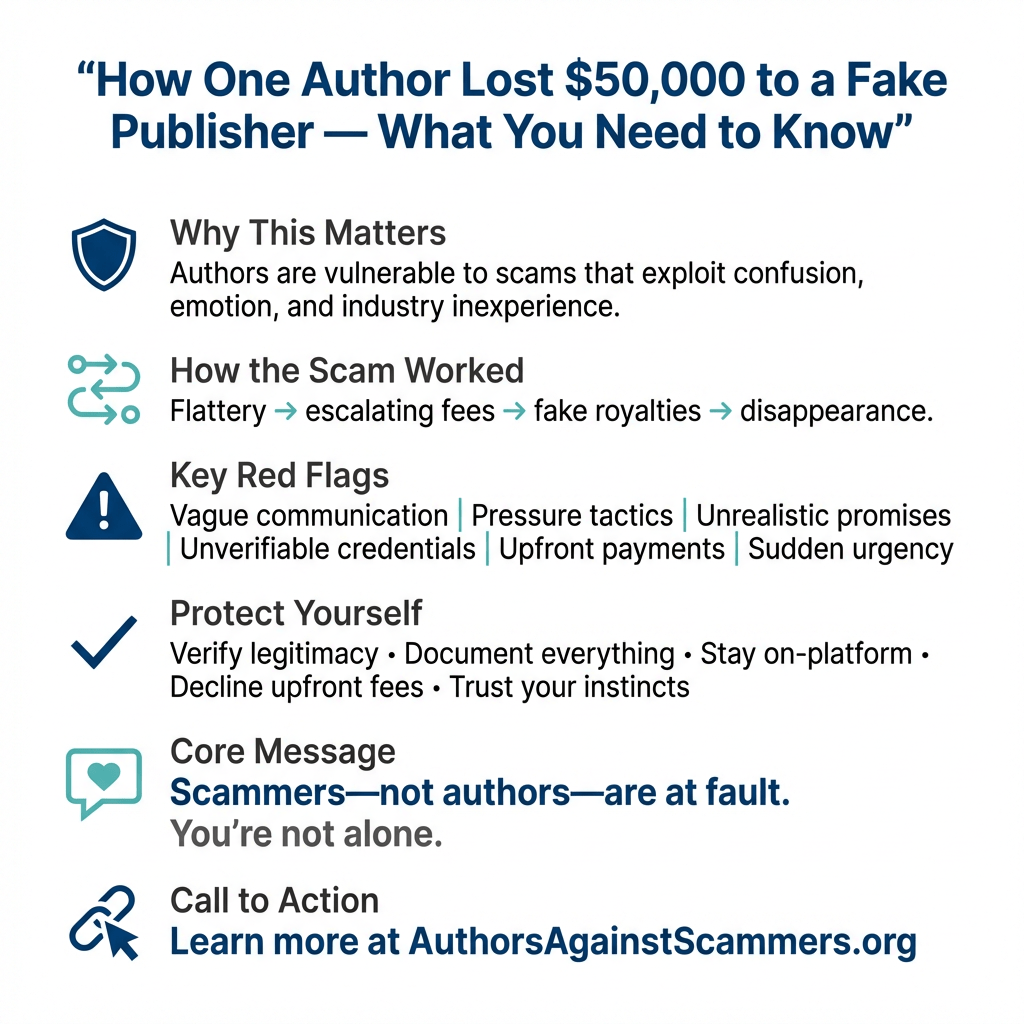
How the Scam Worked: A Step‑by‑Step Breakdown
- The Approach
The scammer contacted the author with a polished pitch:
- “We love your book.”
- “We want to publish it internationally.”
- “We can guarantee major distribution.”
The email looked professional. The website looked real. The testimonials were fabricated.
- Building Trust
The scammer used psychological tactics:
- Reciprocity: offering “free” services upfront
- Authority: claiming ties to major retailers
- Scarcity: “We only accept a few authors each quarter.”
- Social proof: fake reviews, fake success stories
The author felt chosen—special.
- The First Payment
The scammer requested a small “processing fee.”
Then a “layout fee.”
Then a “distribution fee.”
Then a “marketing package.”
Each fee seemed reasonable on its own. Together, they added up.
- The Escalation
Once the author was financially invested, the scammer increased the stakes:
- “Your book is performing well—we recommend upgrading your package.”
- “We can secure a film adaptation meeting.”
- “We can guarantee bestseller status with one final payment.”
The author, already thousands in, didn’t want to lose the progress they believed they’d made.
- The Fake Royalties
The scammer sent fabricated royalty statements showing impressive sales.
This reinforced the illusion of success.
- The Collapse
Eventually, communication slowed.
Emails bounced.
Phone numbers disconnected.
The website vanished.
The author realized the truth: it had all been a scam.
Warning Signs and Red Flags
Here are the indicators that something is off:
- Vague communication with no specifics about your book
- Pressure tactics (“Act now or lose your chance!”)
- Unrealistic promises (guaranteed bestseller status, film deals, bookstore placement)
- Unverifiable credentials (no LinkedIn presence, no staff bios, no real address)
Sudden urgency designed to bypass your critical thinking
- Requests for upfront payment for anything labeled “mandatory”
- Fake royalty reports or unverifiable sales claims
- Off‑platform communication (WhatsApp, Telegram, personal Gmail accounts)
If several of these appear together, disengage immediately.
Practical Guidance for Authors
- Verify Legitimacy
Before signing anything:
- Google the company name + “scam”
- Check LinkedIn for real staff
- Look for a physical address and verify it
- Search for the publisher on Writer Beware, ALLi, and Authors Against Scammers
- Ask for references—and actually contact them
Legitimate professionals welcome scrutiny.
- Document Everything
If something feels off:
- Screenshot emails, messages, and profiles
- Save contracts and invoices
- Record dates and payment amounts
This helps with reporting and recovery efforts.
- Respond Safely
If you’re unsure:
- Stay on the platform where they contacted you
- Ask clarifying questions
- Decline to pay upfront fees
- Say: “Please send me your website, contract, and references.”
Scammers often disappear when challenged.
- What Not to Do
Avoid:
- Sending personal information
- Paying for “mandatory” services
- Clicking suspicious links
- Moving to WhatsApp or private email
- Rushing into decisions
Take your time. Real opportunities don’t expire overnight.
- Protect Yourself in the Future
- Learn standard publishing timelines and practices
- Join reputable writing communities
- Follow scam‑alert accounts
- Use email filters and DM restrictions
- Trust your instincts—if it feels off, it is.
Examples of How These Scams Unfold
Scenario 1: The “Exclusive Offer”
A publisher emails you saying your book is “exactly what they’re looking for.”
They offer a contract—but only if you pay a $1,200 “onboarding fee.”
Scenario 2: The “Royalty Mirage”
A company sends you a glowing royalty report showing hundreds of sales.
But you can’t find your book listed anywhere online.
Scenario 3: The “Film Deal”
A scammer claims your book has been “selected for adaptation consideration.”
They ask for $5,000 to pitch it to producers.
These scenarios are composites of real reports from authors across the writing community.
You’re Not Alone — And You’re Not to Blame
Scammers are skilled manipulators.
They target your passion, your dreams, and your desire to succeed.
Falling for a scam doesn’t mean you’re naïve.
It means someone exploited your trust.
The fault lies with the scammer—not the victim.
At Authors Against Scammers, we stand with you.
We believe in informed, empowered authors who can navigate the industry with confidence.
Stay Informed. Stay Confident. Stay Creative.
If you want to protect yourself from scams like this:
- Explore more resources at AuthorsAgainstScammers.org
- Learn how to evaluate suspicious offers
- Stay updated on emerging scam tactics
- Share your experiences so others can learn
Together, we can build a safer, more transparent publishing world.
Rae Stonehouse is a Canadian author, publisher, and long‑time advocate for writer safety. After being scammed out of more than $2,000 by a fraudulent “publishing service,” he fought back, recovered his losses, and turned the experience into a mission to protect others. Through Authors Against Scammers, Rae works to educate, empower, and support writers so no author has to navigate the publishing world—or its predators—alone.

Rae Stonehouse is a Canadian author, publisher, and advocate committed to exposing publishing scams and supporting writers through education and community. As the creator of Authors Against Scammers, Rae provides clear, practical guidance to help writers protect their work, their money, and their peace of mind. His books and resources reflect a lifelong dedication to empowering others through knowledge, clarity, and real‑world experience.
0 Comments