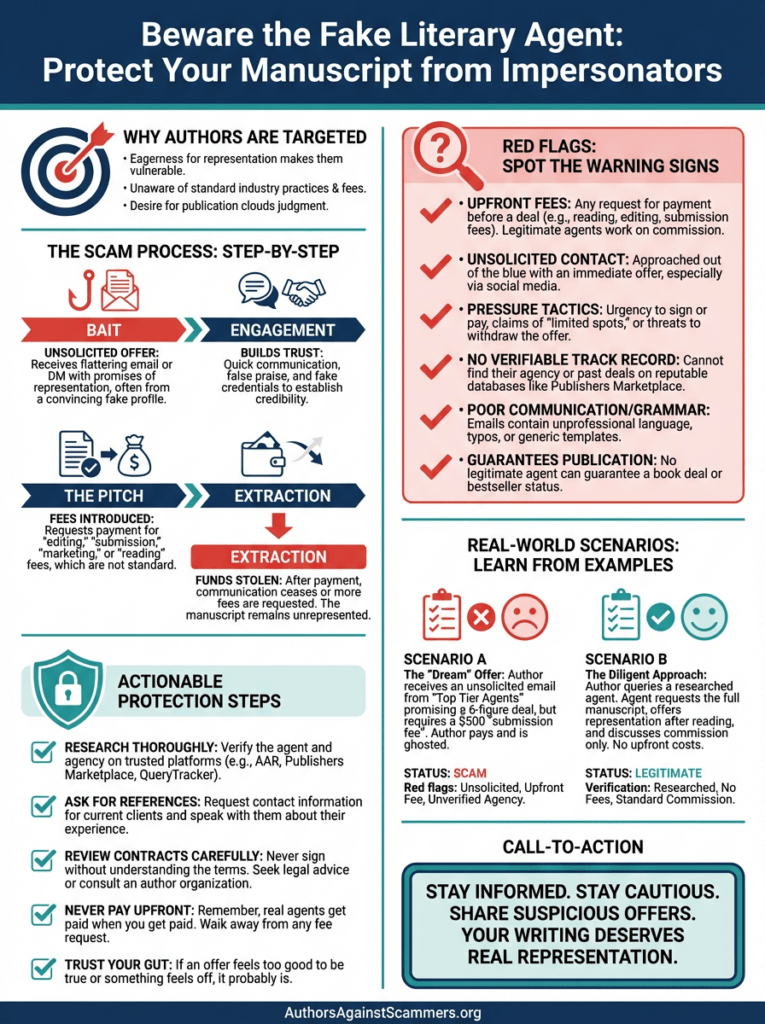
Beware the Fake Literary Agent: Protecting Your Manuscript from Impersonators
As authors, we pour our hearts into our stories, dreaming of that magical moment when a literary agent discovers our work and propels it toward publication. But scammers know this dream all too well—and they’re weaponizing it by impersonating legitimate agencies. At Authors Against Scammers, we’re here to arm you with knowledge so you can chase your goals confidently, without falling prey to fraud. This post breaks down the fake literary agent scam, empowering you to spot it, sidestep it, and thrive.
Why Fake Literary Agent Scams Matter to Authors
Authors, freelancers, and creatives are prime targets because our industry thrives on hope, persistence, and naivety about the business side. Unlike corporate jobs with HR departments, publishing often feels like a solo adventure—querying agents, navigating slush piles, and celebrating rare requests for full manuscripts. Scammers exploit this by mimicking real agencies, preying on your excitement over a “yes” after countless rejections.
They capitalize on emotional highs: the thrill of an offer stirs vulnerability, clouding judgment. Industry inexperience plays a role too—many debut authors don’t yet know that legitimate agents never charge upfront fees. The fallout is devastating: lost manuscripts, stolen personal data, drained savings from fake “processing fees,” and shattered confidence that can stall your writing career. Real-world stories abound of authors who, after being duped, hesitated to query again, letting scammers steal money and momentum. You’re not alone in this; thousands face it yearly, but knowledge turns the tables.
How the Fake Literary Agent Scam Unfolds Step by Step
These scams are cleverly scripted to mimic the real query process, but with manipulative twists. Here’s the typical playbook:
- The Bait: You query a real agency via email or their submission portal. A scammer intercepts or spoofs the agency’s domain (e.g., using “queryagentxyz.com” instead of “agentxyzagency.com”) and responds enthusiastically: “We’ve loved your sample chapters! Send the full manuscript.”
- Building Trust: They adopt the real agent’s name, photo, and bio from the agency’s website. Emails come from slight domain variations or free services like Gmail. They drop insider lingo—”This has bestseller potential for [real publisher]”—to sound legit.
- The Hook: After “reviewing” your work, they offer representation with glowing praise. Then comes the twist: a “processing fee,” “editing deposit,” or “marketing setup cost” of $500–$5,000, promised to be recouped later.
- Extraction and Ghosting: You pay via untraceable methods like wire transfer or crypto. They demand more (“administrative hurdles”) or vanish, leaving you with a fake contract and no deal.
Psychological tactics seal the deal: reciprocity (they “invest” time reviewing your work, so you feel obligated); scarcity (“Limited slots—sign now!”); and authority (impersonating trusted names). Common patterns include poor grammar in contracts, free email addresses, and pressure to act fast before “another agent swoops in.”
Key Red Flags: Spotting a Fake Agent Before It’s Too Late
Trust your instincts—these indicators scream scam:
- Vague or unverifiable credentials: They name-drop real agencies but can’t provide a direct agency website link or LinkedIn profile matching public records.
- Upfront payment requests: Legit agents earn commissions (15% of your sales) post-sale—never fees. Red flag if they ask for “reading,” “submission,” or “legal” costs.
- Pressure tactics and sudden urgency: “Sign today or lose this opportunity!” Real agents give time to review.
- Unrealistic promises: “Guaranteed publishing deal” or “bestseller status in months”—publishing is a marathon, not a sprint.
- Domain discrepancies: Check sender email (e.g., agent@legitagency.com vs. agent.legitagency@gmail.com).
- Evasive about details: Dodges questions on past sales, client lists, or agency events like conferences.
- Free or mismatched tools: Uses Google Docs for contracts instead of professional templates; photos don’t match agency headshots.
Practical Steps: How Authors Can Verify and Protect Themselves
Empowerment comes from action. Here’s your toolkit:
- Verify legitimacy: Cross-check the agent’s name, photo, and email on the official agency website (Google “[Agency Name] official site”). Use QueryTracker, Manuscript Wishlist, or Publishers Marketplace to confirm track records and deals. Call the agency’s listed phone number—ask for the agent directly.
- Document everything: Screenshot emails, save headers (right-click > “View Source” for real sender info), and log timelines. Tools like Have I Been Pwned check for data breaches.
- Respond safely: Never click links or download attachments. Reply only to the official domain. Say, “Excited! Please confirm via your agency phone/email.”
- What not to do: Don’t pay anything upfront. Avoid wire transfers, gift cards, or cryptocurrency. Never share bank details or full manuscripts without verification.
- Future-proof your process: Use a dedicated “query” email. Join communities like Absolute Write or 20BooksTo50K for scam alerts. Track queries in a spreadsheet with agency URLs.
Real-Life Scenarios: How It Plays Out
Scenario 1: The Enthusiastic Responder
Sarah queried Agency X. Days later, “Sarah.Johnson@AgencyXAgents.com” raved about her thriller and requested the full manuscript . Praise flowed, but they insisted on a $1,200 “submission fee” to HarperCollins. Red flag: The real domain was AgencyX.com. Sarah verified via phone—the agent had no record of her. Dodged the bullet.
Scenario 2: The Too-Good Deal
Mike got an email from “JaneDoe@PrestigeLiterary.net” (real agency: PrestigeLiterary.com). “We’re offering representation—an $800 editing deposit secures your spot!” Urgency peaked: “Auction next week!” Mike checked Manuscript Wishlist—no such deals. He reported it, saving his savings.
These aren’t rare; they’re weekly occurrences in author forums. Scammers fail—you succeed—when you’re prepared.
Stay One Step Ahead with Authors Against Scammers
You’re not at fault for dreaming big; scammers are the villains here. By recognizing fake literary agent tactics, you’re reclaiming your power and protecting your passion. Dive deeper into our resources at AuthorsAgainstScammers.org. Share suspicious offers in comments or on our forum to help fellow authors. Stay informed on emerging tactics, query smartly, and keep writing. Your breakthrough is coming—legitimately.
Have a scam story or question? Join the conversation below. Together, we’re unstoppable.

Rae Stonehouse is a Canadian author, publisher, and advocate committed to exposing publishing scams and supporting writers through education and community. As the creator of Authors Against Scammers, Rae provides clear, practical guidance to help writers protect their work, their money, and their peace of mind. His books and resources reflect a lifelong dedication to empowering others through knowledge, clarity, and real‑world experience.
0 Comments