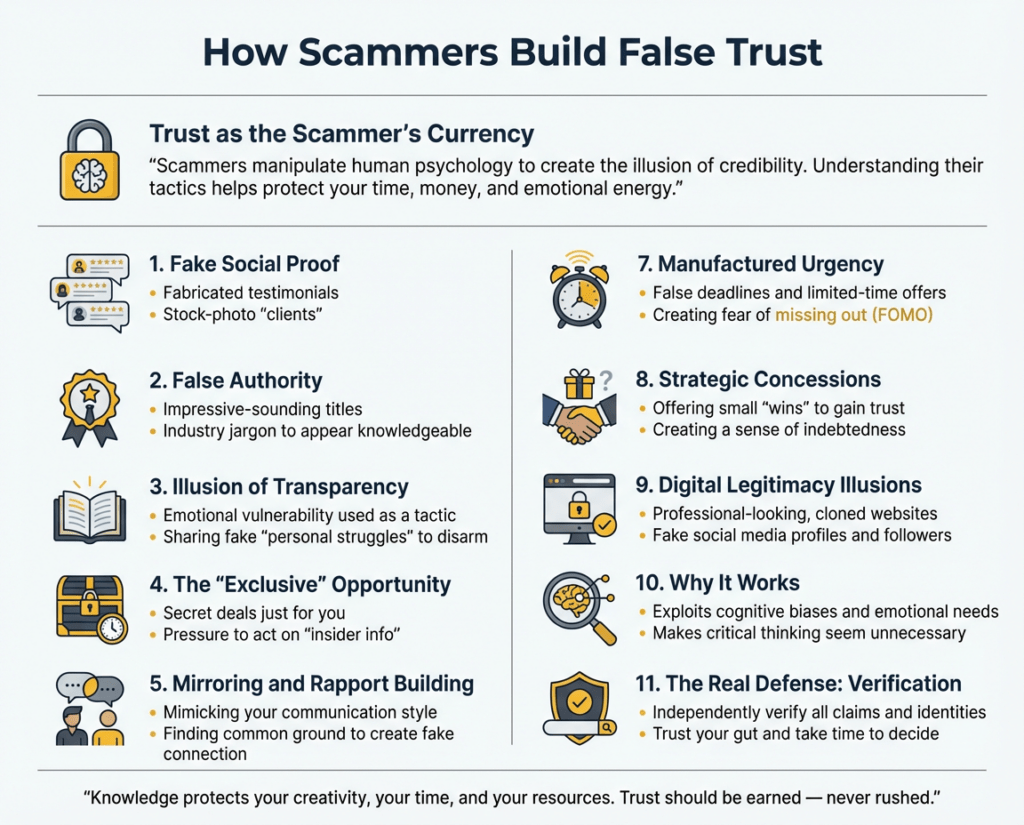
How Scammers Build False Trust
Scammers are experts at making people feel safe, seen, and supported—right up until the moment they strike. Their tactics are subtle, strategic, and designed to bypass your natural skepticism. Learning how they build false trust helps you stay grounded in reality and avoid becoming their next target.
Trust is the currency of confidence artists, and modern scammers have elevated the manipulation of trust into a precise science. Understanding how these criminals construct elaborate facades of credibility can mean the difference between protecting yourself and becoming another victim in their ledger of deception.
The foundation of any successful scam rests on a simple psychological principle: people are far more likely to part with their money, information, or resources when they believe they’re dealing with someone trustworthy. Scammers know this instinctively, and they’ve developed sophisticated methods to manufacture trust where none should exist.
One of the most effective tools in a scammer’s arsenal is the exploitation of social proof. They create fake testimonials, fabricated success stories, and counterfeit credentials that give the illusion of legitimacy. A scammer posing as a literary agent might showcase a website filled with glowing reviews from supposed clients, complete with stock photos and invented names. They might claim associations with prestigious publishing houses or drop names of well-known authors, banking on the fact that most people won’t verify these claims. The sheer volume of positive signals overwhelms our natural skepticism, creating a sense that “everyone else trusts them, so why shouldn’t I?”
Scammers also manipulate the power of authority to build false trust. They adopt titles, certifications, and professional designations that sound impressive but often mean nothing. In the publishing world, they might call themselves “senior acquisitions editors” or “international rights managers” while operating from a basement apartment. They pepper their communications with industry jargon and insider language that makes them sound knowledgeable and connected. This performance of expertise is carefully calibrated to impress without being easily verifiable, creating an aura of competence that discourages questions.
The illusion of transparency is another cornerstone of trust-building manipulation. Paradoxically, scammers often appear remarkably open and forthcoming, sharing seemingly personal details about their lives, their businesses, and their processes. This apparent vulnerability creates a false sense of intimacy and honesty. They might tell you about their own journey as a writer, their struggles in the industry, or their passion for helping emerging authors. These confessions feel genuine because they tap into universal experiences and emotions, but they’re actually carefully crafted scripts designed to lower your defenses.
Time is a weapon scammers wield with particular skill. They understand that trust builds gradually, so many modern scams unfold over weeks or even months. The initial contact might be innocuous, perhaps a compliment on your work or a casual conversation about writing. They invest time in getting to know you, asking about your projects and your goals. This patient cultivation of relationships creates a sense of reciprocal obligation. When they eventually make their pitch, you’ve already spent so much time and emotional energy on the relationship that walking away feels like abandoning a friend rather than avoiding a criminal.
Scammers also exploit urgency to short-circuit our rational decision-making processes. After weeks of building rapport, they suddenly present an opportunity that requires immediate action. A publishing deal that expires at midnight, a conference speaking slot that just opened up, or an agent who’s about to close their client list. This manufactured scarcity creates panic that overrides the trust you should have been building slowly through verification and due diligence. The irony is that real opportunities rarely evaporate in hours, but the false trust they’ve constructed makes their urgency seem like insider knowledge rather than manipulation.
The consistency of their story is another trust-building mechanism that scammers perfect through practice. They maintain elaborate backstories and keep detailed notes about their lies so that every interaction reinforces the previous one. Their website matches their business card, which matches their email signature, which matches what they told you on the phone. This coherence across multiple touchpoints creates an impression of authenticity because inconsistency is what we’ve been taught to look for as a warning sign. But consistency alone is meaningless when the entire narrative is fabricated from the start.
Perhaps most insidiously, scammers build trust by making small, calculated concessions that make them seem reasonable and fair-minded. They might agree to modify their fee structure, offer a “special discount,” or suggest starting with a smaller project first. These gestures of flexibility create the impression that they’re willing to work with you, that they care about your success, and that they’re not just after your money. In reality, these concessions are part of the con, designed to make you feel like you’re in control when you’re actually being guided exactly where they want you to go.
The digital age has given scammers new tools for manufacturing trust at scale. They create sophisticated websites with professional designs, secure checkout systems, and all the visual markers of legitimacy. They build social media presences with thousands of followers, though many of these accounts are fake or purchased. They generate email addresses from legitimate-looking domains and use virtual office services to provide prestigious business addresses. The technical sophistication of these facades makes them nearly indistinguishable from legitimate businesses to the untrained eye.
What makes these trust-building techniques so dangerous is that they exploit fundamentally positive human traits. Our willingness to believe in people’s good intentions, our desire to support others in our community, and our hope that opportunities are real rather than traps are all healthy instincts that make society function. Scammers weaponize these virtues against us, turning our openness into vulnerability.
The antidote to manufactured trust is not cynicism but verification. Real trust is earned through transparent actions that can be independently confirmed. Legitimate publishing professionals have verifiable track records, references you can actually contact, and credentials you can check through official channels. They don’t pressure you to make immediate decisions, they don’t ask for money upfront for services that traditional agents and publishers provide for free, and they don’t vanish when you ask difficult questions.
Understanding how scammers build false trust doesn’t just protect you from financial loss. It protects your time, your creative energy, and your faith in the publishing community. Every hour spent pursuing a fake opportunity is an hour stolen from your actual writing career. Every dollar sent to a scammer is a dollar that could have gone toward legitimate professional development. And every emotional investment in a false relationship leaves a residue of betrayal that makes it harder to trust the genuine professionals who could actually help you succeed.
The best defense against false trust is knowledge paired with healthy skepticism. Ask questions, demand evidence, and take the time to verify claims before committing resources. Real opportunities can withstand scrutiny. Fake ones dissolve under examination. And remember that trust, when it’s genuine, never needs to be rushed.
Rae Stonehouse is an author, speaker, and advocate dedicated to exposing publishing scams and empowering writers with practical knowledge. Continue exploring the Authors Against Scammers resource hub or connect with our Facebook community for ongoing education and support.

Rae Stonehouse is a Canadian author, publisher, and advocate committed to exposing publishing scams and supporting writers through education and community. As the creator of Authors Against Scammers, Rae provides clear, practical guidance to help writers protect their work, their money, and their peace of mind. His books and resources reflect a lifelong dedication to empowering others through knowledge, clarity, and real‑world experience.
0 Comments