The Upsell Spiral: How Scammers Trap Authors in Endless Online Fraud
As authors and creatives, we’re no strangers to the thrill of building our platforms online—whether through publishing services, marketing tools, or AI writing aids. But scammers exploit this ambition with a sneaky tactic called the upsell spiral, a form of online fraud that starts small and pulls you into escalating payments. This isn’t just a scam; it’s a trap that drains authors’ budgets and dreams. Understanding it empowers you to protect your author safety and boost your digital literacy against digital predators.
What Is the Upsell Spiral? Spotting the Red Flags
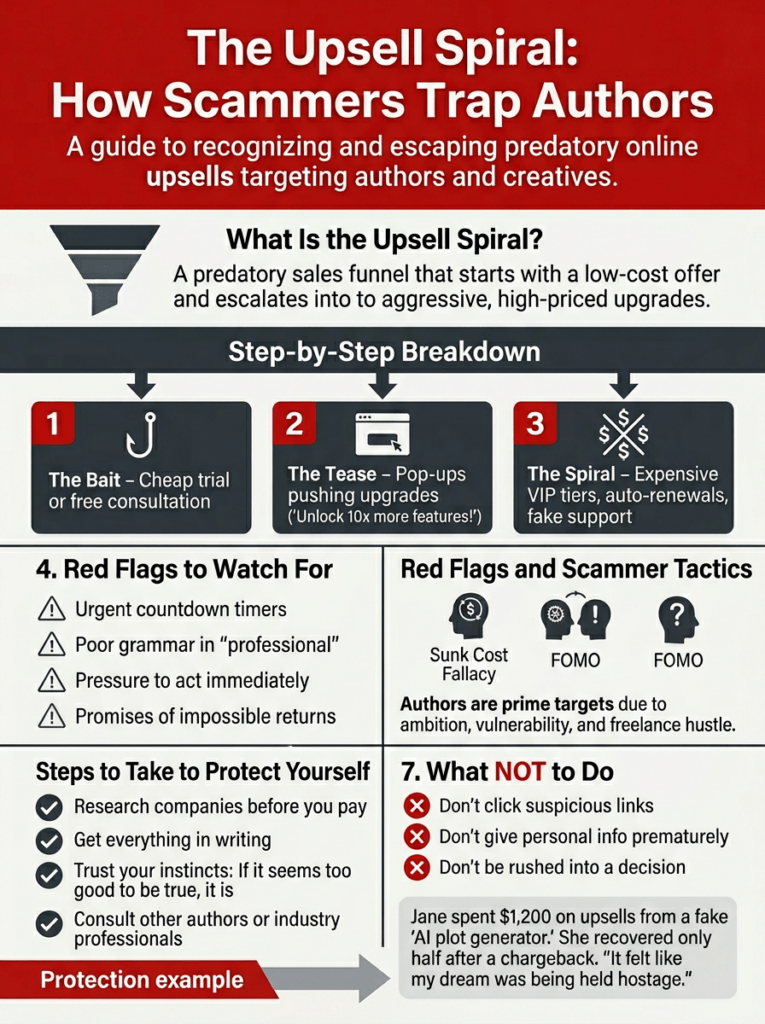
The upsell spiral is a predatory sales funnel disguised as a “deal.” It begins with a low-cost or free entry point—like a $9 AI book generator trial or a “free” publishing consultation—then bombards you with aggressive upsells: premium upgrades, add-ons, or “exclusive” features you “need” to succeed.
Plain-language breakdown with examples:
- Step 1: The Bait. You sign up for a cheap tool promising “instant bestsellers.” It works okay… at first.
- Step 2: The Tease. Pop-ups scream, “Unlock 10x more features for just $47!” Results improve slightly, hooking you.
- Step 3: The Spiral. Now it’s “VIP access” for $197/month, “priority support” at $99, and “guaranteed rankings” for $500. Subscriptions auto-renew, and cancellation? Good luck—hidden fees and fake support keep you paying.
Red flags: Urgent timers (“Offer ends in 5 minutes!”), vague promises (“Transform your writing overnight”), pressure to upgrade immediately, and poor grammar in “professional” pitches. Real services don’t rush you into debt.
Why Scammers Love This Tactic: The Psychology Behind It
Scammers use the upsell spiral because it’s low-risk for them and high-yield. Evidence from FTC reports on online fraud shows these schemes net millions yearly from creatives. They exploit proven psychological triggers:
- Sunk Cost Fallacy: You’ve already paid $9—quitting feels like “wasting” it.
- FOMO (Fear of Missing Out): “Limited-time elite access” preys on your drive for success.
- Reciprocity: A “free” trial makes you feel obligated to buy more.
- Authority Illusion: Fake testimonials and “expert” branding mimic legit tools like Amazon KDP or Reedsy.
It’s not random; data from scam-tracking sites like BBB.org confirms authors are prime targets due to our freelance hustle and trust in growth hacks.
Step-by-Step: How to Recognize, Avoid, and Escape the Upsell Spiral
Arm yourself with these practical, actionable steps for author safety:
- Pause and Research: Before buying, Google “[service name] scam” or check reviews on Trustpilot/Reddit. Legit tools have balanced feedback.
- Set Boundaries: Use a prepaid card or virtual credit card for trials. Avoid linking your main bank.
- Read the Fine Print: Search for “cancellation policy” and “auto-renew.” Test cancellation immediately after signup.
- Say No to Pressure: Close tabs on upsell pop-ups. Real value doesn’t expire in minutes.
- Exit Gracefully: If trapped, document everything (screenshots, emails). Contact your bank for chargebacks within 60 days. Use tools like DoNotPay for subscription traps.
- Verify Legitimacy: Stick to known platforms (e.g., legitimate author services via SFWA or ALLi recommendations).
What NOT to Do: Avoid These Common Pitfalls
- Don’t chase “refunds” through scammer links—it’s often another upsell or data grab.
- Never share more payment info or personal details to “upgrade.”
- Don’t ignore auto-renewals—set calendar reminders for trial ends.
- Avoid “success stories” without proof; they’re often fabricated.
One wrong move can lead to identity theft or deeper fraud.
A Real-Life Wake-Up Call: Jane’s Story
Meet Jane, a debut fantasy author (name changed for privacy). She bit on a $19 “AI plot generator” ad on Facebook. The upsells came fast: $99 for “pro editing,” $299 for “Amazon domination.” By month three, she’d spent $1,200 with zero sales. Cancellation emails bounced; support ghosted her. A chargeback and Reddit post later, she recovered half—but the stress cost her a book deadline. Jane’s now a vocal advocate: “It felt like my dream was hijacked.”
You’re Not Alone—Being Targeted Isn’t Your Fault
If you’ve fallen into an upsell spiral, know this: it’s a sign of your passion, not weakness or stupidity. Scammers are professionals preying on everyone from NYT bestsellers to indie hopefuls. Studies from AARP Fraud Watch show even savvy users get caught—it’s designed that way. You’re taking a strong step by reading this.
Take Action Today: Protect Yourself and Your Community
- Report it: File with FTC.gov, BBB.org, or your state’s AG. For authors, tag @AuthorsAgainstScammers on socials.
- Share widely: Forward this to fellow writers—awareness stops the spiral.
- Dive deeper: Explore our guides on author scams, online fraud prevention, and digital literacy for creatives.
Staying informed is your best defense against scammers. You’ve got this—keep creating safely.
Authors Against Scammers: Empowering authors with evidence-based tools for a scam-free creative life.

Rae Stonehouse is a Canadian author, publisher, and advocate committed to exposing publishing scams and supporting writers through education and community. As the creator of Authors Against Scammers, Rae provides clear, practical guidance to help writers protect their work, their money, and their peace of mind. His books and resources reflect a lifelong dedication to empowering others through knowledge, clarity, and real‑world experience.
0 Comments