
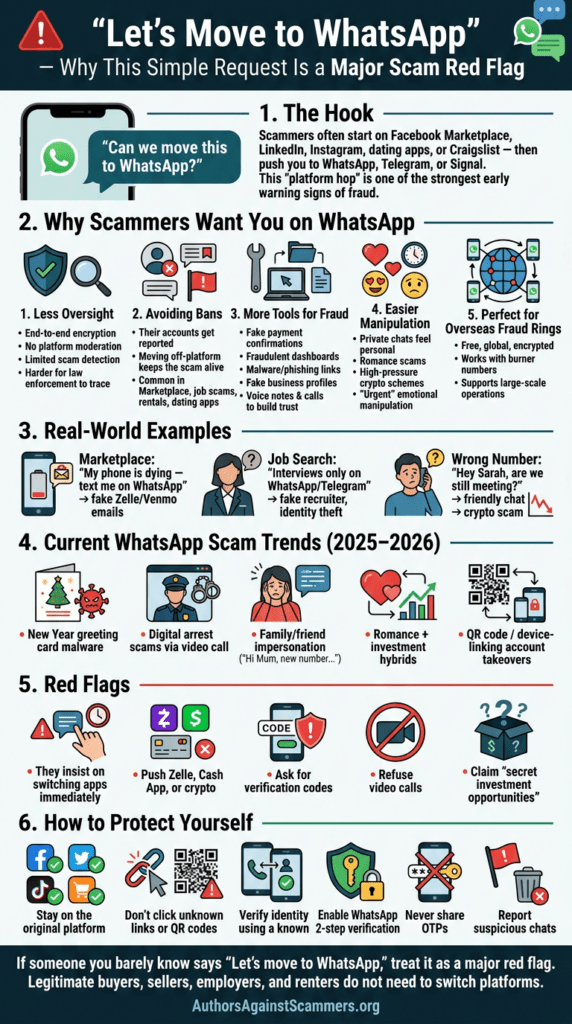
“Let’s Move to WhatsApp” — Why This Simple Request Is a Major Scam Red Flag
If you spend any time on Facebook Marketplace, LinkedIn, Instagram, dating apps, or even Craigslist, you’ve likely seen it:
“I’m not on here much — can we move this to WhatsApp?”
It sounds harmless. Convenient, even. But in the world of online fraud, this is one of the strongest early warning signs that you’re dealing with a scammer.
In 2025–2026, “platform hopping” has become one of the most common tactics used by fraud networks worldwide. Whether it’s romance scams, fake job offers, crypto schemes, or Marketplace fraud, the pattern is the same:
They start on a monitored platform… and quickly push you to WhatsApp, Telegram, or Signal.
Here’s why.
- WhatsApp Has Less Oversight — and Scammers Love That
Platforms like Facebook, LinkedIn, Airbnb, and dating apps use automated systems to detect:
- Suspicious links
- Fraudulent payment messages
- Repeated scam patterns
- Fake profiles
Once the scammer moves you to WhatsApp, all of that protection disappears.
WhatsApp is end‑to‑end encrypted, meaning:
- Meta can’t see the messages
- Automated scam detection is limited
- Law enforcement can’t easily monitor activity
For scammers, this is the perfect environment to operate undetected.
- Moving Off‑Platform Helps Them Avoid Bans
Scammers know their accounts will eventually be:
- Reported
- Flagged
- Suspended
- By shifting you to WhatsApp early, they keep access to you even after their original profile is deleted.
- This is especially common on:
- Facebook Marketplace
- LinkedIn job scams
- Dating apps
- Rental platforms like Zillow or Apartments.com
Once you’re on WhatsApp, they can continue the scam indefinitely.
- WhatsApp Gives Scammers More Control — and More Tools
On WhatsApp, scammers can:
- Send fake payment confirmations
- Share fraudulent investment dashboards
- Impersonate employers or landlords
- Send malware or phishing links
- Use voice notes or calls to build false trust
- Create fake “business profiles”
- They can also juggle dozens of victims at once using scripts, AI‑generated text, and burner numbers.
- Private Chats Make Manipulation Easier
A one‑on‑one WhatsApp chat feels more personal. Scammers exploit this psychological shift to:
- Build emotional rapport
- Run romance scams
- Push high‑pressure crypto schemes (“pig butchering”)
- Create urgency or fear
- Pretend to be a friend or family member
Victims often let their guard down once the conversation feels “private.”
- WhatsApp Works Internationally — Perfect for Overseas Fraud Rings
Many scam operations are based in:
- Southeast Asia
- Eastern Europe
- West Africa
- Middle East
- WhatsApp is ideal for them because it’s:
- Free
- Global
- Encrypted
- Easy to use with VoIP or burner numbers
This allows large‑scale operations to target victims worldwide at almost no cost.
Real‑World Scenarios Where the WhatsApp Hop Happens
In real life, the “move to WhatsApp” tactic shows up across a wide range of everyday situations. On Facebook Marketplace, for example, a scammer posing as a buyer might express interest in your furniture or car, then quickly claim their phone is “dying” and ask you to text them on WhatsApp instead. Once you switch, the fake payment confirmations and bogus Zelle or Venmo emails begin.
Job seekers see a similar pattern. A seemingly legitimate remote data‑entry job appears on LinkedIn or Indeed, but the recruiter insists that all interviews happen only on Telegram or WhatsApp. The moment you move off the hiring platform, the pressure to pay for “training materials” or hand over personal information starts.
Even wrong‑number scams follow this script. You might receive a message like, “Hey Sarah, are we still meeting?” If you respond, the conversation becomes friendly and casual—until the scammer nudges you over to WhatsApp, where the real goal emerges, steering you into a crypto investment scam.
Recent WhatsApp Scam Trends (2025–2026)
- Scams involving WhatsApp have surged globally. Some of the most common include:
- New Year Greeting Card Malware (2025–2026)
- Links promising “personalized greeting cards” installed spyware that stole banking details and OTPs.
- Digital Arrest Scams
Scammers impersonate police or government officials via WhatsApp video calls, demanding money to “clear your name.”
- Family/Friend Impersonation Scams
“Hi Mum, new number — I need help urgently.” Some now use AI voice cloning.
- Romance + Investment Hybrids
Scammers build trust on dating apps, then move to WhatsApp to push crypto investments.
- QR Code / Device Linking Scams
Victims are tricked into linking their WhatsApp account to a scammer’s device.
WhatsApp banned millions of scam-linked accounts in 2025 alone, but new tactics appear constantly.
6 Red Flags That You’re Being Lured Into a WhatsApp Scam
- They insist on moving the conversation immediately
- They push Zelle, Cash App, or crypto payments
- You receive a “business account upgrade” email
- They ask for a verification code
- They refuse video calls despite switching apps
- They claim to have “secret investment opportunities”
- If you see any of these, stop immediately.
How to Protect Yourself
- Stay on the original platform until the transaction is complete
- Never click unsolicited links or scan QR codes
- Verify identity using a known phone number
- Enable two‑step verification on WhatsApp
- Never share OTPs or verification codes
- Report suspicious chats to both WhatsApp and the originating platform
The Bottom Line
Scammers want you on WhatsApp because it gives them:
- Privacy for manipulation
- Freedom from platform rules
- Anonymity and global reach
- A better chance of getting your money
If someone you barely know says, “Let’s move to WhatsApp,” treat it as a major red flag.
Legitimate buyers, sellers, employers, and renters do not need to switch platforms to complete a transaction.

Rae Stonehouse is a Canadian author, publisher, and advocate committed to exposing publishing scams and supporting writers through education and community. As the creator of Authors Against Scammers, Rae provides clear, practical guidance to help writers protect their work, their money, and their peace of mind. His books and resources reflect a lifelong dedication to empowering others through knowledge, clarity, and real‑world experience.